


Private sector anxious as govt pay scale fuels inflation fears

Graphics: Agamir Somoy
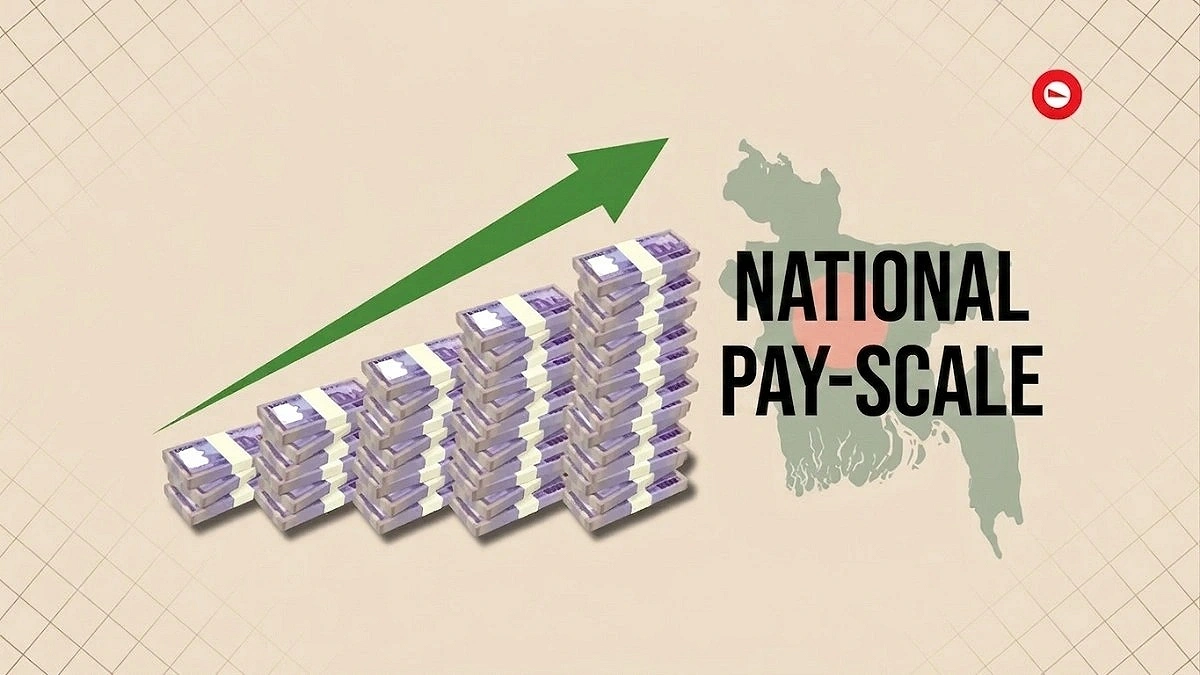
Private sector employees are filled with anxiety over the announcement of the new pay scale for government employees.
These fixed and limited-income employees fear that under the influence of the government salary hike, all expenses - ranging from the commodity market to house rent - will jump astronomically, while their own incomes will remain unchanged.
Economists said the pay scale’s impact creates an excess money flow in the market, which increases demand and directly accelerates inflation. However, the hardest blow comes from “psychological inflation”.
Following the announcement of the new pay scale, dishonest traders and landlords create an artificial crisis to raise prices and rent even before the scale is implemented. If the government borrows from banks to meet the extra budget deficit, it could create additional long-term pressure on the economy.
This inflation has the most negative impact on fixed-income private sector employees. While the heat of commodity prices rises in the market, most private organizations lack a policy to raise salaries regularly in line with inflation.
As a result, the real purchasing power of private sector employees is drastically reduced, forcing them to cut down on their daily food menu and deplete their accumulated savings.
On one hand, there is assured financial security for government employees, while on the other, there is uncertainty of employment and income in the private sector; the resulting gap breeds a form of social inequality and resentment.
Centre for Policy Dialogue (CPD) Executive Director Fahmida Khatun said since the salary structure of government employees has remained unchanged for a long time, the real income and purchasing power of especially lower and middle-grade employees have decreased, so salary adjustment has justification.
However, she added that if the money is supplied through bank borrowing or money creation instead of collecting extra taxes, pressure on the economy will increase. The impact of the salary increase will ultimately depend on the sourcing of funds, the market supply of goods, and the correct coordination of monetary and fiscal policies.
Policy Research Institute Chief Economist Ashikur Rahman said, “In implementing the new pay scale, the government must be most cautious about its financing and the overall monetary management of the market.”
He added, “If only the salaries of government employees are increased and, conversely, the supply of goods and services is not ensured in the market, it will create a reverse reaction on the economy. If the path of extra bank loans or printing money is chosen to arrange the funds, the inflation will rise even higher.
“The biggest price of this will have to be paid by fixed-income private sector employees, whose cost of living will increase many times even though their income does not increase.”
Consumers Association of Bangladesh (CAB) President AHM Shafiquzzaman said, “Since salaries had not increased for a long time, this was needed earlier. However, as a result, intense pressure to increase salaries will be created by the private sector and industrial workers, which will be a major challenge for entrepreneurs to handle.”
He added, “In principle, even if production or transport costs do not increase, businessmen will take this opportunity to increase the prices of all goods and house rent, the final liability of which will fall on the extreme-pressure-facing private sector.”


