
‘Every Time I Left Home, I Thought I Might Never Return’

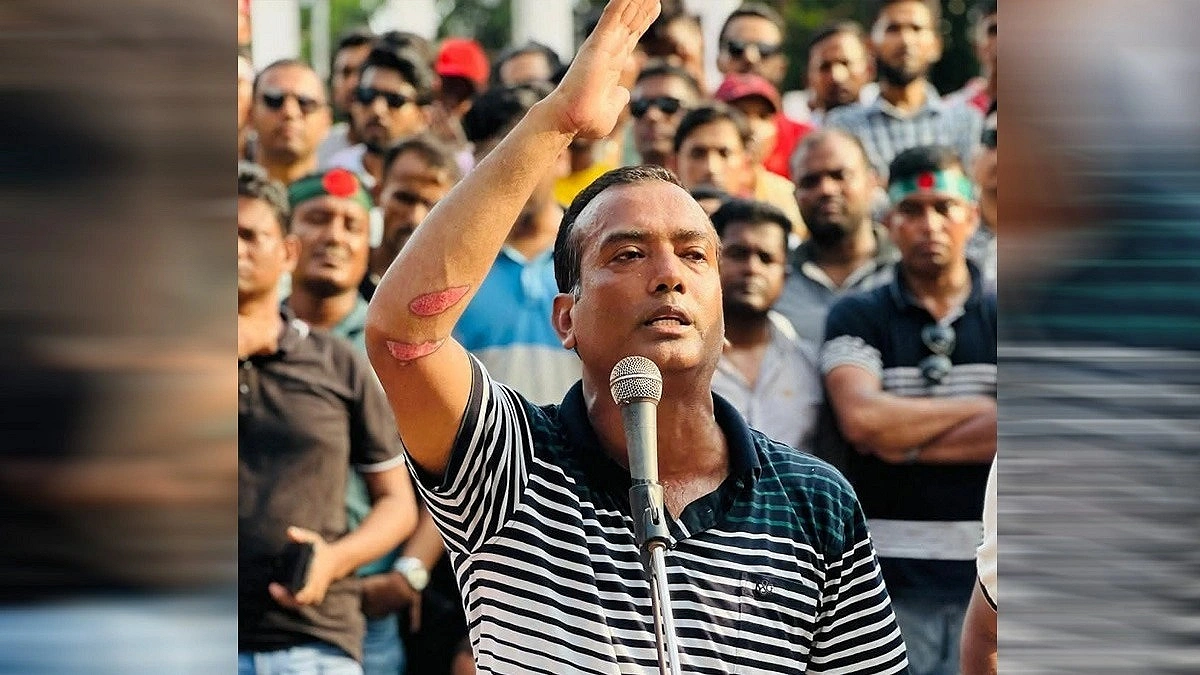
Rakibul Islam Rakib. File photo
As president of the Jatiyatabadi Chhatra Dal (JCD), Rakibul Islam Rakib led the July Mass Uprising from the frontlines. He was shot during the movement. According to a list published by the organization, 142 JCD leaders and activists were martyred during the protests. In an interview with Agamir Somoy, he spoke about the origins of the quota reform movement, the organization’s strategy, and his experiences during the turbulent days. Interview by Amzad Hossain Hridoy.
Agamir Somoy: What was the Jatiyatabadi Chhatra Dal’s position at the beginning of the quota reform movement?
Rakibul Islam Rakib: From the very beginning, we closely monitored the situation. Leaders of the Dhaka University unit of Chhatra Dal informed us that frustration over the quota system had been building among ordinary students for a long time and that it had the potential to turn into a major movement.
In early June, a small group of students began protesting in front of the Central Library. However, the entire campus was then under the control of the Chhatra League. Because of its dominance and repeated attacks, it was impossible to organize large-scale programs.
From the outset, we believed that quota reform was a legitimate demand. Decades after independence, it was no longer acceptable for the benefits of the freedom fighter quota to continue unchanged across successive generations. For that reason, Chhatra Dal extended both moral and political support to the movement from the beginning.
On June 25, during our program at Naya Paltan, a cocktail bomb exploded and police charged protesters with batons. That very day, we announced that if the movement gained momentum from July 1, Chhatra Dal would stand alongside ordinary students on the streets. We later fulfilled that commitment.
Agamir Somoy: How did your strategy change after the Chhatra League attacks on July 15?
Rakibul Islam Rakib: Since the formation of the Anti-Discrimination Student Movement platform, we maintained regular communication with its coordinators. In particular, we coordinated closely with Asif Mahmud. We also held discussions with Nahid Islam and the other coordinators at different times.
After the movement became centered around Shahbagh, we instructed Chhatra Dal leaders and activists at Dhaka University, Dhaka College, and other educational institutions to remain actively involved in the movement while standing beside the general students. As our new committee had recently been formed, our leaders and activists were highly motivated at the time.
After the Chhatra League attacks on July 15, the situation changed dramatically. In the days that followed, many students, including Abu Sayeed and Wasim, were killed, and internet services were shut down. At that point, we decided that Chhatra Dal would not back down and would stand with the general students until the movement reached its conclusion.
After the Chhatra League attacks on July 15, the situation changed completely. In the days that followed, many students, including Abu Sayeed and Wasim were killed, and internet services were shut down. At that point, we decided that Chhatra Dal would no longer retreat and would stand with the general students until the very end of the movement. The following day, we formally announced that decision at a press conference in Naya Paltan and instructed all party units across the country to become actively involved.
Agamir Somoy: How did Chhatra Dal organize its activities under the new reality after July 15?
Rakibul Islam Rakib: After July 15, we realized that the movement was no longer limited to quota reform; it had evolved into a mass uprising against state repression. That is why we decided to continue our organizational activities from hiding rather than operating openly. All our units across the country were instructed to stand alongside the general students.
At the same time, we identified Jatrabari as a key operational center. With the help of local leaders, I took shelter in a house in Lobon Goli, Jatrabari, and coordinated the movement from there. Almost every day, I traveled from Jatrabari to Naya Paltan, Shahbagh, or other designated protest locations. Every trip meant risking my life. Whenever I left the house, I felt that I might never return. Even so, I had to take that risk for the sake of the movement.
Agamir Somoy: How was Chhatra Dal’s organizational coordination managed during the movement?
Rakibul Islam Rakib: We managed the entire movement in a well-planned and systematic way. Responsibilities were divided among different areas of Dhaka. Our General Secretary, Nasir, coordinated activities in Naya Paltan and Shahbagh. Organizational Secretary Amanullah was responsible for the Mirpur area. Other leaders oversaw Rampura, Karwan Bazar, Old Dhaka, Jatrabari, and several other locations.
After universities and colleges were closed, our leaders and activists continued participating in the movement from wherever they were staying. Every unit president was required to report regularly on whether their members were actively taking part in the programs. We made our subsequent decisions based on those reports.
Agamir Somoy: How important was the role of current Prime Minister Tarique Rahman during that period?
Rakibul Islam Rakib: Throughout the movement, the guidance of the Honorable Prime Minister, who was then the Acting Chairman of the BNP—Tarique Rahman served as our primary direction. Even when internet services were suspended, he maintained communication through alternative channels and issued necessary instructions according to the evolving situation.
In particular, the teachers’ and lawyers’ demonstration in front of the High Court was organized under his instructions. I believe that program gave the movement renewed momentum. From July 15 until August 5, he remained in constant contact with the leadership of Chhatra Dal, Jubo Dal, and the BNP. Through them, he directed us to coordinate with those leading the Anti-Discrimination Student Movement and ensured that every party unit maintained an active presence on the ground. At the same time, he personally monitored developments and held party leaders and activists accountable for carrying out their responsibilities.
Agamir Somoy: When did you realize that the government would no longer be able to survive?
Rakibul Islam Rakib: We became convinced after the killings of Abu Sayeed, martyr Wasim, and other ordinary students on July 16 that the government could not survive much longer. Previously, they had attacked opposition party leaders and activists, but this time they openly fired on ordinary students. That was the defining turning point.
Afterward, we instructed our leaders and activists from across the country to come to Dhaka and strengthen the movement further. During that period, Jubo Dal, Swechasebak Dal, and other affiliated organizations of the BNP also played significant roles.
Agamir Somoy: What was your personal experience during the movement? Do you still remember those days in Jatrabari?
Rakibul Islam Rakib: Even today, I become emotional whenever I think about those days in July. Every day was filled with uncertainty. Whenever I left home in the morning, there was no guarantee that I would return alive that night.
After taking shelter in Jatrabari, I participated in the daily protest programs from there. In the house where I was staying, taking photos or recording videos was completely prohibited for security reasons. As a result, many of the events that took place in Jatrabari were never captured on camera.
After taking shelter in Jatrabari, I joined the daily protest programs from there. In the house where I was staying, taking photographs or recording videos was strictly prohibited for security reasons. As a result, many of the incidents that took place in Jatrabari were never captured on camera.
Following July 15, I participated for several consecutive days in demonstrations at Naya Paltan, the Central Shaheed Minar, and other protest venues, traveling from Jatrabari each day. At that time, advancing the movement was a greater responsibility than ensuring my personal safety.
On August 4, I had the opportunity to lead a large procession in Jatrabari. Leaders and activists from Chhatra Dal, Jagannath University, and various units from southern Dhaka took part. It remains one of the most memorable moments of my political life.
Agamir Somoy: You were also shot during the movement. What was that experience like? Did you witness anyone being martyred before your eyes?
Rakibul Islam Rakib: At around 4:00 pm on July 20, in Shonir Akhra, everyone began running off the road to lower ground, and I ran with them. Before we could understand what was happening, indiscriminate gunfire was opened in our direction.
All around us, there was nothing but the sound of gunfire, people’s screams, and people desperately trying to escape. Numerous Chhatra Dal leaders and activists came down with me and helped protect me. After reaching safety, I noticed that blood was continuously flowing from my right arm and leg. I quickly went to a nearby pharmacy, where I received first aid.
At that moment, the situation was far too chaotic to know who had been injured or who had been martyred. Gunfire echoed through Jatrabari every day. Often, it was impossible to tell where the shots were coming from. Later, I learned that shots had also been fired from the rooftops and windows of nearby buildings. Whenever helicopters flew overhead, people rushed to take shelter beneath buildings, fearing tear gas or sound grenades.
According to our records, 142 leaders and activists of Chhatra Dal were martyred during the July Movement.
I witnessed countless people being shot and covered in blood before my eyes. Many were evacuated while injured, and later I learned that many of them did not survive. According to our records, 142 leaders and activists of Chhatra Dal were martyred during the July Movement. We always remember their sacrifice with the deepest respect.
Agamir Somoy: Despite playing a major role in the movement, do you think Chhatra Dal has received the recognition it deserves?
Rakibul Islam Rakib: No, I do not think so. Many of those who stood on the front lines of the movement have not received proper recognition from the state. Even during the tenure of the interim government, we did not see any formal initiative to sit down with those who led the movement to evaluate their experiences or contributions.
This was not the movement of any single party or organization; it was a national mass uprising. Therefore, history should recognize the contributions of everyone involved. One hundred and forty-two Chhatra Dal leaders and activists were martyred, while countless others were injured or permanently disabled. Their sacrifices also deserve to be properly recorded in history.
Agamir Somoy: How do you view the controversy over who deserves credit for the July Movement?
Rakibul Islam Rakib: I believe the July Mass Uprising was not the achievement of any single organization. It was the result of a collective movement involving students, ordinary citizens, and various political forces. However, afterward, some attempted to portray it as their own exclusive achievement.
In my opinion, history should not be judged through a narrow political lens. Those who were on the streets, those who were martyred, and those who were injured all made equally important contributions and deserve equal recognition. Future generations will ultimately learn the true history.
Agamir Somoy: Has the unity that emerged during the movement faded?
Rakibul Islam Rakib: During the movement, we all shared a single objective—the fall of the authoritarian regime. Once that goal was achieved, the political reality changed, and the various organizations returned to pursuing their respective political positions.
I believe everyone must take a broad and inclusive approach to preserving the history of the July Movement. Just as leaders of the Anti-Discrimination Student Movement, including Nahid Islam, Asif Mahmud, Hasnat Abdullah, and Mahfuz Alam—made significant contributions, the roles of Chhatra Dal, Jubo Dal, Swechasebak Dal, and other political organizations should also be properly acknowledged.
Even so, I believe everyone must take a broad and inclusive approach to preserving the history of the July Movement. Just as leaders of the Anti-Discrimination Student Movement, including Nahid Islam, Asif Mahmud, Hasnat Abdullah, and Mahfuz Alam—made significant contributions, the roles of Chhatra Dal, Jubo Dal, Swechasebak Dal, and other political organizations should also be properly acknowledged. History must be evaluated on the basis of facts and reality.
Agamir Somoy: As the president of Chhatra Dal, how proud are you of leading the July Mass Uprising?
Rakibul Islam Rakib: It is one of the proudest chapters of my political life. By the grace of Allah, I was given the opportunity to witness such a historic moment and to lead a movement against injustice. I spent many years in opposition politics, and having the chance to play a leadership role in a historic mass movement is one of the greatest achievements of my life. It is an experience I will always remember with pride.
