

Thousands of Trees Saved
Digital Census Saved 42.2 Million Pages of Paper

প্রতীকি ছবি। সংগৃহীত।
The offices of the Bangladesh Bureau of Statistics (BBS) were once synonymous with sacks and stacks of papers. Files would be piled on and under employees’ desks, in front and behind them. Whenever heaps of documents used to appear in corridors or corners, it was understood that a census was underway.
That familiar scene has now changed. Trucks full of paper waste are no longer produced, because censuses are now conducted digitally—saving the lives of countless trees.
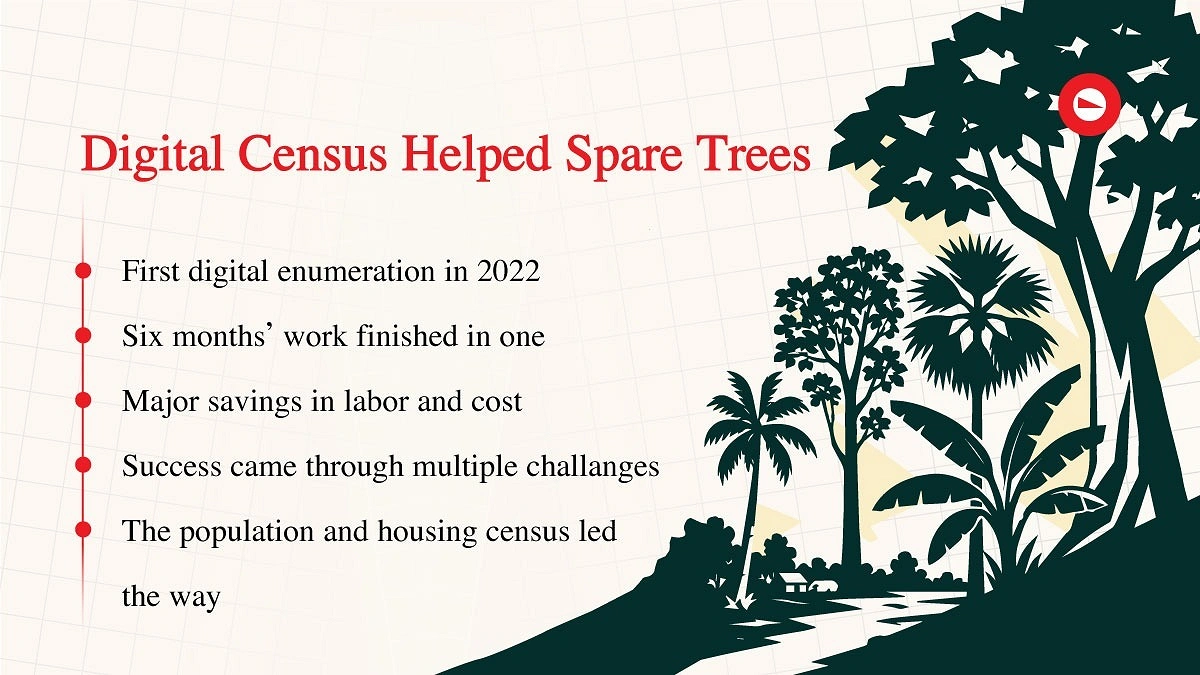
Bangladesh conducted its first digital census in 2022, the Population and Housing Census. This single census alone saved approximately 42.2 million pages of paper. A fully paperless census meant that vast quantities of paper—and the trees required to produce them—were spared. At the same time, significant savings were made in labor, time, and money.
Calculations show that without the digital method, around 41 million pages of paper would have been needed just to print census questionnaires. In addition, about 500,000 forms, 400,000 pages for enumerators’ profiles, and another 300,000 pages for tally sheets would have been needed. As because the census was conducted using digital devices, none of these were warranted. Moreover, items such as pencils, erasers, and sharpeners did not have to be purchased by the government. Transporting sacks of paper by truck to districts, upazilas, and villages across the country would also have incurred fuel, driver, and other logistical costs—all of which were avoided. Data processing complexities were reduced to almost zero compared to the past.
The digital shift has transformed the entire process. All censuses and surveys are now conducted digitally, using Computer-Assisted Personal Interviewing (CAPI). As a result, reports can be prepared and published in much less time, with fewer errors. Previously, producing a preliminary census report took at least six months. For the digital population census, it took just one month. Moreover, the amount of information released was far greater than what was typically published in earlier censuses. However, the journey to this digital beginning was not an easy one.
As the country’s first digital census, it involved numerous challenges. To overcome them, extensive preparations were required before implementation. One of the major challenges was integrating nearly 20 to 25 traditional systems into a single platform for the census. To ensure the security of the tablets, software had to be installed on each of the 400,000 devices used in the operation. In addition, to safeguard the data, a four-tier data center located in Gazipur was utilized, with the Bangladesh Bureau of Statistics (BBS) establishing connectivity with the center. To protect data from hackers, multilayer firewall systems were installed.
To ensure mobile network coverage, Robi was selected through a tender process. In remote areas of the country where network coverage was unavailable, support from other mobile operators was arranged. The government agency BTRC provided direct assistance by installing SIM cards in all 400,000 tablets.
Speaking about the project planning, the then Project Director (PD) of the Population and Housing Census Project, Dildar Hossain, said that the idea of a digital census had been under consideration for quite some time. He noted that during the implementation phase, the former Secretary of the Statistics and Informatics Division, Yamin Chowdhury, showed strong interest and provided significant support. With cooperation from all concerned, the project was successfully completed. It was a new experience for BBS, but the lessons learned have since been applied, and now almost all censuses conducted by BBS are carried out digitally.
According to BBS sources, the census enumeration was conducted from June 15 to June 28, 2022. Based on the Population and Housing Census results, the country’s population stands at 169,828,921. The number of males exceeds that of females. Population density is 1,119 per square kilometer, and the annual population growth rate is 1.22 percent. The urban population has increased to 31.51 percent.
For the first time, the transgender population was counted in this census, numbering 12,629 individuals. The Dhaka Division has the highest population, with 44,244,723 people.
On the other hand, Barishal Division has the lowest population, with 9,100,102 people. The census also included data on foreign nationals working in Bangladesh and Bangladeshis who were abroad during the census period.

