
Dhaka: This will not be the last submersion!

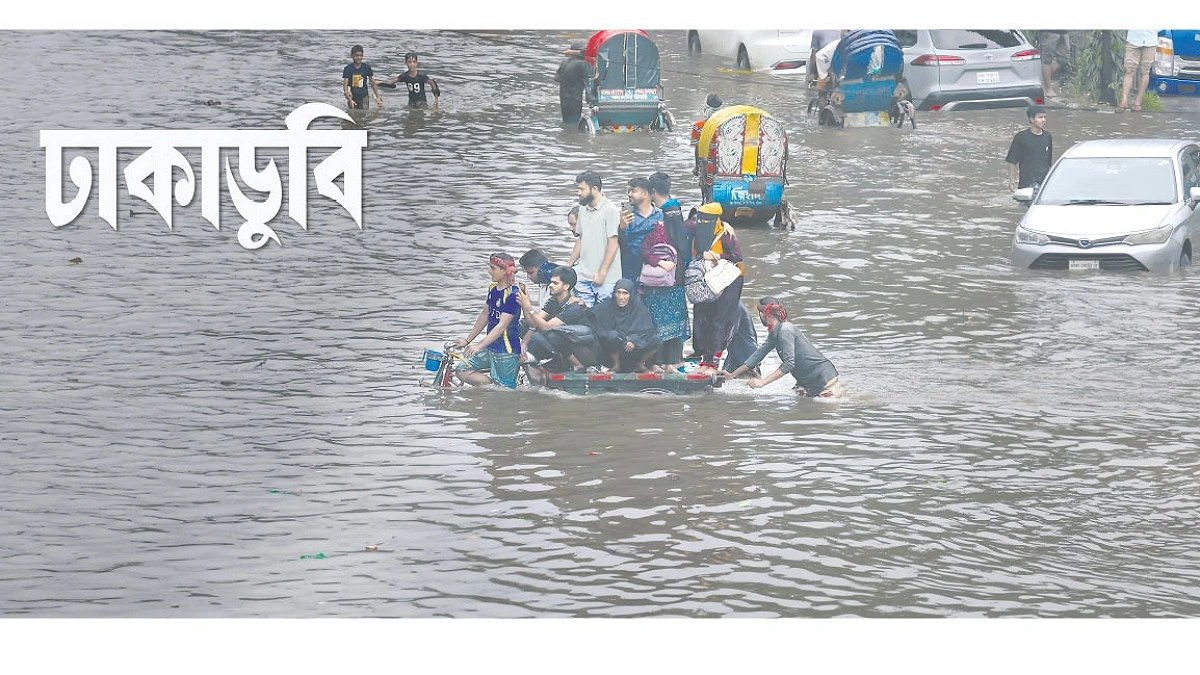
Photo: Mohubar Rahman
Nearly half a decade ago, the two city corporations of Dhaka took a major step toward rain-water drainage. On December 31, 2020, they took over the management of approximately 80 kilometers of 26 canals and 385 kilometers of major storm drains from WASA. Since then, more than five years have passed filled with assurances of resolving the waterlogging issue. Within this period, city mayors have changed, the government has changed, and numerous modifications have been introduced to the initiatives and programs.
What has been the outcome? Residents of the capital complain that the picture of waterlogging remains unchanged. Meteorologists warn that the record for Dhaka's average rainfall might be shattered this time, raising fears that Dhaka could submerge yet again.
Yesterday, Sunday, 82 millimeters of rainfall was recorded in the capital in just 6 hours from 6 AM to 12 PM. Prior to that, 97 mm of rain was recorded in the 24 hours leading up to 9 AM. This alone was enough to submerge vast areas of both city corporations in Dhaka. Shops and roads became waterlogged, virtually bringing the lives of millions to a standstill.
Every year ahead of the monsoon, the two city corporations identify waterlogging hotspots. This time, the two agencies identified 141 hotspots. Among them, the Dhaka South City Corporation (DSCC) marked 33 waterlogging-prone hotspots, including New Market, NAEM Road, Green Road, Shantinagar, Mugda Medical, Madrasah Education Board, Old Dhaka, Majed Sardar Road, West Malibagh, and Rajarbagh.
On the other hand, the Dhaka North City Corporation (DNCC) identified 108 waterlogging-prone hotspots. Notable among these are Airport Road, Khilkhet, Bepari Para, Madhya Para, Nama Para, Kuril, Kalshi Road, Muslim Bazar in Mirpur-12, Mirpur-10 Roundabout, Mirpur-11, the front of the Prime Minister's Office, Shaheenbagh, and Bijoy Sarani. However, waterlogging could not be contained within these designated areas; many other localities were submerged as well. The depth of the waterlogging varied from 8 inches to two and a half feet depending on the area, leaving everyone from the agency administrators to the waste management department struggling desperately to manage it.
The situation in the DNCC is even more dire. Seeing the vast body of water accumulated at the base of the exit ramp of the Banani Elevated Expressway, anyone could easily mistake it for a sea. The condition is similar at various points along the Airport Road. If it keeps raining like this throughout the monsoon, the government might eventually have to build a ship-docking jetty there instead of using it for aircraft traffic.
his Drowning is Not the Final Drowning
Photo: Mohubar Rahman
Nearly half a decade ago, the two city corporations of Dhaka took a major step toward rain-water drainage. On December 31, 2020, they took over the management of approximately 80 kilometers of 26 canals and 385 kilometers of major storm drains from WASA. Since then, more than five years have passed filled with assurances of resolving the waterlogging issue. Within this period, city mayors have changed, the government has changed, and numerous modifications have been introduced to the initiatives and programs.
What has been the outcome? Residents of the capital complain that the picture of waterlogging remains unchanged. Meteorologists warn that the record for Dhaka's average rainfall might be shattered this time, raising fears that Dhaka could submerge yet again.
Yesterday, Sunday, 82 millimeters of rainfall was recorded in the capital in just 6 hours from 6 AM to 12 PM. Prior to that, 97 mm of rain was recorded in the 24 hours leading up to 9 AM. This alone was enough to submerge vast areas of both city corporations in Dhaka. Shops and roads became waterlogged, virtually bringing the lives of millions to a standstill.
Every year ahead of the monsoon, the two city corporations identify waterlogging hotspots. This time, the two agencies identified 141 hotspots. Among them, the Dhaka South City Corporation (DSCC) marked 33 waterlogging-prone hotspots, including New Market, NAEM Road, Green Road, Shantinagar, Mugda Medical, Madrasah Education Board, Old Dhaka, Majed Sardar Road, West Malibagh, and Rajarbagh.
On the other hand, the Dhaka North City Corporation (DNCC) identified 108 waterlogging-prone hotspots. Notable among these are Airport Road, Khilkhet, Bepari Para, Madhya Para, Nama Para, Kuril, Kalshi Road, Muslim Bazar in Mirpur-12, Mirpur-10 Roundabout, Mirpur-11, the front of the Prime Minister's Office, Shaheenbagh, and Bijoy Sarani. However, waterlogging could not be contained within these designated areas; many other localities were submerged as well. The depth of the waterlogging varied from 8 inches to two and a half feet depending on the area, leaving everyone from the agency administrators to the waste management department struggling desperately to manage it.
The situation in the DNCC is even more dire. Seeing the vast body of water accumulated at the base of the exit ramp of the Banani Elevated Expressway, anyone could easily mistake it for a sea. The condition is similar at various points along the Airport Road. If it keeps raining like this throughout the monsoon, the government might eventually have to build a ship-docking jetty there instead of using it for aircraft traffic.
To resolve the waterlogging in the capital, the two city corporations of Dhaka rely on eight permanent pump stations, three of which belong to the Dhaka South City Corporation (DSCC). Through these pumps, the agency discharges waterlogged rainwater into canals and rivers. Using three primary outlets—Kamalapur TT Para, Dholaikhal, and Hatirjheel—the DSCC can drain rainwater from an area spanning 109.24 square kilometers. However, the crisis this time lies elsewhere. The agency states that because heavy rainfall has caused the water levels in canals and rivers to rise, they are struggling to remove water using the pumps. If there were 11 pump stations instead, mitigating the waterlogging would have been much easier.
On the other hand, 21 Quick Response Teams are working across 10 zones to resolve waterlogging within the Dhaka North City Corporation (DNCC). Additionally, five permanent irrigation pumps are currently operational in areas like Mirpur and Kalyanpur to clear waterlogging. Beyond these, both city corporations possess some portable pumps for immediate and emergency pumping of water from low-lying, flood-prone areas. Despite these measures, city dwellers are finding no respite from waterlogging.
Prior to 2020, the two city corporations of Dhaka repeatedly assured the public that waterlogging would be eradicated once the city's drains and canals were brought under a single authority. However, even after gaining sole responsibility, their failure to fully restore the navigability of the canals and modernize the drainage network means citizens must pay the price every monsoon. Residents fear they will have to endure even more suffering this year. According to the Bangladesh Meteorological Department, the monsoon season spans June, July, August, and September, with July experiencing the highest rainfall. Since today is only July 13, there is a strong possibility of more rain later this month.
Meteorologist A. K. M. Nazmul Haque told Agamir Somoy, "The average total rainfall in Dhaka for the month of July is 375 millimeters. Out of this, 175 millimeters of rain fell in just one day between 6:00 PM on Saturday and 6:00 PM on Sunday. Furthermore, according to the Meteorological Department's calendar, the monsoon season is far from over. Therefore, Dhaka's average rainfall could break records this year."
If this forecast by the meteorologist holds true, Dhaka's waterlogging situation could become even more critical in the coming days. When asked why waterlogging has remained unresolved year after year, urban planner Iqbal Habib highlighted three primary reasons. Speaking to Agamir Smoy, the urban planner pointed out that implementing three key elements—a 'Blue Network', the segregation of solid and liquid waste, and a coordinated effort among service agencies—could reduce Dhaka's waterlogging to zero. Here, the 'Blue Network' refers to identifying and reclaiming the boundaries of Dhaka’s canals and rivers. Additionally, the accumulation of solid waste in drains and water bodies is a major cause of waterlogging. Therefore, the urban planner urged the city corporations to focus on segregating solid and liquid waste. Finally, he blamed the lack of coordination among nine of Dhaka's service-providing agencies, including the City Corporations, WASA, RAJUK, and the Water Development Board, for the persistent waterlogging. He advised these organizations to work in an integrated manner while also emphasizing public involvement in resolving the crisis.
Meanwhile, DSCC Administrator Abdus Salam took to the field yesterday morning to inspect the waterlogging situation. He claimed that the city corporation is trying its level best to mitigate the issue. However, ongoing road excavation work by WASA and Titas Gas has made it difficult for workers to operate underwater.
On the other hand, in a written statement, DNCC Administrator Shafiqul Islam Khan claimed that the city corporation teams have been actively working to resolve the waterlogging. He attributed the waterlogging to the excessive rainfall and assured that if any emergency issue arises anywhere, a solution will be provided as soon as it is reported to the relevant team.
