
Government, Opposition Clash Over Constitutional Reform

Graphics: Agamir Somoy
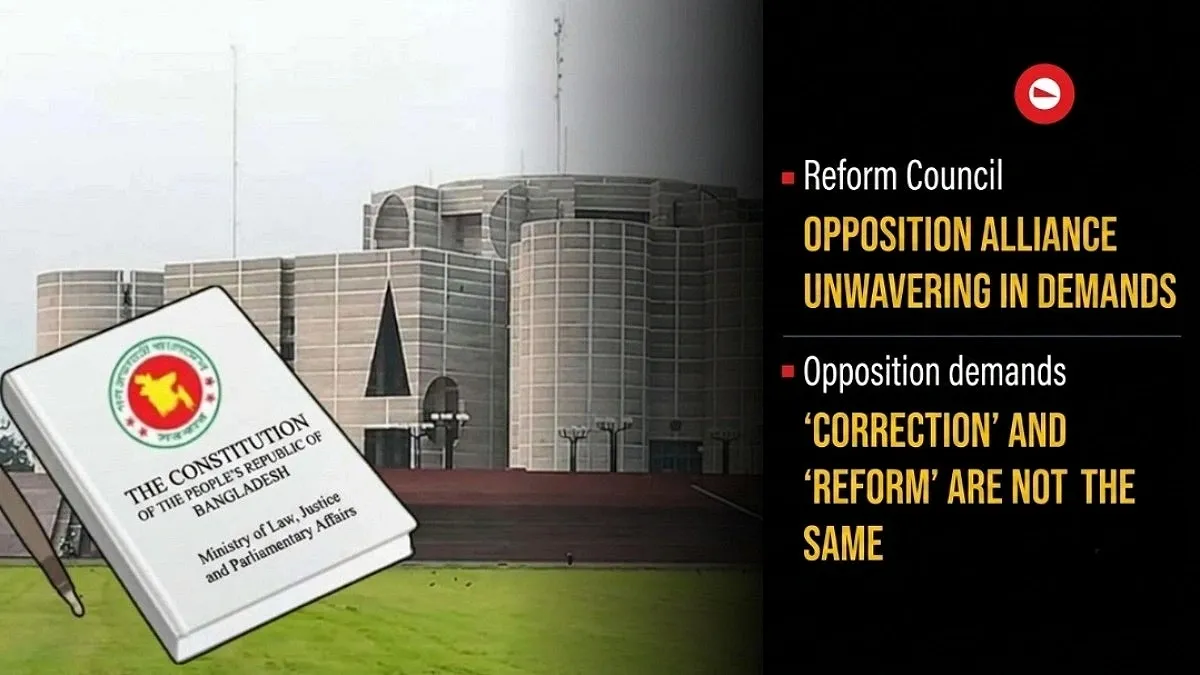
A new political confrontation has emerged in Parliament over the government's initiative to amend the Constitution. The government has formed a 12-member special parliamentary committee to oversee the process. However, the opposition alliance, which has opposed the initiative from the outset, rejected the committee and staged a walkout from the parliamentary session. The alliance also announced that it would continue political programs both inside and outside Parliament to press for the implementation of the referendum's outcome.
On Monday, Parliament formed the special committee, headed by Home Affairs Minister Salahuddin Ahmed. The government had originally planned a 17-member committee and reserved five seats for the opposition. Since the opposition declined to nominate members, Parliament constituted the committee with 12 members for now. The opposition lawmakers walked out after the proposal was approved by voice vote.
Chief Whip Nurul Islam, on behalf of Leader of the House Tarique Rahman, placed the proposal to form the committee. He said the government had contacted the opposition several times seeking nominations, but it did not submit any names. He added that the committee could later be reconstituted if the opposition decided to fill the five vacant seats.
The opposition alliance, however, maintained a clear position. Since the first sitting of the new Parliament, it has opposed any parliamentary committee on constitutional reform. The alliance argues that the people, through the February 12 referendum held alongside the parliamentary election, endorsed not merely amendments to several constitutional provisions but the creation of an independent Constitutional Reform Council to draft a new constitutional framework.
Opposition leaders argue that constitutional 'amendment' and 'reform' are fundamentally different. In their view, amendment means changing selected provisions of the existing Constitution, while reform means redesigning the country's political and constitutional framework in line with public expectations. Therefore, they argue, a parliamentary committee cannot implement the mandate delivered through the referendum.
Opposition Leader and Bangladesh Jamaat-e-Islami Ameer Dr. Shafiqur Rahman reiterated that position in Parliament. He said the opposition alliance had never promised to nominate members to such a committee and remained committed to implementing the referendum's verdict in accordance with its pledge to the public.
Dr. Shafiqur said the alliance was bound by its commitment to the people. He added that its members had taken two oaths: one as members of Parliament and another as members of the proposed Constitutional Reform Council to implement the referendum's mandate.
"If this committee is formed by bypassing the Constitutional Reform Council, we reject the proposal. We remain firm in our previous position," he said.
He argued that the government should not ignore the will of the people. To protest what he described as the government's refusal to honor the referendum's outcome, the opposition alliance decided not only to stay out of the committee but also to walk out of Parliament.
Speaking to reporters outside Parliament later, Dr. Shafiqur reiterated the same position. He argued that the parliamentary election and the referendum were parts of the same political process. Voters cast separate ballots in both, and therefore, he said, the government could not accept one outcome while ignoring the other.
The government, however, defended its position. Speaking in Parliament after the opposition walkout, Home Affairs Minister Salahuddin Ahmed, who chairs the special committee, said the election, Parliament, and all constitutional institutions had been established under the existing Constitution. Therefore, any necessary changes must also be made within the framework of the current Constitution.
He also questioned the legal basis of the opposition's claim regarding a second oath. He said the existing Constitution does not recognize a separate Constitutional Reform Council outside Parliament. According to him, Parliament must first amend the Constitution to create the necessary legal provisions before any subsequent steps can be taken through political consensus.
Meanwhile, the dispute appears set to spill beyond Parliament. NCP Member Secretary and Member of Parliament Akhtar Hossain said his party would not retreat 'even an inch' from its demand for a Constitutional Reform Council based on the referendum's verdict. He said the government had formed the committee despite opposition objections and warned that the movement would continue both inside Parliament and on the streets.
He also said every Bangladeshi who voted ‘Yes’ in the referendum is now waiting for the formation of the Constitutional Reform Council. He argued that the country's desired state reforms can only be achieved by implementing the people's verdict.
At the center of the dispute is the February 12 referendum. Voters were asked whether an elected Constitutional Reform Council should be formed to draft a new constitutional framework to replace the existing Constitution. The referendum was held alongside the parliamentary election, with voters casting separate ballots on the issue.
The opposition alliance argues that the referendum created a political and moral obligation to implement the public's verdict. It therefore remains firm in its demand for an independent Constitutional Reform Council instead of a parliamentary constitutional amendment committee.
Some analysts who worked with the National Consensus Commission during the interim government's tenure believe the dispute could trigger a new political crisis. Badiul Alam Majumdar, a member of the commission and secretary of Sujon, said the unnecessary controversy over the Constitutional Reform Council was deepening political divisions. He warned that such disagreements at the outset of the government's tenure could complicate the political situation further. He also questioned who stands to benefit from creating unnecessary controversy over the Constitutional Reform Council instead of taking the required oath.
