
Home Minister
Sheikh Hasina Shows No Remorse for Massacre

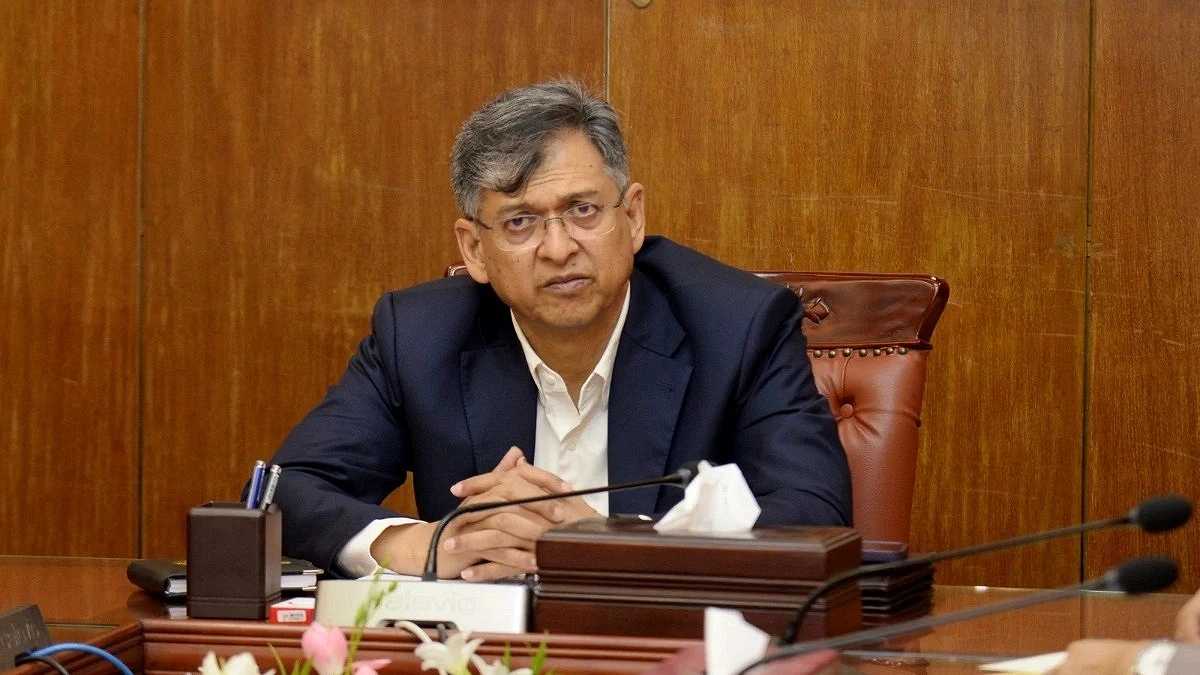
Home Minister Salahuddin Ahmed
Home Minister Salahuddin Ahmed said those who are exploiting the spirit of the July Revolution for political gain and selling that spirit will face consequences that the nation will witness in the future. He made the remarks on Saturday at an event titled ‘July National Conference’ marking the second anniversary of the July Revolution.
The organizations ‘July 24 Martyrs’ Family Society’ and ‘We Are July Warriors’ organized the event.
Prime Minister Tarique Rahman attended the program as the chief guest.
Salahuddin Ahmed said, “I request the organizers of this event that none of us should turn the spirit of July into a business. Those who are selling this spirit in various ways to gain political benefits through different political organizations will face consequences in the future. History tells us that.”
The home minister spoke about the fate of the Awami League, which he described as a fascist party. He said, “Those who used to sell the spirit of the Liberation War have now ended up sitting in Delhi after selling that spirit. The people of Bangladesh have overthrown them. Therefore, trading in ideals is not good, and seeking political gain through such means is not a good objective.”
In his speech, he recalled the years of exile he and Prime Minister Tarique Rahman spent abroad. “Today I want to reveal some behind-the-scenes stories. Both my leader and I lived in exile. By the grace of Allah, had we not been in exile, it might not have been possible to successfully bring an uprising like July to its conclusion. That is what happened behind the scenes.”
“We never slept. We coordinated around the clock, organizing leaders and activists in various ways and advancing the movement to a certain stage under a non-political identity while keeping the July warriors at the forefront.”
“When we reached July 16, my leader declared: one demand, one point, the resignation of the autocrat. There was no other way to resolve the crisis,” added the BNP Standing Committee member.
“Many of those who now claim leadership of the July warriors said at the time that they had no political demands. Their only demand was the removal of quota discrimination. We knew that establishing a discrimination-free Bangladesh would not be possible while keeping the autocrat in power. We succeeded in convincing them, but they did not have that courage.”
He said, “We reached this point by uniting people across Bangladesh in a non-political way. Bangladesh became stained with blood, and we achieved victory standing on the blood of the martyrs. If we divide that achievement along political lines, the largest share will belong to the Jatiyatabadi Chhatra Dal, Jubo Dal, and BNP-affiliated organizations.”
He remarked, “The United Nations report mentions 1,400 deaths. But various newspapers and surveys account for around 700 to 800. Where did the rest go? Hospitals could not preserve the records of the martyrs; the documents were made to disappear. Authorities buried many as unidentified bodies. Today, family members search for their graves, but we cannot provide answers. Even after such a brutal massacre, mass-killer Sheikh Hasina has shown no remorse. They are labeling the July warriors as criminals and describing the mass uprising as terrorism. They claim that their state power was taken away through extremism in Bangladesh.”
He alleged that the Awami League has shown no remorse and is unwilling to admit wrongdoing. “They do not even have such a tradition in their history. Instead, they are sitting abroad and conspiring against the democratic government in various ways. The Awami League has suffered political collapse. It has been buried in Delhi. That Awami League will never again be able to engage in politics in Bangladesh.”
The home minister said authorities would soon place the Awami League on trial as a political party. “The law has been amended under Article 47 of the Constitution. Both the Anti-Terrorism Act and the ICT Act contain provisions for trying political parties. So, wait and see.”
At one point, Salahuddin Ahmed recalled martyr Wasim Akram. “Just two days before becoming a martyr, the boy (Wasim) came to see me in Shillong. I asked him why he had spent so much money, obtained a passport and visa, and traveled all that way to meet me. He said he had always wanted to see me in person. We took a photograph together, and he used it as his Facebook profile picture. Two or three weeks later, he returned home and gave his life for Bangladesh. It is a heartbreaking story. His father was abroad at the time. I spoke with his mother and could not hold back my tears. Today she told me that she wants to see justice for every killing in this country.”
Latest Status of the Trials
The home minister said, “Verdicts have already been delivered in five crimes against humanity cases. Twenty-seven cases remain under trial. Investigations in 72 cases are nearly complete. Two people have received death sentences in the case involving martyr Abu Sayeed. The vice chancellor and several others from that university have received prison terms of varying lengths.”
“The first verdict concerned massacre. As everyone knows, Sheikh Hasina and her former home minister Asaduzzaman Khan Kamal received death sentences. Former IGP Mamun received a reduced sentence after becoming a state witness. Two people received death sentences in the Ashulia case involving the burning of bodies after killings. A former MP and an officer-in-charge were among the accused. Others, including a deputy inspector general, received life sentences and various other prison terms.”
He added, “In the Chankharpul murder case, former Police Commissioner Habib and Joint Commissioner Sudipta, both associates of the former autocratic regime, received death sentences. Others received prison terms of varying lengths. A boy had hidden near the Rampura TV Center and was shot. I heard that he somehow survived. May Allah grant him a longer life through treatment. Several others, including children, were also killed in that incident. A verdict has been delivered in that case as well.”
“Most recently, a verdict has been delivered in the case involving Hasanul Haq Inu, one of the associates of the former autocratic regime. I have heard that the plaintiff's side is dissatisfied because he received only a 10-year sentence and plans to appeal. They want him to receive at least the maximum punishment,” the home minister added.
Chief Whip of Parliament Nurul Islam Moni chaired the discussion. Law Minister Md. Asaduzzaman, Housing Minister Zakaria Taher, Liberation War Affairs Minister Ahmed Azam Khan, State Minister Ishraque Hossain, Prime Minister’s Additional Press Secretary Atikur Rahman Rumon, Chhatra Dal President Rakibul Islam Rakib, Private University Chhatra Dal President Md. Abu Hurayra, Qaumi Student Forum President Maulana Jamil Siddiqui, President of We Are July Warriors Aminul Islam Imon, General Secretary Al Miraj, President of the July-24 Martyrs’ Family Society Golam Rahman, and General Secretary Rabiul Awal, among others, also spoke at the event.
Abu Hossein, brother of martyr Abu Sayeed; Abul Hossain, father of martyr Shahriar Hossain Alvi; Fatematuz Zahra, mother of martyr Abdullah Bin Jahid; Shafiul Alam, father of martyr Wasim Akram; and Abdur Rab Mia, father of martyr Miraj Hossain of Jatrabari, shared memories of their loved ones who were killed during the July Revolution.
Those injured during the July Revolution, including Shahin Malu, Sujan Molla, Millat Hossain, Al-Amin, and Mehedi Hasan Miraj, spoke about their suffering and appeals.
