
Lives of Patients Put at Risk in Unplanned Buildings
- Hardware stores on the ground floor, hospital above.

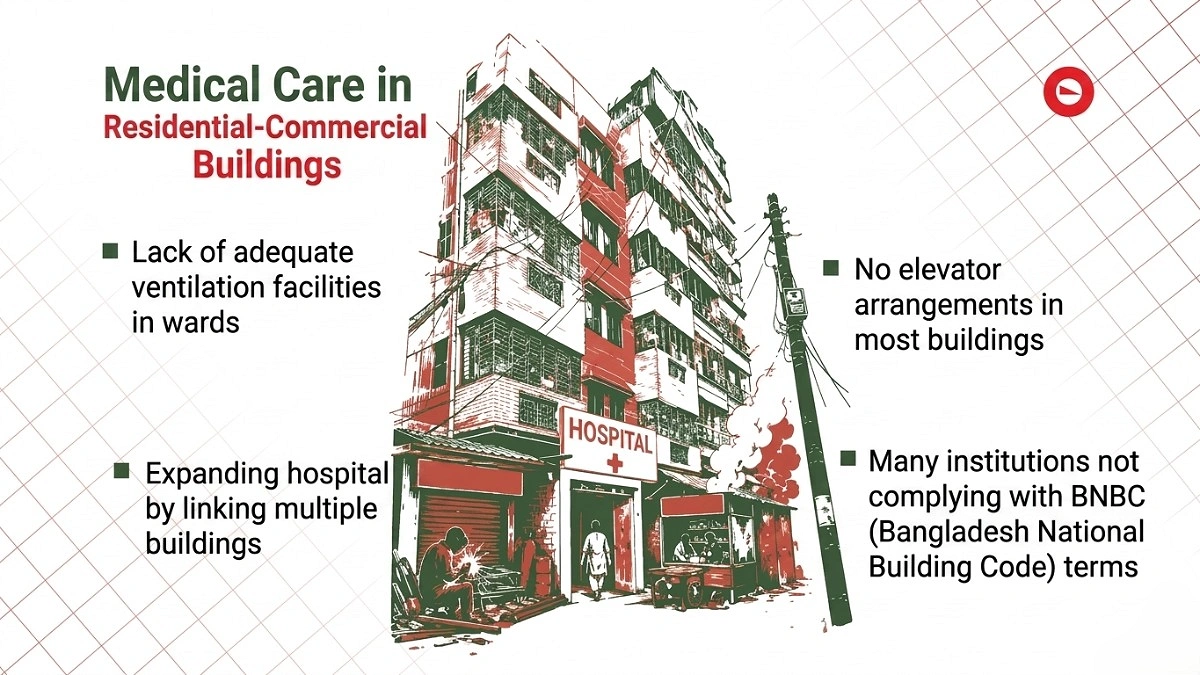
Graphics: Agamir Somoy generated by AI
From busy city streets to narrow alleys in the capital, hospital, clinic, and diagnostic center signboards are everywhere. Yet many of these healthcare facilities operate in buildings that were never designed for medical use. In some cases, several floors of residential buildings are rented out for treatment services; in others, multiple houses are merged and modified to create large hospitals. These establishments often violate the Bangladesh National Building Code (BNBC), exposing patients to serious safety risks without their knowledge.
Recent incidents have reignited concerns about the structural safety of private hospitals, including the deaths of six newborns at Ad-din Medical College Hospital in Moghbazar, Dhaka. Investigations revealed irregular ward setups, inadequate ventilation, and unauthorized construction.
On 28 May, six newborns died one after another in the hospital’s post-operative ward, triggering nationwide debate. A probe by the Directorate General of Health Services found several serious irregularities, including the placement of a post-operative ward in an old building without proper authorization, lack of ventilation, a shut-down central air-conditioning system, and even an unauthorized bakery operating inside the hospital.
Following the incident, Health Minister Sardar Md. Sakhawat Hossain stated that the hospital building was not suitable for medical operations and had failed to meet basic operational standards.
Rules on paper, not in practice
According to the national building code, a hospital’s main corridor must be at least 2.4 meters wide. Even secondary passages must be at least 1.8 meters. The code also mandates adequate elevators, emergency exits, fire safety systems, and ventilation facilities.
However, visits to various hospitals and clinics in the capital show widespread violations. Narrow staircases, insufficient corridors, poorly lit wards, and unsafe structures have become common features of healthcare facilities.
Modern Diagnostic Center (Johnson Road)
At Modern Diagnostic Center on Johnson Road in Old Dhaka, the second and third floors of a building are used for medical services, while the ground floor houses a hardware store. Patients must climb narrow stairs, as there is no elevator.
Critically ill patients in wheelchairs often have to be carried upstairs by family members. In many cases, transporting patients on stretchers is nearly impossible.
Public relations officer Golam Mostafa said, “We are aware of the issue. Since this is not our own building, we cannot make structural changes ourselves. We have requested the landlord to install a lift.”
Dhaka City Clinic
Located on the floor above the diagnostic center, Dhaka City Clinic faces similar issues. The surrounding dense buildings block light and ventilation. Additionally, a transport company operates on the upper floor, meaning patients and workers share the same narrow staircase used to move heavy equipment and iron pipes.
Patient Rashid Anjum expressed frustration, saying he had to stop midway on the stairs when someone carrying heavy iron pipes blocked the way, calling it an unacceptable environment for a hospital.
When asked about building code compliance, the clinic’s PRO, Dr. Imdadul Haque, said they have been operating since 2010 at low cost and possess government approvals. He added that strict compliance with all requirements would make it difficult for hospitals to operate.
Medinova Medical Services (English Road)
At Medinova Medical Services on English Road, a similarly congested entrance leads into the facility, with hardware shops crowding the surroundings. There is no lift or ramp, and staircases are narrower than required standards.
The in-charge, Tamanna Tabassum, admitted the inadequacy, saying the building is not ideal for a diagnostic center but was considered advanced when it opened 23 years ago. Staff currently carry immobile patients upstairs using wheelchairs, while plans for a lift are under discussion.
Anwar Khan Modern Medical College Hospital (Dhanmondi)
Not only small clinics but also large hospitals are expanding into residential buildings. Anwar Khan Modern Medical College Hospital began in 2008 in a seven-story building and later expanded by acquiring and connecting around 10 nearby residential buildings.
Experts say residential structures are not suitable for hospital design. This type of expansion has led to poor ventilation and inadequate airflow in many wards.
Public health experts and urban planners emphasize that hospital design requirements are fundamentally different from residential buildings. Hospitals require safe central oxygen systems, fire safety infrastructure, wide corridors, emergency exits, specialized elevators, infection control systems, and proper ventilation.
Without these, treating patients in such adapted buildings can turn any accident into a major disaster.
Experts stress the need for stricter monitoring by the Directorate General of Health Services, RAJUK, and other regulatory bodies before granting approval for hospitals. Otherwise, patient lives will continue to be placed at risk in unsafe buildings under the guise of healthcare.
