
Hired on Contract at 41, Made Permanent at 45

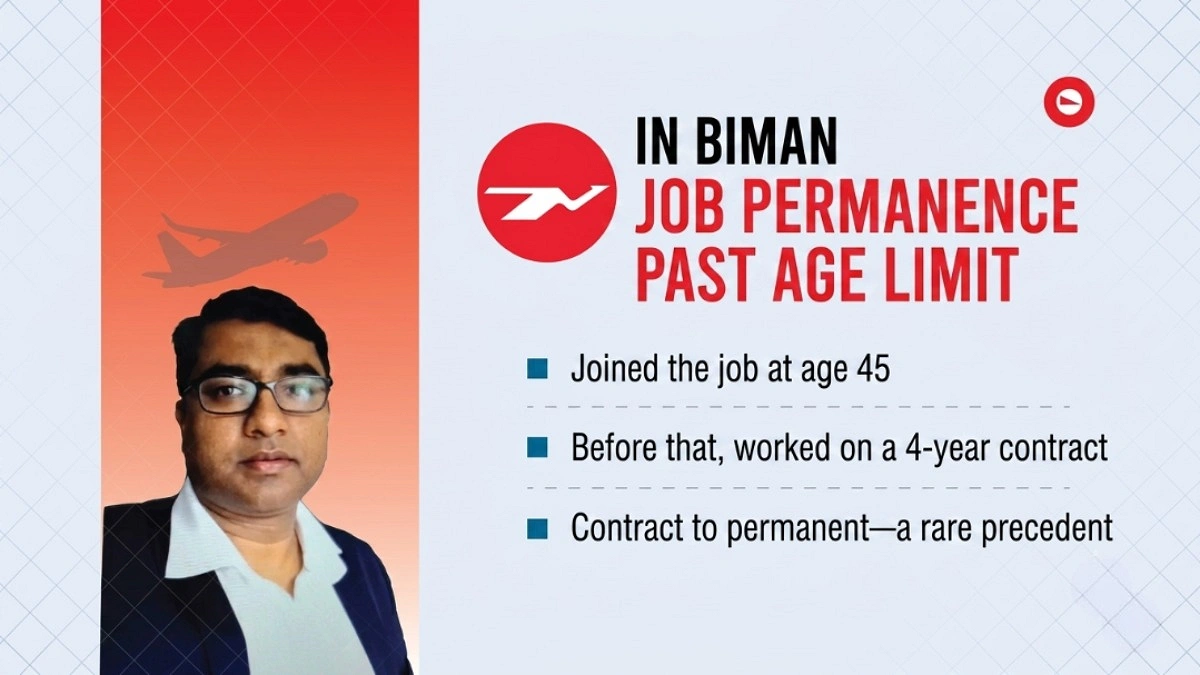
Graphics: Agamir Somoy generated by AI
A contract appointment is generally meant to end when the contract expires. But that was not the case for Md. Ashraful Alam, Deputy General Manager of Biman Bangladesh Airlines. His contractual position was converted into a permanent one—a move that appears to fall outside the existing recruitment framework.
Ashraful Alam joined Biman on a special contractual appointment at the age of 41. After serving an initial three-year term, his contract was extended for another year, bringing his age to 45 by the time the contract ended. Under Bangladesh’s public recruitment rules, the maximum age for entering government service is 30, leaving no apparent provision for permanent appointment at that age.
Despite these apparent irregularities, Ashraful has already received one promotion and is reportedly being considered for another.
An internal Biman letter obtained by Agamir Somoy suggests the matter is not limited to a single official. As part of an ongoing promotion process, the airline sought information on whether the officials under consideration faced any departmental proceedings or court cases—a standard requirement before promotions. The list includes 16 officials, including Ashraful Alam.
According to official records, Md. Ashraful Alam (G-51200) joined as Manager (Finance–Accounts) on July 1, 2018, exactly at the age of 41. His monthly salary was fixed at Tk 110,000, including a basic salary of Tk 49,880 and house rent of Tk 24,940.
After completing his three-year contract, Biman formally ended his appointment on May 9, 2021. Just days later, on May 16, he applied for a one-year extension. The airline approved the request, signing a new agreement effective July 1, 2021, to June 30, 2022.
Under the renewed contract, his monthly salary increased to Tk 121,793, including a basic salary of Tk 57,742, house rent of Tk 28,871, and other allowances totaling Tk 35,180.
Documents further show that after the contract ended, Ashraful himself applied for permanent employment. Based on that application, he was appointed as a permanent manager—a decision that has raised questions about the legality of the process.
On August 9, 2023, just five years after joining on contract, he was promoted to the position of Deputy General Manager (Accounts), prompting further scrutiny.
When contacted by Agamir Somoy, Ashraful Alam declined to comment on his appointment, contract extension, and permanent employment, referring all questions to Biman’s Human Resources (HR) and Administration departments.
State-owned companies generally follow government recruitment rules, under which the maximum entry age is 30. However, it remains unclear under which legal provision Ashraful was appointed at the age of 41, and Biman has offered no explanation.
Biman’s Deputy Managing Director (DMD) Syed Moinuddin Ahmed said he was in a meeting and requested that reporters call back later. However, repeated attempts to reach him afterward went unanswered.
Public administration analyst and former secretary AKM Abdul Awal Majumder said contractual recruitment has long been practiced and is not unusual. However, he noted that contractual appointments are generally not converted into permanent positions.
He said there may be limited scope for regularization under the President’s 10 percent quota in exceptional cases, but emphasized that Biman’s process should be thoroughly examined.
“If the individual is an expert in the relevant field, there may be certain legal or policy provisions that allow such an appointment,” he said. “However, it is equally important to determine why someone was recruited on contract beyond the prescribed age limit.”
He added that if the process followed all applicable rules, it would be one matter; if influence or favoritism played a role, it would be another. According to him, such practices may not be limited to Biman Bangladesh Airlines and could exist in other institutions as well.
The entire process—from contractual appointment to permanent employment and subsequent promotion—has now come under scrutiny. Observers say it remains unclear whether the case represents an exception permitted under policy or a departure from established recruitment rules.
