
Testimony of a Former RAB Officer
Alkas Majhi an accomplice of mastermind Ziaul Ahsan also made to disappear

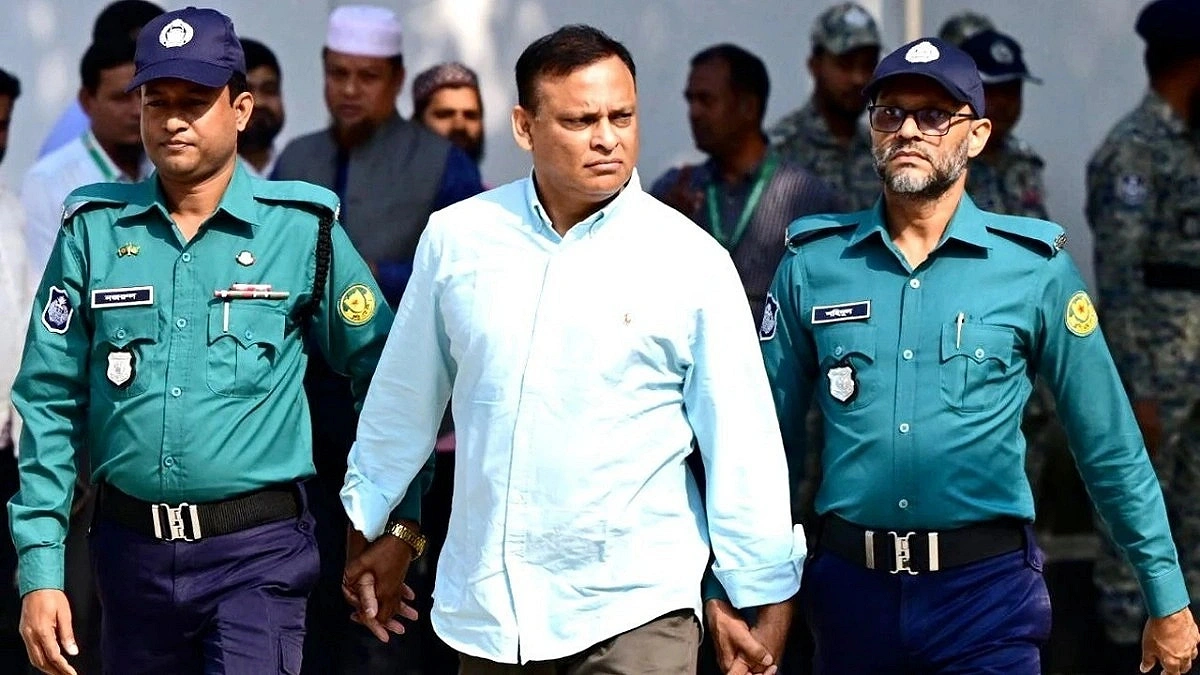
Ziaul Ahsan being taken to the tribunal. File photo.
Ziaul Ahsan. There are allegations against him of involvement in the enforced disappearance and extrajudicial killing of hundreds of people. There are multiple cases against him over crimes against humanity. He has also lost his job in the army. He is accused of carrying out these killings during the Awami League government, whose activities were banned. A former RAB officer, retired Major Sabbir Rahman Osmani, who was an eyewitness, has testified about how Ziaul used to dispose of bodies after killings.
In his statement, the RAB officer said that in May 2010, four people, including Nazrul Islam, an eyewitness to the BDR killings, and at least 15 other victims identified over time as political opponents and critics of the government, were shot dead, after which their stomachs were cut open, cement bags were tied to them, and they were submerged in rivers. Ziaul Ahsan used to call these killings "Operation Golf" in code language. Alkas Majhi was an accomplice in many of his operations. At one point, fearing that information about the misdeeds would leak, Ziaul also made him disappear.
The testimony was given on Thursday at the International Crimes Tribunal-1. The sole accused in the case is former NTMC Director General, dismissed Major General Ziaul Ahsan. At the time the operations were carried out, he was the director of RAB's intelligence wing.
Sabbir Rahman Osmani said that in RAB operations in the Sundarbans and Barishal regions, detained people were killed and the incidents were staged as "gunfights." These operations were carried out under the planning and direction of Ziaul Ahsan.
Sabbir Rahman Osmani said that in January 2010, after leaving Char Duani in Barishal by a trawler toward the estuary, a person was shot dead in front of him.
According to him, before shooting, two cement-filled bags were tied around the neck and legs of the person brought in. Then a RAB member would press a small pillow against his head and ear and fire one round from a pistol. After that, one person would cut open the stomach of the shot person. Another would put his hand into the cut stomach of the shot person to confirm that the stomach had been cut properly. Then, when Ziaul Ahsan signaled that everything was alright, the shot person was thrown into the water.
In May 2010, in a similar operation, four people were killed and thrown into the water. Later, within two to three days, reports were received that a body with a cut stomach and cement bags tied to it had floated up in the Baleshwar River. Based on intelligence information, the body was identified as that of former BGB member Nazrul.
According to the statement and the prosecution, Nazrul was an eyewitness to the BDR mutiny. When Nazrul's body floated up from the river, Ziaul Ahsan instructed those concerned to only follow up on the matter without making any further fuss or conducting an investigation. Through this, information came up in court that they were deliberately killed to silence the eyewitnesses to the BDR killings.
In his statement, Sabbir Osmani also claimed that three operations conducted in 2011 and 2012 in the Nishankhali, Katka, and Mora Bhola areas of the Sundarbans were staged.
According to him, in these operations, previously detained people were killed first and then shown as killed in gunfight incidents. He also mentioned that although two bodies were found at the scene in the Nishankhali operation, six bodies in the case was tagged.
He claimed that in the 2012 Katka operation, after four people were killed on a trawler and thrown into the water, another person was taken into the forest and shot. Later, it was shown that four bodies were recovered in the operation.
Chief Prosecutor Md. Aminul Islam Faces Media After Taking Testimony
He said, "Retired Major Sabbir Rahman Osmani was one of the eyewitnesses to these killings organized by Ziaul Ahsan."
Regarding staged gunfights and the involvement of certain journalists, the Chief Prosecutor said that Ziaul Ahsan used to disguise these killings as so-called "gunfights" or crafted dramas. Through Sohel, the then head of RAB's media wing, a selected group of media outlets and journalists were taken from Dhaka, given life jackets, and brought to the operation site at Char Duani in Patharghata Upazila. They were briefed in such a way that the staged gunfight drama was broadcast in the media exactly as presented.
The prosecution indicated that these pieces of information would be included as complicity or "abetment" in crimes against humanity in the ongoing investigation against journalists.
According to the prosecution, Major Sabbir's direct testimony will serve as a historic and irrefutable document in uncovering what happened to the fates of hundreds of missing victims of enforced disappearance, and the Chief Prosecutor noted that this single testimony is enough to prove Ziaul Ahsan's crimes.
'Operation Golf': How the Chilling Killings Were Carried Out
In his testimony in court, Major Sabbir Rahman Osmani said that Ziaul Ahsan would travel from Dhaka to Char Duani in Patharghata Upazila of Barguna with his own trusted team and the victims. There, the victims were covered in such a way that it was impossible to tell whether they were male or female. They were then put on a trawler, and a pillow was pressed against their head or beside their ear before they were shot. Later, so that the bodies would not float up, their stomachs were cut open, cement-filled bags were tied to them, and they were thrown into the river.
Alkas the Boatman, Who Disposed of the Bodies, Did Not Escape Disappearance Either
Important information was also given in court about Alkas Majhi, the driver of one of the trawlers used in the operations. Alkas Majhi was involved in many operations. Later, when he began to reveal the matter in the local market, it came to Ziaul Ahsan's attention. After that, Sabbir was assigned to "eliminate" Alkas. But when Sabbir expressed his inability, Ziaul said he would handle the matter himself. A few days later, Alkas Majhi received a phone call from Ziaul, left his home, and never returned. Based on circumstantial evidence, it was assumed that he too was killed and his body made to disappear.
'Orders from the Highest Levels of the State' and the Helplessness of Other Officers
In his testimony, the witness said that when he went to the then battalion commander seeking redress in protest against such brutal killings, the commander made it clear that he could do nothing. Because Ziaul Ahsan had direct collusion with and sole authority from the highest levels of the government, including then Prime Minister Sheikh Hasina, no officer of RAB-8 or RAB-6 had the courage to disobey or oppose his orders. After the first operation, when a tense atmosphere developed in the car, Ziaul told everyone to act normal and arrogantly remarked, "They are enemies of the state, they have to be finished off like this."
Major Sabbir Rahman Osmani said that while serving in RAB, he became mentally devastated by these incidents. After completing 18 years of service, he voluntarily applied for retirement.
Major Sabbir Rahman said that "in August 2013, he received orders to return to the army, and in March 2014, he went into retirement."
