
The Argentine town that emerged after 25 years underwater

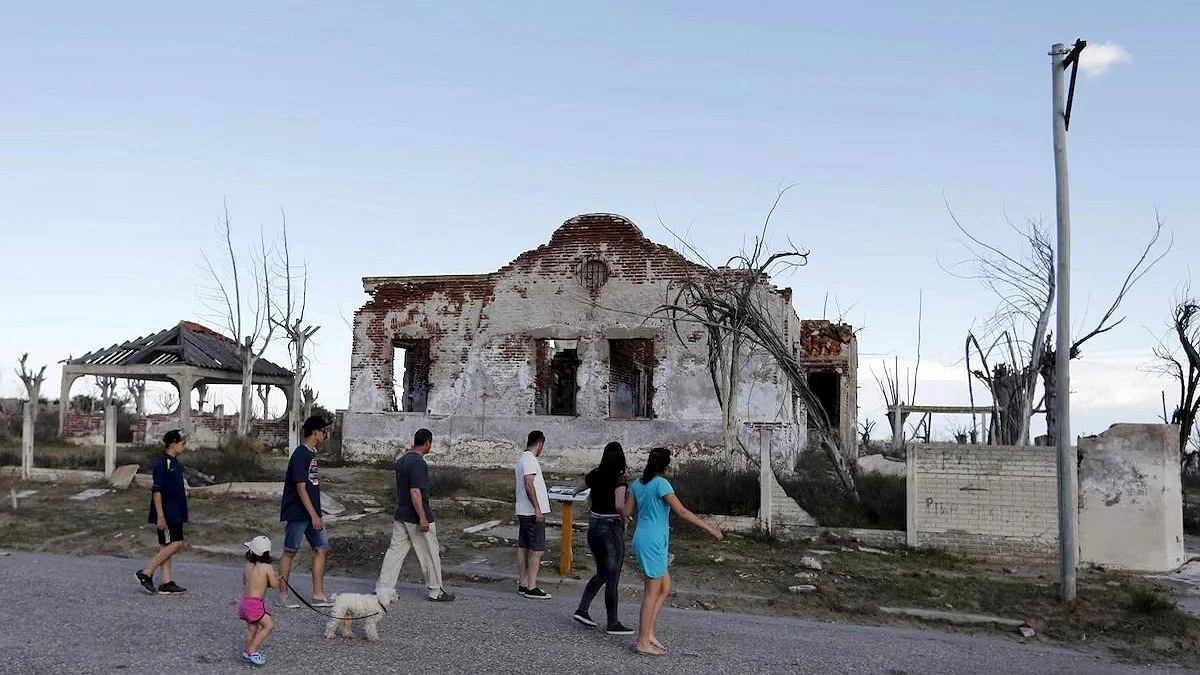
Tourists have flocked to the Argentine town of Epecuén after floodwaters receded, following more than two decades of submersion. Photo: Reuters
Once bustling with the footsteps of tourists, the town was filled with hotels, restaurants, businesses, and various leisure arrangements by the lake. During the summer season, the entire area would come alive with crowds of thousands of tourists.
But excessive rainfall over several years eventually submerged that busy town underwater. After nearly 25 years, a drought caused the water to recede, and the ruins of the town gradually became visible once again.
The story of Villa Epecuén, a popular tourist town in Argentina, reads like a real-life tale of a lost city. Located about 570 kilometers southwest of the capital, Buenos Aires, this town was once one of Argentina's most renowned spa cities.
The water of Lake Epecuén, adjacent to Villa Epecuén, had an extremely high salt content. Many believed that bathing in this water provided various health benefits. Because of this, the town rapidly gained popularity in the mid-20th century.
The lake itself has a fairly old history. Various reports mention that in the early 20th century, its valuable minerals were collected and used for glass production and medicine manufacturing.
Additionally, due to its salinity, the lake was considered one of the most saline water bodies in the world. At one time, it was even compared to the Dead Sea.
In the 1960s and 1970s, the number of tourists grew rapidly. In the 1970s, around 5,000 people lived in Villa Epecuén, with about 300 businesses. During the summer season, the town would host up to 20,000 tourists. The lake's salty water was the main attraction.
However, the situation changed in the 1980s. Rainfall in the region increased after 1980. A dam had been built in 1978 to protect the town from floodwater. But on November 10, 1985, that dam collapsed under the pressure of heavy rain.
After that, the lake's water level rose rapidly. Reports say the water level increased by about one centimeter per hour. Within just two weeks, parts of the town were submerged under nearly three meters of water. Residents were forced to abandon the town.
The floodwaters continued to rise. By 1993, Villa Epecuén was under about 10 meters of water. The town that once attracted thousands of tourists had become a city lost beneath the water.
For nearly 25 years, no trace of the town was visible. In the first decade of the 21st century, due to climate change and prolonged drought, the lake's water gradually began to recede. Around 2009, the water level dropped so low that the ruins of Villa Epecuén started to reappear.
The scene that emerged after the water receded was completely different. The buildings had collapsed after being submerged for so long. The lake's extremely salty water had left a white crust of salt on buildings, trees, and other structures.
Here and there lay old walls, collapsed buildings, and salt-encrusted trees still standing.
Today, Villa Epecuén is largely a ghost town. However, tourists visit to see its ruins. Various local initiatives have also been taken to preserve the town's history.
The old railway station has been converted into a museum, housing various memorabilia and recovered items from the town's past.
The name most associated with the town is Pablo Novak. Though he had to leave during the disastrous flood, he later returned to the vicinity of Villa Epecuén. For many years, he has lived near the ruins and shared the town's history with interested visitors.
Once lost underwater, Villa Epecuén now offers a unique attraction for tourists. The salt-covered buildings and trees standing amidst the rubble serve as a reminder of how helpless human plans can be against the power of nature.
Having emerged after nearly 25 years underwater, this town today stands as a unique historical and tourist landmark in Argentina.
Source: The Economic Times


