

Clashes Erupt as Thousands Protest in Geneva Ahead of G7 Summit in France

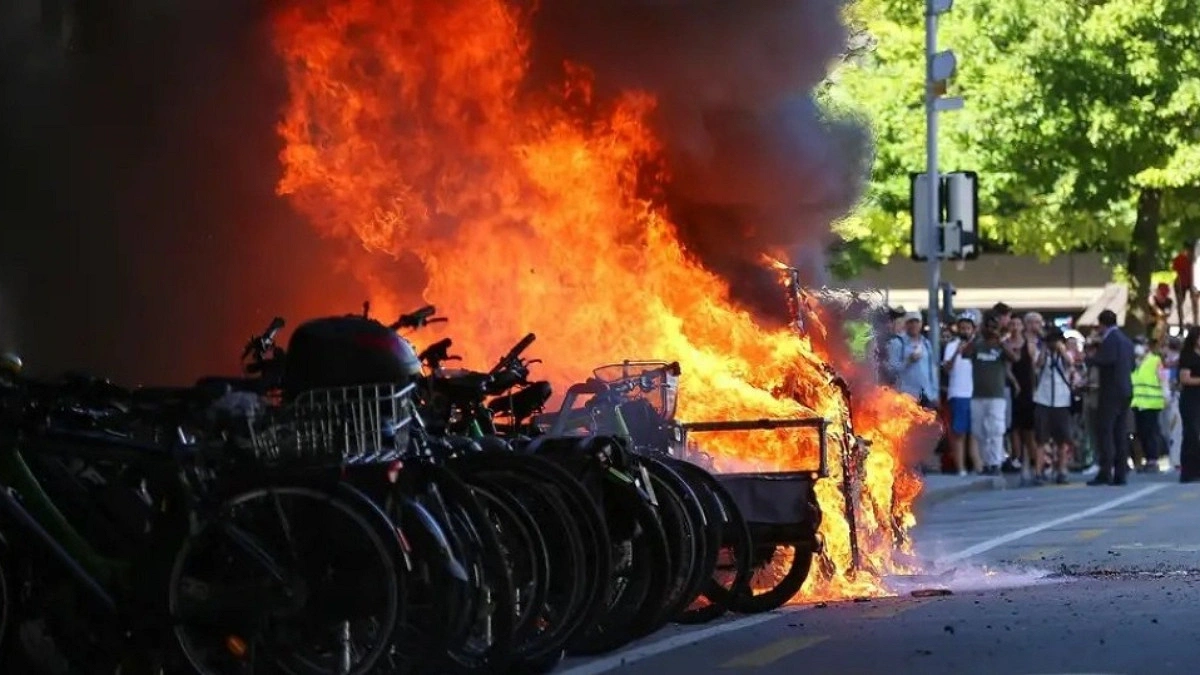
A Tesla car gets engulfed in blaze after setting fire to it by some protestors near French resort town of Evian. Photo Courtesy: DW
Clashes broke out between protesters and police near the United Nations (UN) building in Geneva on Sunday on the eve of the G7 summit in the nearby French resort town of Evian.
Protests against the upcoming G7 summit in nearby Evian turned violent in Geneva, as demonstrators threw stones and firecrackers at police. Authorities responded with tear gas and water cannons. Thousands had gathered in the Swiss city to voice opposition to the gathering of world leaders, which begins Monday across Lake Geneva in France.
As clashes intensified Sunday evening between police and groups of protesters in several parts of Geneva, French President Emmanuel Macron—this year's summit host—arrived in Evian.
On Monday, he will welcome leaders from the other G7 nations—Britain, Canada, Germany, Italy, Japan, and the United States—alongside invited guests from countries such as Brazil and India, to the lakeside resort town.
The three-day summit marks one of the first major international meetings since the United States and Israel launched a war against Iran in late February—a conflict that has upended the Middle East and deepened transatlantic rifts.
Most Protesters Peaceful
The G7 agenda is packed with potentially explosive issues, including efforts to end the war in Iran. U.S. President Donald Trump's claims of an imminent deal remain clouded in uncertainty.
Ukrainian President Volodymyr Zelensky is also set to attend, drawing sharp attention to the war triggered more than four years ago by Russia's full-scale invasion. Most leaders, including Trump, will arrive at Geneva Airport before traveling to Evian.
Geneva—located roughly 40 kilometers southwest of Evian—had been on edge for weeks. City authorities were anxious to avoid a repeat of the chaos seen in 2003, when anti-G8 rioters caused millions of dollars in damage across the Swiss city.
This time, officials permitted a march along a lengthy loop on the city's north side, far from the center and its luxury boutiques. By Saturday, small shops, supermarkets, and university buildings—some well away from the protest route—had boarded up their facades.
Despite the precautions, however, some protesters caused extensive damage on Sunday.
According to police, most of the approximately 20,000 demonstrators who took part in Sunday's protests were peaceful.
Waving banners with messages such as "No to the G7 and all imperialist alliances!" and "Abort the G7," the protesters gathered in a park along the shores of Lake Geneva. They then marched through a barricaded city that appeared to be bracing for an invasion, with helicopters hovering overhead.
Under a blazing sun, the crowd set off chanting slogans covering a wide range of causes, including support for Palestinians, climate action, feminism, and anti-capitalist activism.
"I'm here because I'm not happy that this group of heads of state is meeting here to make decisions that affect all of us," Michel, a 69-year-old Swiss retiree waving a Palestinian flag, told AFP.
'Eat the Rich'
However, shortly after the march began, several groups of black-clad protesters broke through barriers protecting affluent apartment buildings along the route and set vehicles on fire.
AFP journalists witnessed a Tesla car engulfed in flames, spray-painted with the words "Eat the Rich," while several buildings near the United Nations' European headquarters sustained damage.
Clashes with police followed. Protesters chanting "Down with the police state" hurled bottles, chunks of cement torn from sidewalks, and firecrackers. Authorities responded with clouds of tear gas and water cannons.
Hours into the ongoing clashes, police reported that approximately 600 so-called "Black Bloc" radical protesters had taken part in the violence.
Due to restrictions imposed by French authorities, the No-G7 coalition abandoned its plans for a counter-summit and demonstration on Sunday in the French border town of Annemasse.
Switzerland mobilized up to 4,000 troops to support police forces, while France has announced the deployment of nearly 16,000 police officers, gendarmes, soldiers, firefighters, and border guards around Evian. (Source: Radio France International)