
When the Washington Tiger Becomes a Geneva Kitten

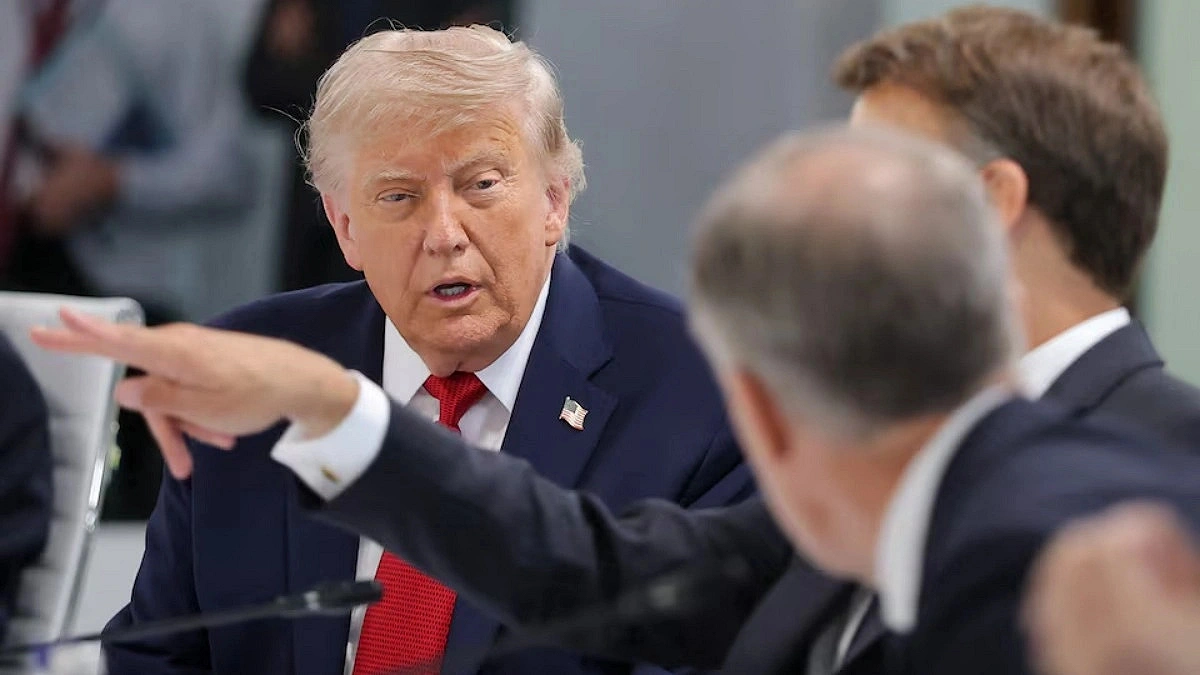
US President Donald Trump meets with G7 leaders and allies to discuss boosting economic growth during the G7 summit in Evian-les-Bains, France. Photo: Reuters
The pages of history are quite restless, especially when written in ink dripping from the inkwell of the White House in Washington DC. Last spring, on exactly February 28, when the war drums beat loud, a thunderous announcement shook the skies—Tehran's royal crown would be ground to dust. The targets were fivefolds: the government would change, nuclear reactors would turn to ash, missile wings would be clipped, Iran's fleet would sink in the Persian Gulf, and the threads of resistance across the Middle East would be torn apart in one swift pull. The condition was only one—unconditional surrender.
But as the draft of Friday's memorandum of understanding fluttered in Geneva's gentle breezes, it became clear that history's wheel sometimes does not turn 180 degrees, but a full 360, returning to its starting point. In modern political science, this might be called a "strategic retreat"; in plain Bengali—"saving one's skin while pretending to stand firm."
The Labyrinth of Conditions and the New Definition of Victory
Every line of this fourteen-point epic hides a strange tragicomedy. The US Navy, which once roamed the Persian Gulf, must now, within thirty days of signing the deal, pack its bags and begin a countdown to return to "pre-war" positions. And if Israel tries any new "mischief," Mr. Trump himself would have to personally step in to stop it—a bizarre theatrical scene where the hunter now becomes the guard!
The most delightful scene unfolds in the Strait of Hormuz. The American warships, which until now considered the strait their private lake, will now be shown generous magnanimity by Iran. They will clear mines, remove technical obstacles, and mercifully open the way for the world. And Washington's think tanks are thrilled just by watching this "opened" passage. The day before yesterday, when Trump himself opened his mouth, one had to wipe one's glasses. He performed a splendid literary somersault and declared: "Hey, regime change? That was never our goal! Our main goal was to keep the Strait of Hormuz open. See, we succeeded!"
Kundera's Oblivion and Žižek's Red Ink
Bravo! If that was the goal all along, then was the thunderous roar of February 28 merely the call of a spring cuckoo? Celebrating "victory" with $300 billion in reparations (ahem, reconstruction funds), the return of seized assets, and the lifting of sanctions—this would have drawn a wry smile from Milan Kundera if he were alive. Like the tragic heroes in Kundera's novels, Washington now embraces an extreme "existential oblivion." They forget their previous pronouncements so perfectly that they now believe the new history they have fabricated as the sole truth. This is not a victory; it is a Kundera-esque "festival of lightness," where all the horrors of war and the weight of promises are swept away in an instant, and they say: "We came here to win the game, and now that the referee has blown the whistle, it means we have won!"
To understand this entire situation, Slavoj Žižek's famous Soviet joke comes to mind. A Polish gentleman was going to Siberia. He told his friends, "When I get there, if I write in blue ink, understand that everything is true. And if I write in red ink, understand that everything is a lie." A month later, a letter written in blue ink arrived for his friends. It said: "Everything here is wonderful. The shops are packed with food. The cinemas are showing great Western films. The rooms are like palaces. There is only one thing lacking here—you cannot buy red ink anywhere."
Washington's "victory celebration" is exactly like that blue-ink letter. They come back home and write in celebratory blue ink: "We have freed the Strait of Hormuz! We have stopped nuclear weapons! Our goals have been met!" Everything is fine, except that the "red ink" is no longer left in the White House drawer—the ink with which they would write: $300 billion is lost, sanctions have evaporated like camphor, and Tehran's centrifuges continue to spin proudly as before!
When the tiger dresses as a home cat
Our generation is truly fortunate. We are witnessing a scene where a superpower erases the boundaries of its own goals with a rubber, declaring the boundaries set by Tehran as its own "victory wall." When the pen's ink dries in Geneva on Friday, Washington's veteran diplomats might breathe a sigh of relief and say, "Well, Iran didn't surrender unconditionally, but at least the terms under which we surrendered—we managed to give them legal form with the UN Security Council's stamp!"
A fitting description for this new chapter of history could be: "Having lost 300 billion dollars, having returned the keys to the Strait of Hormuz, laughing the laugh of world conquest!"
Author: Poet, Journalist
