
Flames Over the Blue Waves of Hormuz
Iran’s rain of fire across the Middle East

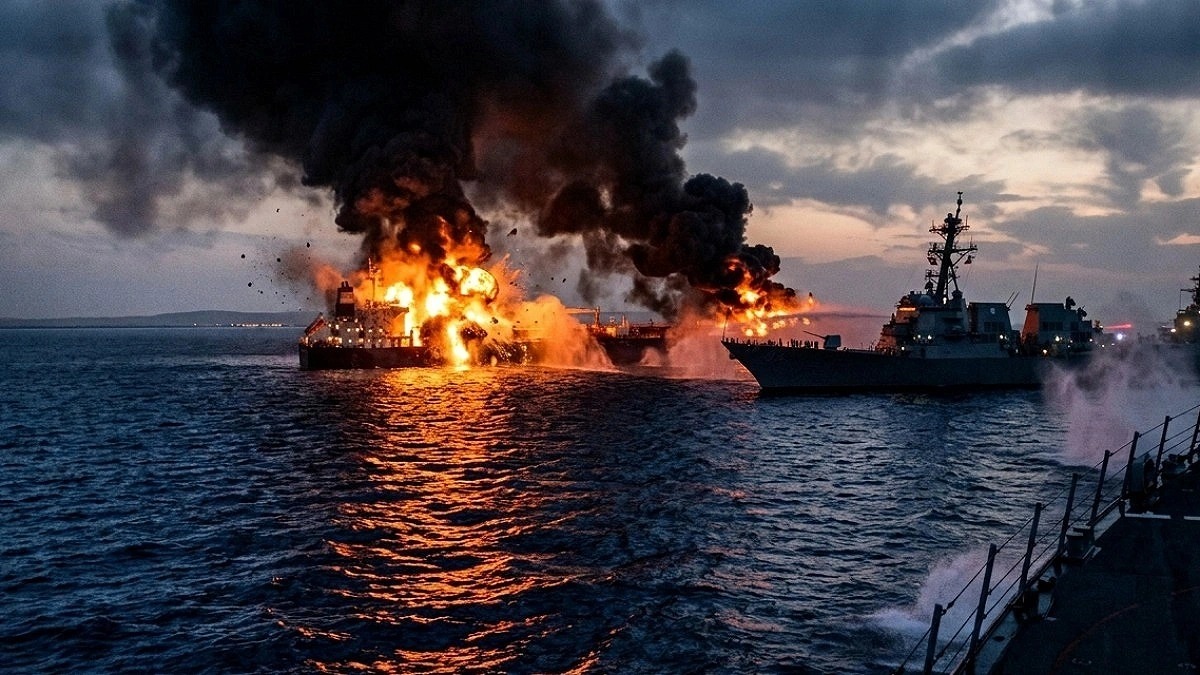
Representative image
Not stars, but missiles now fill the night sky over the Middle East. Flames of vengeance are blazing over the calm blue waters of the Strait of Hormuz. As night falls, American war machines are swooping down on Iran’s sleeping towns and cities. In retaliatory strikes, Iran’s rain of fire is scorching the skies of what it describes as the American empire across the Middle East, from Kuwait and Bahrain to the scorching deserts of Jordan and Syria’s Al-Tanf.
The Iran-United States conflict is taking an increasingly dangerous turn. On the sixth day of the attacks, from Thursday night to Friday morning , the United States struck key Iranian military and infrastructure facilities. In response, Iran launched fierce attacks on US military installations across the Gulf region. The exchanges of fire have shaken cities, ports and communities across the Middle East.
US attacks
Hormozgan: Bandar Khamir bridges
The United States attacked bridges in Bandar Khamir in Hormozgan province. The bridges are among the main routes connecting local communities. The strikes damaged links between coastal and inland areas, creating risks for supply and transportation networks.
Bandar Abbas: Rail infrastructure
The United States also struck key rail infrastructure near Bandar Abbas. The railway connects the country’s main southern seaport with the inland transportation network. It is of major importance for cargo transportation, trade and supply systems.
Iranshahr: Airport
Iranshahr Airport in Sistan and Baluchestan province was also targeted. It is an important regional airport in southeastern Iran and plays a significant role in passenger transport, emergency services and regional connectivity.
Chabahar: Maritime traffic control radar
The United States also struck Chabahar’s maritime traffic control radar. The system is responsible for airspace monitoring, air traffic coordination, maritime surveillance and aviation safety in this strategically important coastal region.
Sirik
The coastal area of Sirik in Hormozgan also came under attack. Its proximity to the Strait of Hormuz gives it considerable strategic importance.
Qeshm Island
Qeshm Island, the largest island in the Strait of Hormuz, was also targeted. The island is highly important for maritime trade, commercial activities and monitoring the Strait of Hormuz.
Ahvaz
The industrial city of Ahvaz in Khuzestan province was also attacked. It is one of Iran’s most important economic centers because of its oil, energy and industrial infrastructure.
Bushehr
Bushehr, on the coast of the Persian Gulf, also came under attack. The city holds significant strategic importance because of its energy infrastructure, maritime activities and regional connectivity.
Iran’s retaliatory attacks
Bahrain
In response, Iran’s military claimed it struck US helicopters and surveillance aircraft stationed at Sakhir Air Base in Bahrain.
Qatar
Iran launched multiple attacks toward Qatar. Qatari forces claimed they intercepted the strikes. However, the country’s Interior Ministry said a child was injured by falling debris.
Kuwait
Iran’s military claimed it used drones to strike locations where U.S. troops are deployed and logistics support centers in Kuwait. The Islamic Revolutionary Guard Corps (IRGC) also claimed it struck US missile defense radars, weapons depots and two HIMARS missile launch systems.
Syria
The IRGC claimed it attacked the command center of US special operations forces at the Al-Tanf military base in Syria. According to Iranian state media, this was Iran’s first attack in Syria during the ongoing conflict in the Middle East.
Oman
The IRGC claimed it destroyed a US air control radar in Oman’s Ghanim region. It also claimed to have attacked a maritime control radar in the Strait of Hormuz within Iranian-Omani waters.
The conflict in the Middle East is no longer confined to borders. The scope of the attacks has spread across land, air and sea. Strategic infrastructure has become a direct target of warfare. Tensions across the Gulf region are rising rapidly. The biggest question now is where this new conflict will end.
