
From Jules Rimet Cup to the World Cup
French Jules Rimet, the man behind the World Cup plan

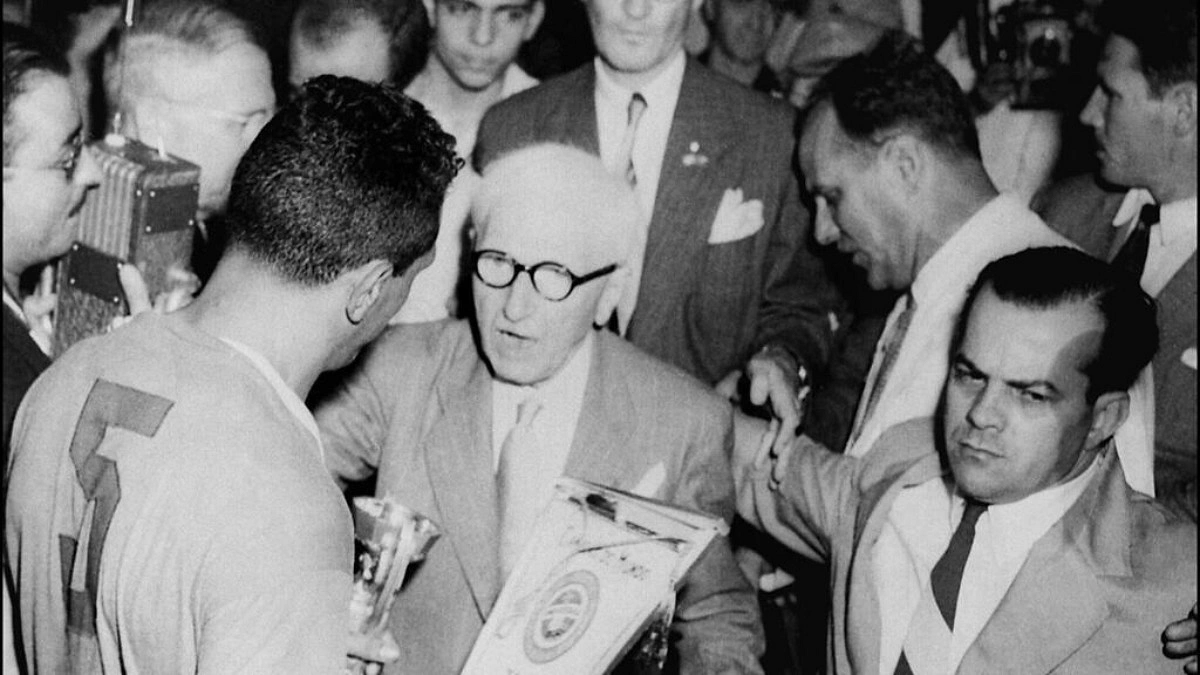
Photo Courtesy: RFI
Jules Rimet's brainchild has come a long way in 96 years. Fourteen teams accepted an invitation to take part in the inaugural tournament in 1930. In 2026, more than half of the 48 squads competing have battled through two years of qualifying games.
Before Rimet's plan, the most prestigious international football team prize was handed out at the Olympic Games which was organised by the International Olympic Committee (IOC).
Rimet, a founding member of the Fédération Internationale de Football Association (Fifa) in 1904, wanted his organisation to be the big noise in football.
And after taking up the Fifa presidency in 1921, the 54-year-old Frenchman proposed his World Cup concept at the 17th Fifa congress in Amsterdam in May 1928.
Compatriot Henri Delaunay, who was a Fifa vice-president as well as a top executive with Rimet at the French Football Federation, backed Rimet's resolution "to organise a competition which would be open to the representative teams of all of the affiliated national associations."
Unsurprisingly, the associations in the Americas were up for the cup but their European counterparts were reluctant to send their squads on a three-week voyage across the Atlantic Ocean for a two-week tournament before a three-week trip back home.
Two months before the start of the event, no European teams had registered. Rimet, who had trained as a lawyer, had to twist a few arms in France to persuade his home country to boost the credibility of the competition. The Belgian-born Fifa vice-president Rodolphe Seeldrayers eventually wooed his football association to participate.
Egypt miss World Cup boat
Egypt would have made it 14 teams but their ship from Egypt to Europe was held up by a storm in the Mediterranean and they missed their connecting boat to Uruguay from Marseille.
The 1930 tournament started on 13 July with two games. France took on Mexico at the Estadio Pocitos in Montevideo and a few kilometres to the north, Belgium played the United States at Estadio Parque Central.
Just over two weeks after the tournament began, Uruguay were crowned the first World Cup champions, defeating Argentina 4–2 in the final at the Estadio Centenario. Nearly 69,000 spectators filled the stands to watch the reigning Olympic champions of 1924 and 1928 confirm their dominance and, in doing so, vindicate Jules Rimet’s bold decision to launch a new global tournament. Appropriately, Rimet presented the trophy—then known simply as Victory—to Uruguay captain José Nasazzi.
The tournament’s growing appeal was confirmed four years later. For the 1934 World Cup in Italy, 32 of FIFA’s 50 member associations applied to take part in a competition limited to 16 teams. To manage the demand, FIFA introduced a qualifying system, which even included the host nation. Italy survived the qualifiers and went on to win the tournament, with Rimet again presenting the trophy to the champions.
Italy repeated the feat in 1938, beating Hungary 4–2 in the final in Colombes, just outside Paris. Rimet was once more on hand to award the cup. But the celebrations proved short-lived. Within 15 months, Europe was engulfed in the Second World War.
Having moved FIFA’s headquarters from Paris to Zurich in 1932, Rimet was able to keep the organisation functioning from neutral Switzerland while much of the world was at war.
Post-war development
The World Cup returned in 1950, by which time the trophy had been renamed the Jules Rimet Cup in recognition of his 25 years as FIFA president. An added incentive was introduced: the first nation to win the tournament three times would earn the right to keep the trophy permanently.
Rimet presented his namesake cup to Uruguay in 1950 and was again central to the ceremony in June 1954 when West Germany claimed their first World Cup title. Shortly after that final, Rimet—approaching his 81st birthday—stepped down as FIFA president, ending a 33-year tenure at the helm of the organisation he had helped to found.
He died on 16 October 1956, a few days after his 83rd birthday, in Suresnes on the western outskirts of Paris.
The Jules Rimet Cup made its final appearance at the 1970 World Cup final, when two-time champions Italy faced Brazil at the Estadio Azteca in Mexico City—a venue that will also host the opening match of the 2026 tournament. With victories in 1958 and 1962 already secured, Brazil needed one more triumph to claim the trophy outright. They did so in emphatic fashion, thrashing Italy 4–1 and earning permanent possession of the Jules Rimet Cup—and a lasting place in football history. (Source: Radio France International)
