
Before pay scale, fighter jet or boeing—fix the banks first

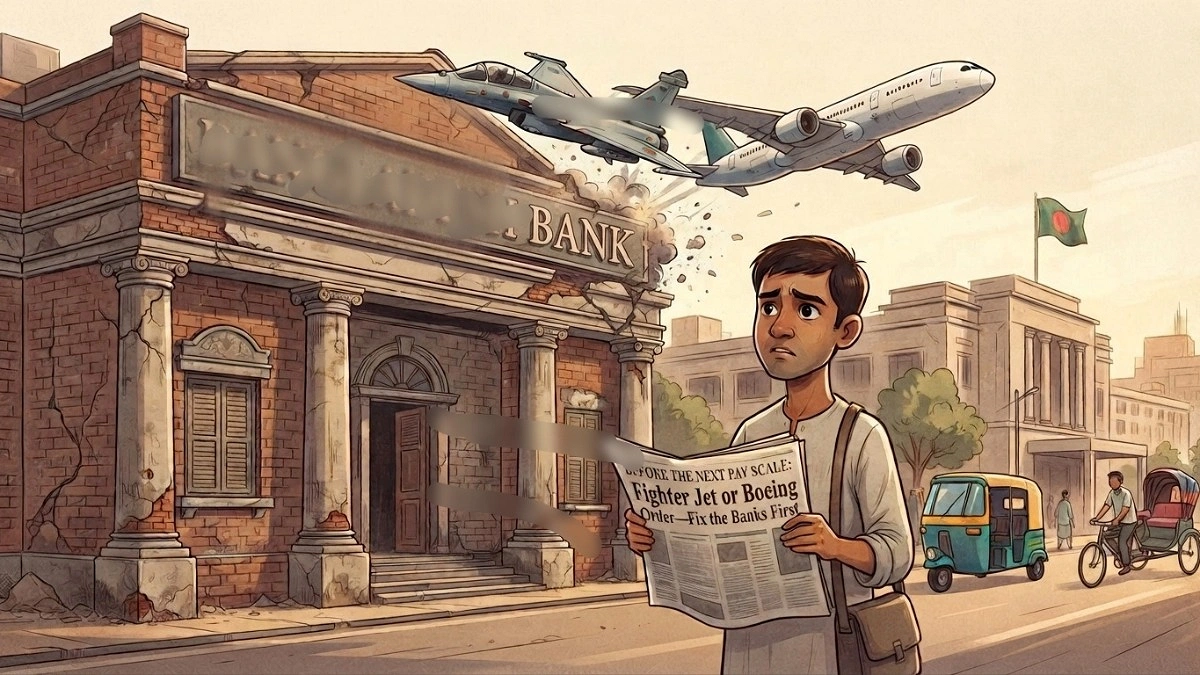
AI generated image
In June 2026, Bangladesh's non-performing loans climbed to 32.78% of all bank loans of Tk 606,555 crore, or roughly $49.3 billion, the highest such rate in the world, surpassing even Ukraine, a nation grappling with war. Two months later, in August 2026, the government moved ahead regardless: the cabinet approved the Ninth National Pay Scale, raising government salaries by up to 142%, and finalized a draft $2.302 billion deal to purchase 20 Chinese J-10CE fighter jets, pending final cabinet sign-off. With a tax-to-GDP ratio of just 6.8% which is one of the lowest in the world. These commitments raise a critical question: can Bangladesh afford to reward its employees and expand its military while its banking sector teeters on collapse?

The Scale of the Crisis
The numbers are stark. Defaulted loans increased by Tk 17,851 crore in just three months (March to June 2026) with ten banks accounting for over 72% of the total bad debt. This is not a temporary liquidity crunch; it is a systemic failure of credit discipline. When offenders are repeatedly rewarded with restructuring facilities rather than held accountable, an economy cannot sustain basic lending standards.
The human cost is equally severe. When banks are burdened with bad loans, they tighten lending to viable businesses, stifle entrepreneurship, and raise interest rates for honest borrowers. Small and medium enterprises which are the backbone of Bangladesh's economy now face credit starvation, while willful defaulters, often politically connected, enjoy repeated loan restructuring facilities.
The Path Forward: Reform Before Spending
Before another taka is committed elsewhere, Bangladesh needs a five-point roadmap to restore credit discipline.
Enforce the Defaulter Law That Already Exists
Bangladesh already amended its Bank Company Act to bar willful defaulters from travel, trade licenses, and political office, and Bangladesh Bank has ordered banks to form dedicated units to identify them. The law is not the problem, enforcement is. The Anti-Corruption Commission and Bangladesh Bank should be required to publish, at minimum quarterly, exactly how many identified willful defaulters have actually faced these penalties, closing the gap between what is written into law and what is applied in practice.
Finish the CIB Reform Already Underway
Bangladesh Bank licensed four private credit bureaus in late 2025 specifically to modernize credit reporting, and foreign-loan defaults were only added to the CIB database in 2024, both long overdue steps. But a reform announced is not a reform completed. Full-file, real-time reporting must be made mandatory across every bank and NBFI, not optional, and defaulters flagged in one institution must be automatically locked out of credit everywhere, not just on paper.
Apply the New Bank Company Act to State Banks First
Recent amendments to the Bank Company Act now require independent board members and smaller, more professional boards, a genuine step forward. Yet state-owned banks like Janata Bank, which carry the largest share of bad debt, are precisely where political appointments and weak oversight have been most entrenched. Recapitalization of these banks should be made conditional on visible compliance with the new governance rules, not treated as a routine budget line item that arrives regardless.
Modernize Bankruptcy and Collateral Recovery Laws
Bangladesh's legal framework for recovering bad debt remains slow and defaulter-friendly, with cases routinely dragging on for years in the Artha Rin Adalat (Money Loan Courts). Banks need a faster, clearer legal path to seize and liquidate collateral once a borrower defaults, rather than watching recovery cases stall indefinitely while assets depreciate.
Insulate The Central Bank from Political Interference
Many of the largest defaulted loans trace back to lending decisions shaped by political connections rather than creditworthiness. Strengthening the central bank's independence through fixed, non-renewable leadership terms and statutory protection from government directives on individual loan approvals would help ensure that lending decisions are judged on repayment capacity, not political proximity.
None of this is complicated or unprecedented. What has been missing is sequencing, the political will to fix the system before asking it to carry more weight.
Pay Hikes, Fighter Jets, and a Boeing Order: Priorities Misaligned?
Instead, the months since June have brought the opposite of sequencing. In late August, the cabinet approved the Ninth National Pay Scale, raising government salaries by up to 142%, covering roughly 24 lakh civilian and military employees and 9.25 lakh retirees, at a cost of Tk 1,05,580 crore annually. Around the same time, Dhaka finalized a draft $2.302 billion deal for 20 J-10CE fighter jets from China.
The pattern extends further back and further out. In April 2026, Biman Bangladesh Airlines signed a $3.7 billion deal with Boeing for 14 aircraft which is the part of a broader trade arrangement aimed at easing US tariff pressure on Bangladeshi exports. By this September, officials signaled the order would expand further. That purchase is not financed through the domestic banking sector, so it does not add directly to the non-performing loan burden. But taken together with the pay scale and the jet deal, it reflects the same underlying posture: large, multi-year financial commitments made in parallel with, rather than in response to, a banking system in visible distress.
These expenditures are not inherently wrong. Public servants deserve fair wages, national defense is essential, and an ageing national carrier needs modernizing. However, all three are harder to justify when the state's revenue base cannot support them. With a tax-to-GDP ratio of just 6.8% which is one of the lowest in the world. Bangladesh collects far less than regional peers: Sri Lanka's ratio stands at roughly 13.7%, and even India's central-government tax collection alone runs close to 12% of GDP. A large and growing share of the FY2026–27 budget is already committed to salaries, pensions, debt servicing, and subsidies, leaving comparatively little room for development spending.
The Bigger Picture: Economic Sovereignty at Stake
If Bangladesh continues on this trajectory, the consequences will be dire. Foreign investors will shy away from a market where one-third of bank loans are bad. The taka will depreciate under pressure from inflation and debt servicing. And the government will face a sovereign debt crisis as it struggles to finance pay hikes, defense imports, fleet expansion, and development projects with a shrinking revenue base.
The Ninth Pay Scale, the fighter jets, and the Boeing order are each symbolizes of progress. But they are hollow if the financial system underpinning them is broken. Bangladesh must choose: reform the banks first, or risk a national economic emergency.
A Call to Leadership
Prime Minister Tarique Rahman's government has a narrow window to act. The July 2024 uprising that ousted Sheikh Hasina was fueled by public anger over corruption and economic mismanagement. If the new administration repeats the same mistakes, prioritizing popular spending over structural reform - it will face the same fate.
The message is clear: banking reform must precede pay hikes, defense spending, and fleet expansion alike. Only then can Bangladesh claim a record worth having, not the world's highest default rate, but a demonstrated capacity for financial discipline.
Writer: Lecturer in BHM at AITM College, Kathmandu
