
Dengue poses fourfold higher risk of death for pregnant women, unborn babies also at risk

Graphics: Agamir Somoy
Arpita Das got married on October 16 last year. A new member of the family was expected to arrive this month. But the 26-year-old woman could neither celebrate her wedding anniversary nor see her child. She died of dengue at Chattogram Medical College Hospital last Friday while 35 weeks pregnant. A stillborn baby boy was delivered immediately after her death. Arpita’s death is not merely a statistic. It highlights the severe health risks faced by pregnant women infected with dengue.
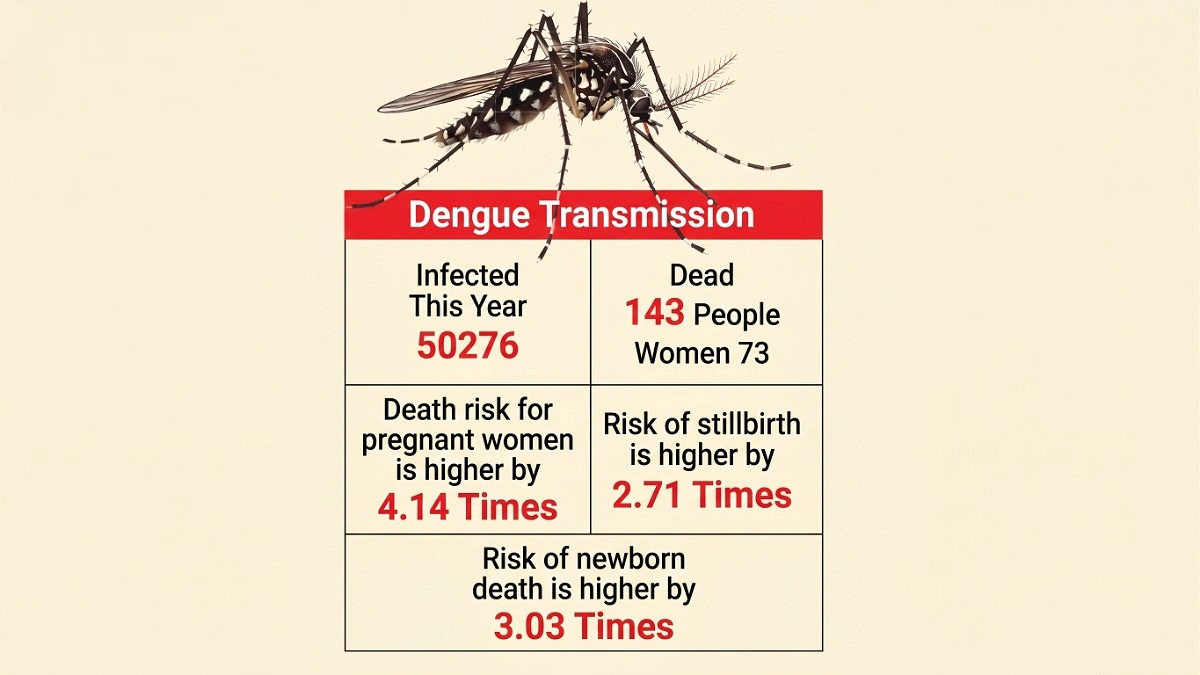
An analysis of data provided by the Health Emergency Operations Center and Control Room of the Directorate General of Health Services shows that although men are more frequently infected with dengue, the mortality rate is higher among women. A total of 143 people have died from the mosquito borne disease this year. Of them, 73 were women. However, there is still no separate data on dengue infections or deaths among pregnant women.
Health experts said pregnant women face several times higher health risks when infected with dengue. Along with the mother, the unborn child may also face various physical complications and even death.
A study titled “Health risks to mothers and newborns from dengue infection during pregnancy” found that pregnant women infected with dengue had a 4.14 times higher risk of death compared with pregnant women who did not have dengue. They also had a 2.71 times higher risk of stillbirth and a 3.03 times higher risk of neonatal death. The study published in the international medical journal Tropical Medicine & International Health analyzed data from 39,632 pregnant women infected with dengue.
Mushtaq Hossain, former Chief Scientific Officer of the Institute of Epidemiology, Disease Control and Research and a public health expert, said dengue creates a highly risky situation for pregnant women. He advised taking additional measures at home to protect pregnant women from mosquito bites at the initial stage. The public health expert also advised pregnant women to get tested for dengue immediately if they develop a fever. If they are infected with dengue, he advised taking them to a hospital quickly.
The study data also showed that among pregnant women infected with dengue, the rate of dengue shock syndrome was 14.9 percent. The rate of premature birth was 14 percent. The rate of maternal bleeding was 13.8 percent. The rate of miscarriage was 6 percent and the rate of stillbirth was 5.6 percent.
Chattogram Civil Surgeon Mohammad Sajedur Rahman advised considering pregnant women as a particularly vulnerable group in dengue management. He said a pregnant woman had died of dengue at Chattogram Medical College Hospital. However, the case will be added to the list after a report from the hospital’s review committee. He said pregnant women infected with dengue should be kept under the supervision of gynecology and obstetrics specialists and medicine specialists from the beginning. This can significantly reduce the risk of serious complications.
Sadikun Nahar Dilruba has been suffering from dengue for 10 days. She had to be hospitalized twice with a high fever and breathing difficulties. The platelet counts of the two-and-a-half-month pregnant woman has dropped to 97,000. She is also suffering from severe itching across her body and has been unable to sleep.
The 32-year-old woman said, “I have suffered terribly from dengue for several days. I have thought so many times that I would die this time. Thinking about my four-and-a-half-year-old daughter made me suffer even more. Tears kept flowing from my eyes.”
Chabikun Nahar, a gynecology and obstetrics specialist and surgeon at Kurmitola General Hospital, said women’s immunity naturally decreases during pregnancy. There are also many restrictions on medications because of pregnancy. If a pregnant woman becomes infected with dengue in this situation, various complications can increase, putting the lives of both the pregnant woman and her unborn child at risk.
The doctor said she sees pregnant dengue patients from time to time. She said dengue during pregnancy can cause low blood pressure and electrolyte imbalance. There is also a risk of miscarriage. If a woman is infected with dengue during delivery, the risk of excessive bleeding is higher.
According to the Directorate General of Health Services, 50,276 people have been hospitalized with dengue this year. A total of 1,056 people were infected with dengue in the past 24 hours. Two people died. Dengue infections are higher in Dhaka, Khulna, Barishal and Chattogram divisions.
Entomologist and Professor of the Department of Zoology at Jahangirnagar University Kabirul Bashar told Agamir Somoy that the density of Aedes mosquito larvae across the country is above the level suitable for dengue transmission, with the Breteau Index above 20. The Breteau Index is used to measure the density of Aedes mosquito larvae. The entomologist advised taking effective mosquito control measures wherever Aedes mosquito larvae and dengue patients are identified.
