
BANGLADESH
'Pulak’s death has shown the inescapable doom of periphery journalism'

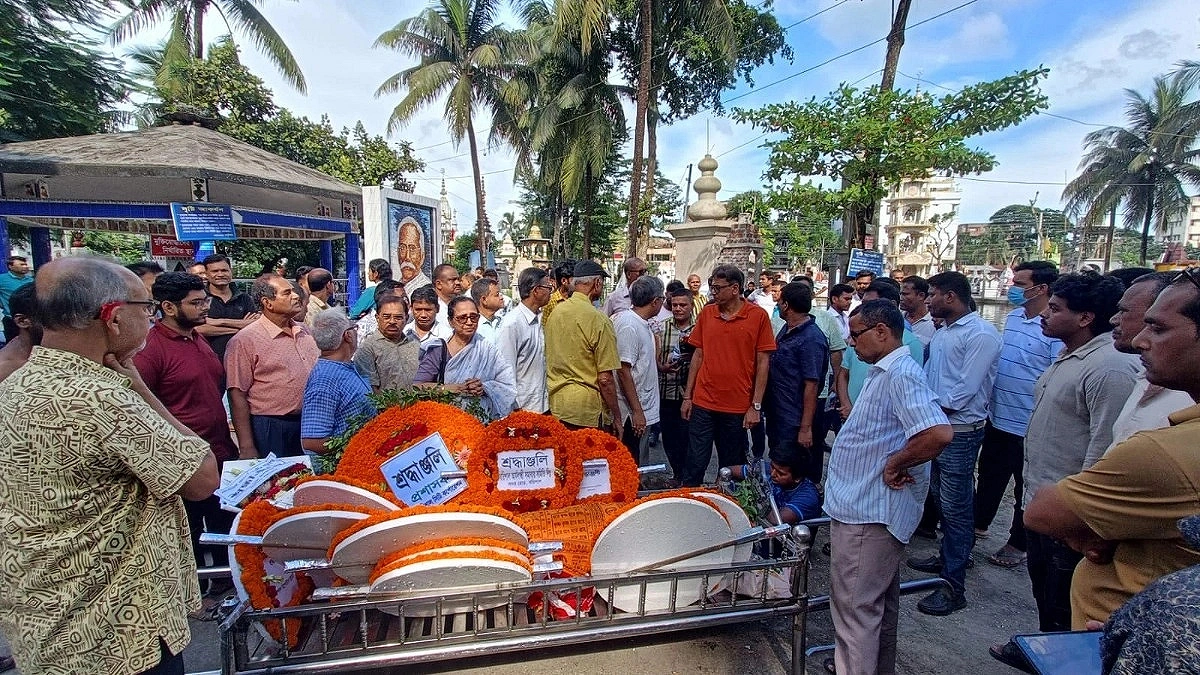
Photo: Agamir Somoy
Barishal journalist Pulak Chatterjee was mentally distressed after losing his job and ultimately chose to take his own life. His colleagues believe his death has exposed the suffering endured by journalists working in the peripheries of the country.
The hanging body of Pulak Chatterjee, a senior journalist in Barishal and former bureau chief of Samakal, was recovered from the Samakal Barishal office on Friday night.
Five suicide notes were found in his pocket. In them, he expressed his anguish over losing his job as well as not receiving money owed to him by the organisation.
Pulak’s younger brother, Dipak Chatterjee, said, “After losing his job at Samakal, my brother was under mental pressure and was depressed. He made numerous attempts to recover his provident fund money from Samakal, but failed. He tried for three years but could not recover the money. This had put a serious impact on his mental state. But we never imagined, even in our wildest dreams, that he would take his own life because of this.”
Pulak Chatterjee was cremated at the Barishal Mahashmashan on Saturday evening. Before that, his body was kept at his residence on North Mallik Road in the city.
An autopsy was conducted on Pulak Chatterjee’s body in the morning at Sher-e-Bangla Medical College Hospital in Barishal. The body was then taken to the Barishal Press Club, where his long-time colleagues broke down in tears during a ceremony to pay their final respects.
The discussions on social media surrounding Pulak Chatterjee’s death were reflected in the tributes paid by his colleagues.
Bappi Majumder, former general secretary of the Barishal Reporters Unity, said, “Pulak Chatterjee’s death has shown the ultimate fate of local journalism. Journalists are made to work hard in their youth and then dismissed when they grow old. A man who produced hundreds of crime reports for his organisation while putting his own life at risk ultimately had to die because of that very organisation.”
Pulak Chatterjee had been facing financial hardship since losing his job at Samakal in 2023. In one of his suicide notes, he wrote to Samakal’s current Barishal bureau chief, Suman Chowdhury, “Recover the money owed to me by Samakal and hand it over to your sister-in-law.”
Pulak Chatterjee had previously worked for the daily Jugantor before joining Samakal.
Akhtar Faruk Shahin, the Barishal bureau chief of the daily Jugantor and a longtime colleague of Pulak Chatterjee, said, “The offices of Jugantor and Samakal are in the same building. Jugantor is on the third floor and Samakal on the second. I knew that even after leaving Samakal, Pulak-da would continue to come to the Samakal office out of long-standing habit. He would spend time reading newspapers and then leave.
“I never imagined that such a knowledgeable and accomplished person like him would take his own life in this way. On Friday evening, Suman, the Samakal bureau chief, ran to the Jugantor office and informed us that Pulak-da had died by suicide. I immediately rushed downstairs and was stunned by what I saw. I informed the police, who arrived and broke open the door of the Samakal office and recovered our beloved Pulak-da’s body.”
M Mofazzel Hossain, joint general secretary of the Barishal Press Club, said he could not accept the death of his colleague Pulak Chatterjee. “He could not have taken his own life. He was forced onto this path. He once again proved through his own life how difficult journalism in the regions can be,” he said.
Moinul Islam Sobuj, a member of the executive committee of the Barishal Press Club, said that although Pulak Chatterjee carried a hidden pain over losing his job, he never allowed others to understand it.
“Pulak-da has sent a message to the authorities of the country’s 1,436 newspapers through his death. The condition of journalists working in the peripheries, and the lack of security for their lives and financial supports, have been laid bare through Pulak-da’s sacrifice,” he said.
After performing the final cremation rites for Pulak Chatterjee, his brother Dipak Chatterjee said that Samakal had been deeply intertwined with his brother’s life. He said Pulak had been unable to accept his dismissal from the newspaper.
SM Zakir Hossain, general secretary of the Barishal Press Club, said the Samakal authorities had contacted him and that they had discussed the money owed to Pulak Chatterjee.
Samakal Barishal bureau chief Suman Chowdhury said an unnatural death case had been filed over Pulak Chatterjee’s death. He also expressed grief over the death of his senior colleague.
Dipak Das, an office assistant at the Samakal Barishal office, said he left the office around 1pm on Friday. Meanwhile, Pulak Chatterjee called him twice at 2:17pm, but he was unable to answer the calls.
Dipak said Pulak Chatterjee used to arrive at the office around 2pm when he was employed there. Dipak did not return to the office after leaving on Friday afternoon. He came back to the office in the evening after hearing about Pulak Chatterjee’s death.
Pulak Chatterjee left behind his wife, Priyanka Chatterjee, and their only daughter, who is a fifth-grade student. In his suicide notes, he reportedly asked his brother to take responsibility for looking after them.
Prime Minister’s Advisor Zahir Uddin Swapon, Barishal-1 constituency MP Mazibur Rahman Sarwar, Barishal City Corporation Administrator Bilkis Akter Jahan Shirin, Barishal District Council Administrator Akon Kuddusur Rahman, various organisations like Barishal metropolitan BNP, Barishal Press Club, Barishal Reporters Unity, National Dailies Bureau Chief Association, Barishal Television Multimedia Association, the Journalists’ Union, Bangladesh Puja Udjapan Parishad, Sri Sri Shankar Math Puja Udjapan Committee, and various social, cultural and journalists’ organisations expressed their condolences over Pulak Chatterjee’s death.
