
Dhaka WASA: grand improvement plan leads to decline after 14 years

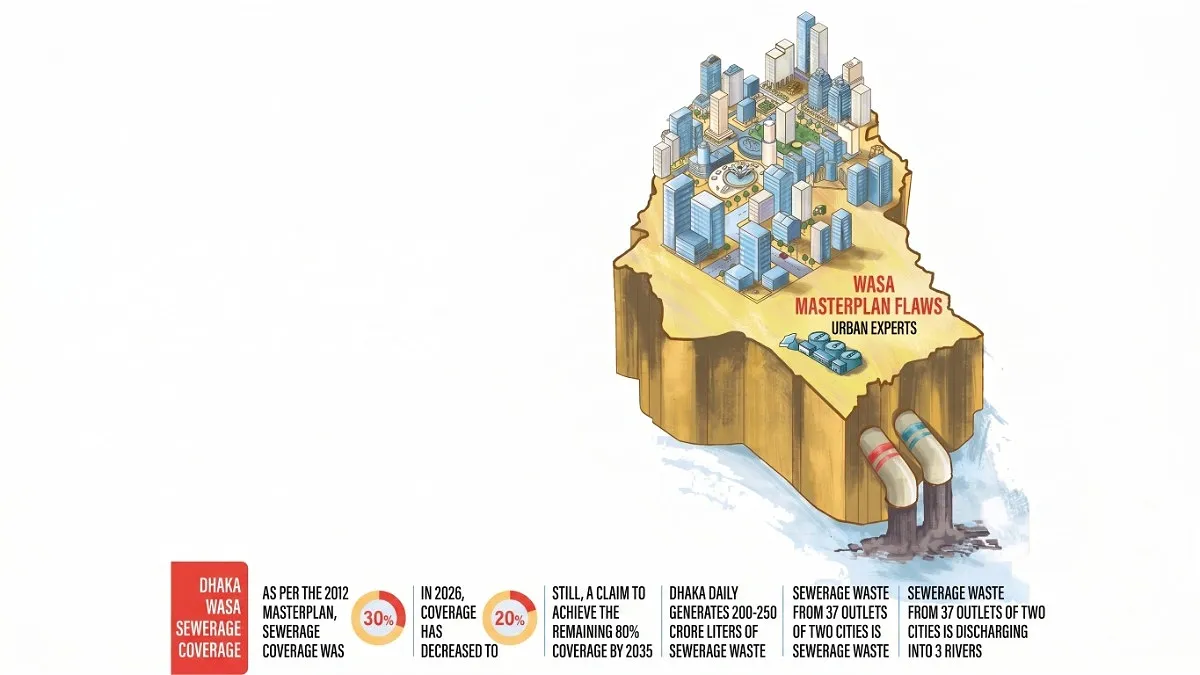
Graphics: Agamir Somoy
Human waste is supposed to flow through drains to treatment plants. After treatment, the liquid is supposed to be discharged into rivers. In reality, there is no proper route for waste to reach treatment plants. The number of plants is also insufficient. As a result, untreated toxic waste is flowing directly into water bodies. This is spreading diseases such as diarrhea, typhoid and jaundice.
To address the crisis, Dhaka WASA adopted a master plan in 2012. The goal was to build a 100 percent sewerage network. At the time, 30 percent of the capital was covered by the network. The plan envisioned covering the remaining 70 percent by 2035.
However, after 14 years, coverage has instead fallen to 20 percent.
Despite this failure, WASA is now claiming that the remaining 80 percent will be covered by 2035. Urban planners, however, say the plan is flawed. According to them, building large treatment plants alone will not solve the problem. A city as densely populated as Dhaka needs solutions based on local conditions. Sewerage networks should be built where they are feasible. Modern septic tanks should be used where networks are not feasible.
In September 2012, Dhaka WASA formulated a long term “Dhaka Sewerage Master Plan” at a cost of Tk 24,600 crore or $2 billion. The plan is known as WASA’s Sewerage Master Plan 2013. It was supposed to be implemented in three phases by 2035 to bring the entire city under a sewerage network.
Dhaka WASA’s Public Information Officer Md. Abdul Quader told Agamir Somoy, “To be honest, currently only 20 percent of the area is covered by the sewerage network. City residents will have to wait until 2035 to achieve 100 percent coverage. Besides, there is some confusion over the total population of Dhaka city. The Bangladesh Bureau of Statistics says it is 13 to 14 million while various international organizations estimate it at around 30 million. Given this reality, it is taking some time to review and coordinate the master plan. However, our main goal is to connect 100 percent of the wastewater from every household in Dhaka to the sewerage lines. We will treat that water at treatment plants before discharging it into rivers. We have set a target of bringing the entire city of Dhaka under 100 percent sewerage coverage by 2035. It may take somewhat more or less time, but this master plan is certainly achievable.”
When the plan was unveiled at a five-star hotel in 2012, it was announced that 30 percent of the capital was covered by the network. According to the plan, the first phase in 2015 was supposed to include upgrading the Pagla treatment plant, renovating the Madhubagh Pagla main line, developing new systems in Gulshan and Banani, and constructing four lift stations.
The second phase envisioned constructing six treatment plants in Dhaka and Narayanganj by 2025. The final phase was scheduled to include five more treatment plants in Savar, Tongi, Keraniganj, Purbachal and Gazipur by 2035.
Dhaka WASA revised the 2012 master plan and published a new master plan in 2019. Before that, Dhaka had been divided into five zones. The plan proposed five major sewage treatment plants or STPs in Dasherkandi, Pagla, Uttara, Mirpur and Rayerbazar along with sewerage networks. The target was to treat 2 billion to 2.5 billion liters of waste daily by 2035.
Later in 2020, then Managing Director Taqsem A Khan announced a new target of completing all treatment plants by 2030. However, the projects remain stalled due to complications over land acquisition and the cancellation of proposed sites. WASA’s biggest problem now is that it has plants and waste but no network. As a result, coverage has not increased. Instead, it has fallen to 20 percent, according to WASA earlier this month.
The main reason for the decline in coverage is the poor condition of the treatment plants and the failure to implement the projects. Although five plants exist on paper, only two are operational. One is new while the other is dilapidated. The Dasherkandi plant has a capacity of 500 million liters but currently treats 300 million liters. Meanwhile, the capacity of the Pagla plant has fallen to 120 million liters. It will have to wait until 2028 to be upgraded to 200 million liters.
The remaining three plants are confined to proposals and paperwork. Land acquisition for the Uttara plant has been completed while the acquisition process for Mirpur remains pending. The Rayerbazar plant was eventually canceled due to a lack of adequate space. It is now being proposed for integration with the Pagla plant. As a result, prolonged delays and indecision over the projects have reduced coverage instead of increasing it.
In contrast to the severe failure of the treatment plants, Dhaka generates 2 billion to 2.5 billion liters of sewage every day. Of the 3 billion liters of water produced daily by WASA, 20 percent is lost through system losses. Nearly 90 percent of the remaining 2.4 billion liters turns into sewage or wastewater. This huge volume of waste flows untreated through 37 outlets of the two city corporations directly into the Turag, Buriganga and Shitalakshya rivers.
As a result, oxygen shortages in the river water are threatening aquatic life. At the same time, the accumulation of toxic waste is turning lakes and canals across the city, including Hatirjheel, into harmful gas chambers. These water bodies are constantly emitting foul odors. Environmentalists say the entire ecological balance of Dhaka will be destroyed if a 100 percent sewerage network is not developed quickly.
Environmental expert Professor Ahmad Kamruzzaman Majumder told Agamir Somoy, “Dhaka’s underground drainage system was primarily designed to drain rainwater. However, as there are no dedicated sewerage lines, household solid waste and human waste are also being dumped into these drains. As a result, when waterlogging occurs after even a small amount of rain, this dirty human waste becomes exposed and mixes with the surrounding environment. This is causing the spread of waterborne diseases such as diarrhea, typhoid and cholera across the city.”
The environmentalist said, “On the other hand, Dhaka’s groundwater level is rapidly declining every year. At the same time, due to the lack of an adequate sewerage network, polluted waste on the surface is seeping into the soil and mixing with groundwater. As a result, there is a serious long-term risk that even water from deep tube wells in this city will become unsuitable for drinking.”
However, urban planners have identified WASA’s entire master plan as flawed. According to them, the master plan had various shortcomings from the beginning. Bringing an already unplanned city entirely under a sewerage network is not realistic.
Urban planner Professor Dr. Akhtar Mahmud told Agamir Somoy, “There is no opportunity or need to build an entire sewerage network from scratch in a city that has already developed. Instead, WASA must first identify where sewerage networks are feasible and where waste can be managed at the individual level through septic tanks or other methods.” Dr. Adil Muhammad Khan holds a similar view.
According to them, most of the lanes and alleys in old and developed Dhaka are extremely narrow. Therefore, there is no practical way to build a complete network underneath these roads despite spending huge amounts of money. Instead, these experts recommend developing sewerage networks in the newly expanding areas of the capital.
Urban planner Sheikh Muhammad Mehedi Ahsan described the biggest weakness of WASA as the fact that treatment plants have been launched without having the necessary network. He told Agamir Somoy that separate plans must be developed for slum areas. Networks will not work in such places. Therefore, WASA should develop networks based on the characteristics of each area. Waste management does not simply mean building sewerage networks. However, WASA’s master plan has focused one sidedly on treatment plants or STPs and sewerage networks. He considers this the biggest weakness of the master plan.
