


Comrade Muzaffar stood at the front, clutching the red flag

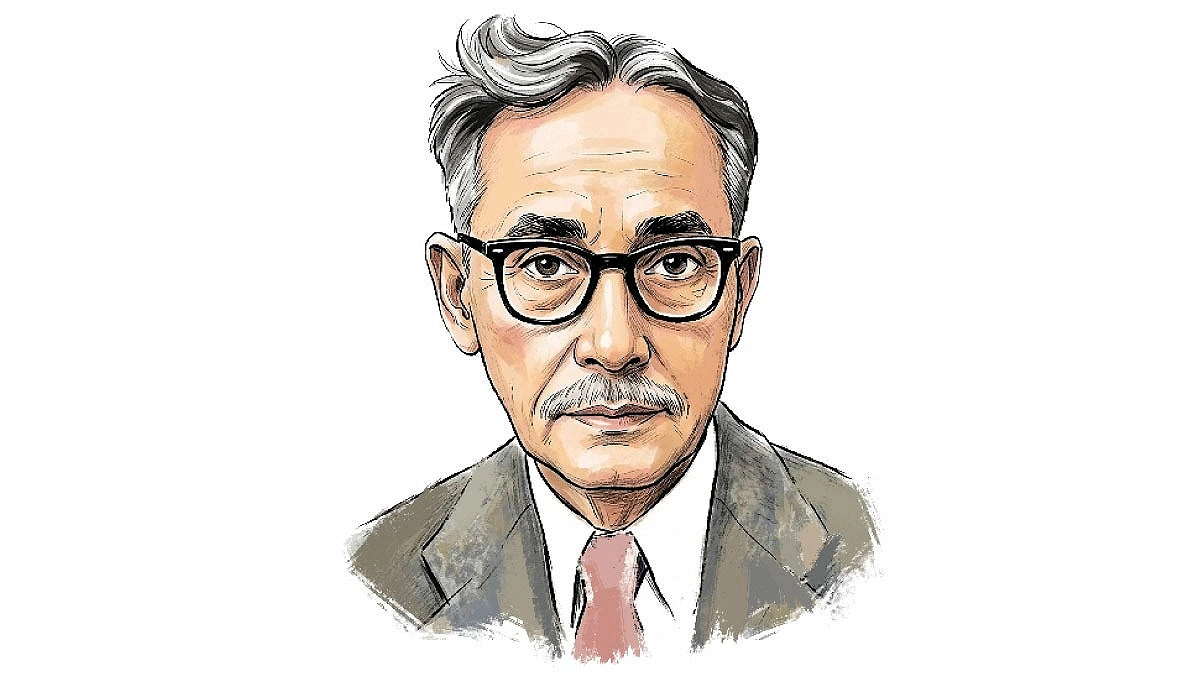
Muzaffar Ahmad (5 August 1889 – 18 December 1973). Agamir Somoy Graphics.
From the very beginning, Comrade Muzaffar stood tall with the red flag. Comrade Muzaffar Ahmad was one of the key founders of the Communist Party of undivided India and a pioneer of the communist movement. Born in a remote area like Sandwip in East Bengal, it is quite remarkable how deeply and consciously he became involved in political thought during his youth.
Although events like the partition of Bengal, the formation of the Muslim League, and the annulment of the partition occurred during his formative years, they did not create a significant stir within him. He viewed these events as a form of communal politics. Instead, he was more drawn to the boycott movement, the Swadeshi movement, underground organizations, and the call for armed struggle following the annulment of the partition. Raised in the financially strained household of a lawyer's assistant, Muzaffar possessed a sharp class consciousness. In 1913, he moved to Kolkata and enrolled in the IA program at Bangabasi College. However, after failing to pass, he left his formal education behind and dedicated himself to a life of struggle.
In 1917, the Bolshevik Revolution took place in Russia under the leadership of Lenin. Even before this, Muzaffar had begun participating in political meetings and rallies. At the inception of the Communist Party of India on 17 October 1920, he stood firm with the red flag. In the same year, Muzaffar Ahmad was nominated as a member of the Bengal Provincial Khilafat Committee. He joined the Khilafat movement driven by his anti-British sentiment. On 12 July of that year, he joined the newspaper Navayug as a joint editor, where he wrote features addressing various issues faced by working-class people.
On 15 May 1922, the first mouthpiece of the Communist Party was published under the title "The Vanguard of the Indian Independence." Towards the end of 1922, Muzaffar Ahmad met Comrade Abdul Halim, and together they took on the responsibility of organizing the Communist Party of India. During this period, he joined the working-class movement and gradually became involved with the Trade Union Congress. He was arrested on 17 May 1923. Shortly after, he was found guilty in the Kanpur Bolshevik Conspiracy Case and sentenced to four years of rigorous imprisonment. However, he was released after some time due to contracting tuberculosis. On 20 March 1929, Muzaffar Ahmad was arrested again in Kolkata after being accused in the Meerut Conspiracy Case.
This prominent founder of the Communist Party of India spent nearly 20 years in prison during the British and Congress regimes, yet he never compromised on his ideals. While imprisoned, he went on hunger strikes twice to demand better facilities for political prisoners. When public political activity was restricted, he chose the hazardous path of underground politics.
His success as an organizer was enviable. Muzaffar Ahmad had a clear understanding of party management, mass movements, and electoral dynamics. He possessed extensive knowledge of the works and lives of Marx and Lenin, and was thoroughly familiar with the country's existing laws and regulations. Consequently, he played a massive role in strengthening the Communist Party organizationally.
Between 1938 and 1940, under his leadership, branches of the Communist Party spread across 28 districts of undivided Bengal. Thousands of members began to join, and trade unions and peasant fronts (Kishan Sabhas) were established everywhere. From 1940 to 1943, Muzaffar Ahmad served as the secretary of the Bengal Provincial Committee of the party. Following the partition of India in 1947, Muzaffar Ahmad chose to remain in Kolkata.
The man who led the party throughout his entire life passed away in 1973.

