


Huge asteroid Apophis will zoom very close to earth

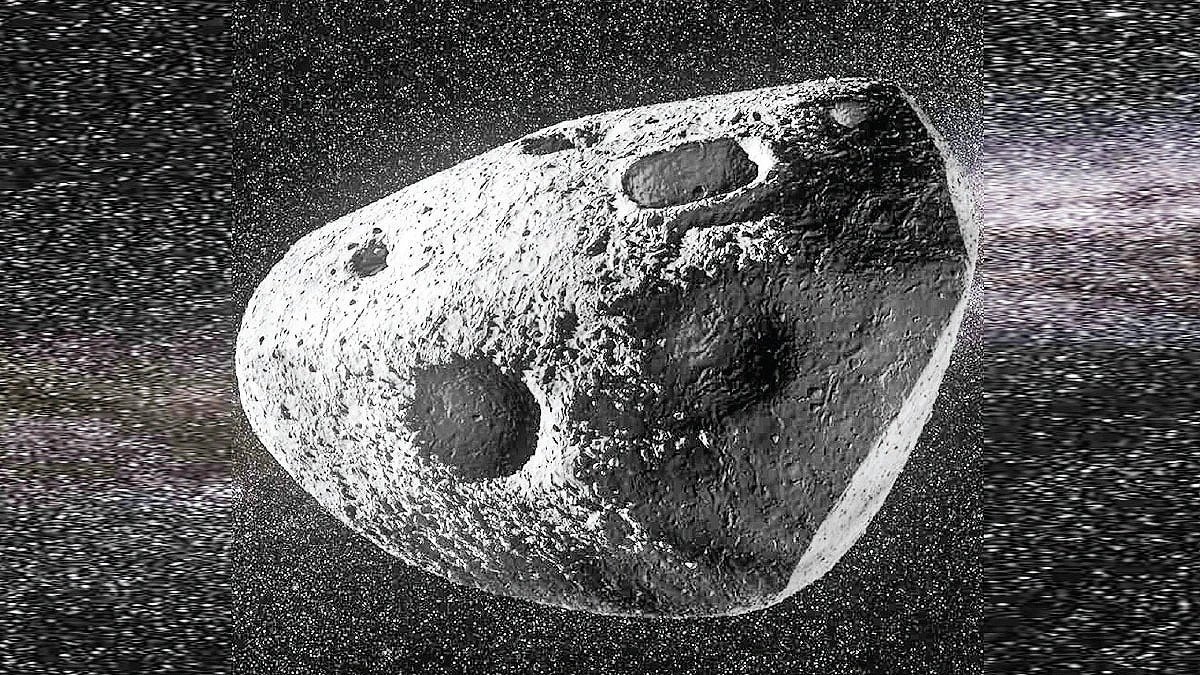
Collected Photo
Scientists are preparing to witness this rare cosmic event. But what could happen if human-made space debris drifts right into its path?
The clouds of concern surrounding the inbound cosmic visitor, asteroid 'Apophis', have thickened further. On April 13, 2029, this massive object, approximately 370 meters in length, is expected to sweep past Earth at an extremely close range. Scientists have already confirmed that the asteroid will not directly impact Earth during its passage, so there is currently no immediate fear of a catastrophic or large-scale destruction. However, a recent provocative study has brought forth a new cause for concern, raising furrowed brows among scientists worldwide.
A new study by researchers Giulia Scivipino and Alessandro Rossi from the Institute of Applied Physics of Italy's National Research Council (CNR) has been published in The Planetary Science Journal. Their intensive computer-based observations suggest that as Apophis passes near the geostationary orbit (GEO)—located about 36,000 kilometers above Earth's surface—the asteroid's path could be obstructed by invisible human-made debris in space. The researchers fear that during this long journey, small or medium-sized pieces of space junk could directly strike the asteroid's surface.
Defunct satellites, fragments of rocket stages, and various tiny metal pieces discarded by humans in space have now turned into a severe menace in high orbits. While larger objects can be tracked, scientists have limited knowledge about the actual number and location of smaller, invisible fragments. According to researcher Rossi, some of this invisible debris could pass so close to Apophis that the risk of an accidental collision simply cannot be ruled out.
Scientists have issued warnings about the potential consequences of such a collision. While Apophis may not veer toward Earth or undergo a dramatic change in its core trajectory, the impact would be far-reaching—and would require further investigation. For a long time, scientists from the European Space Agency's RAMSES mission and NASA's OSIRIS-APEX spacecraft have been preparing to study how Apophis's own motion, rotation, and surface are altered by Earth's powerful gravitational pull. However, if a collision with space debris occurs before the scheduled flyby, it could suddenly create craters on Apophis's surface or eject massive clouds of dust and rocks.
This would throw the entire research and observation process into extreme disarray. It would become impossible to determine the exact cause of these surface changes—whether they occurred naturally due to Earth's gravity, or as a result of a sudden, destructive collision with space junk. Years of meticulous preparation and calculations by scientists could be ruined in an instant, posing a severe risk.
Although researchers note that the density of objects in the geostationary region is low, so there is no fear of a chain-reaction catastrophe like the Kessler Syndrome, this event nonetheless highlights humanity's profound irresponsibility. Beyond Earth, we have now turned the high orbits of outer space into a dump of invisible debris, which is no longer under our control. While the European Union plans to launch a new space surveillance telescope in the future, the biggest fear now is whether our limited knowledge will bring about a major disaster before this cosmic rendezvous in 2029.

