
Why Messi became Messi


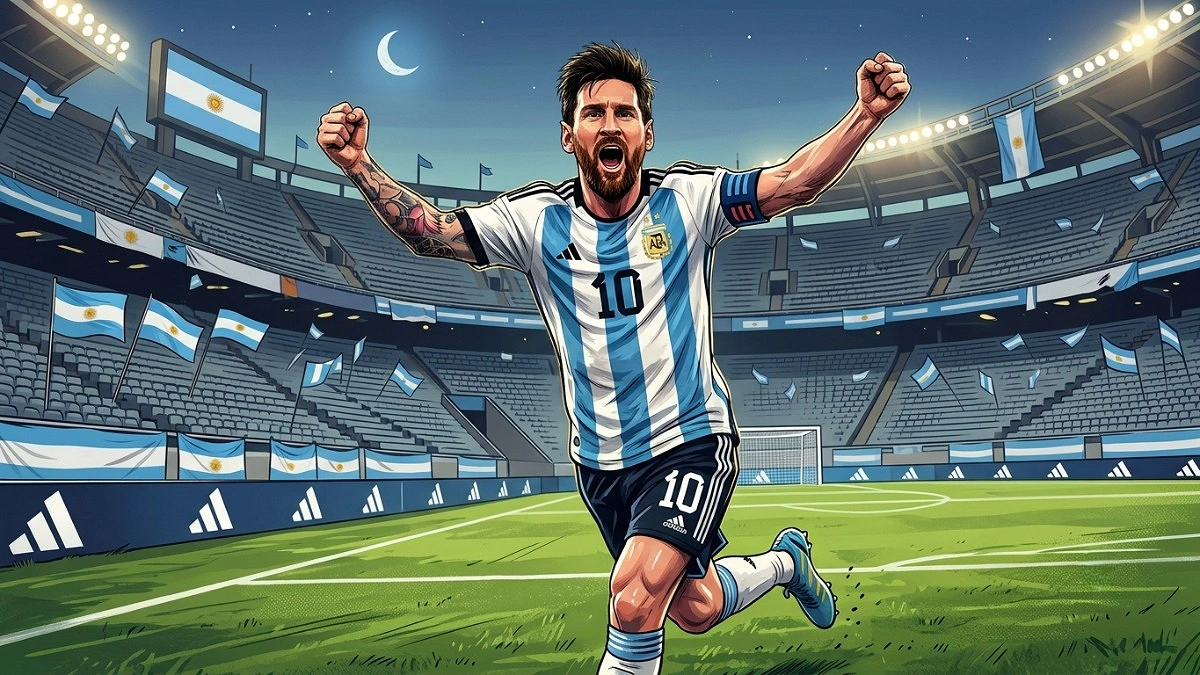
Picture: Generated by AI
There is a question that has followed Lionel Messi since he was barely tall enough to see over the advertising boards at Newell’s Old Boys, a question that never really goes away no matter how many trophies pile up in his cabinet. Why him? Why did a boy from Rosario, a modest city on the banks of the Parana River, grow into the player many now call the greatest to ever kick a football? The easy answers, talent, luck, timing, are not wrong, but they are not enough either. To understand why Messi became Messi, you have to look past the goals and the golden statues and into something quieter, something closer to character.
A Body That Almost Betrayed Him
Start with the part of the story that sounds like a cruel joke from the universe. At age eleven, Messi was diagnosed with a growth hormone deficiency. His body simply was not producing what it needed to grow at a normal rate. In a sport that has always prized height, strength and physical dominance, this could have been a career ending diagnosis before the career even began. His family could not afford the treatment on their own. River Plate, the biggest club in Argentina, showed interest but balked at covering the medical costs. It was Barcelona, thousands of miles away in Catalonia, that agreed to pay for his treatment and bring the family to Spain.
Picture that moment for a second. A thirteen-year-old boy, uprooted from everything familiar, his father sitting at his side in a foreign country, his medical bills being paid by a football club that was betting on a scrawny kid nobody could be sure would ever grow into his talent. This is often where people stop the story, treating it as a nice footnote before the trophies begin. But it deserves more attention than that, because it planted something in Messi that never left him. An outsider’s hunger. A sense that nothing was guaranteed, that the ground could shift under him at any moment, and that he had to prove himself over and over simply to stay in the picture.
Contrast this with a player like Cristiano Ronaldo, whose early struggles were more about proving his physical dominance in a macho dressing room culture in Portugal, not about literally growing enough to compete. Messi’s obstacle was biological, almost existential. He was not fighting to be the biggest presence in the room. He was fighting just to be present at all.
The La Masia Effect
Barcelona’s famed academy, La Masia, gets credited constantly in football writing, sometimes to the point of cliche. But it matters here because of what it did not do. It did not try to make Messi bigger, stronger or more physically imposing. Instead, the coaching philosophy at Barcelona in that era, shaped heavily by the ideas of Johan Cruyff, valued positioning, first touch, spatial awareness and quick combination play over raw athleticism.
This was, in effect, a system built for a player exactly like Messi. If he had been developed within a footballing culture that prized long balls, physical duels and aerial dominance, his gifts might have been seen as a weakness rather than a strength. Instead, La Masia gave him a canvas where his low center of gravity, his ability to change direction in an instant and his extraordinary close control were treated as gold.
There is a lesson buried here that goes beyond football. Talent does not exist in a vacuum. It needs an environment that recognizes and nurtures its particular shape. Messi in a different system, at a different time, might have been a good player. At Barcelona, in that specific footballing philosophy, he became something the sport had never quite produced before.
The Practice Nobody Sees
Football fans love the mythology of natural talent, the idea that some players are simply born touched by magic. It makes for a better story than the truth, which is less romantic and more mundane. Messi’s teammates and coaches, over decades, have described a player obsessed with repetition. Free kicks practiced long after training sessions ended. Specific movements, like his signature drop of the shoulder before cutting inside on his stronger left foot, rehearsed thousands of times until they became less like decisions and more like reflexes.
Xavi Hernandez, his former teammate and later his coach, once described watching Messi train and noticing that he would run the exact same sequence of movements dozens of times in a row, adjusting by centimeters each time. This is not the profile of a man coasting on gifts. This is the profile of a craftsman.
It is worth pointing out something uncomfortable about how sports media often frames this. Genius is frequently treated as something that arrives fully formed, almost by accident, when in reality nearly every transcendent athlete has a private relationship with tedium that the public never witnesses. Messi’s brilliance on matchday is the visible tip of an enormous, boring, repetitive iceberg that nobody puts on television.
Silence as a Weapon
One thing that separates Messi from almost every other athlete of his caliber is his temperament. He does not perform anger. He rarely engages in the trash talk, staged rivalries or manufactured feuds that dominate modern sports coverage. For years, critics in the media, particularly in Spain, used this as a stick to beat him with, suggesting his quietness meant he lacked the killer instinct or leadership qualities of a Ronaldo or a Diego Maradona.
This criticism, in hindsight, misunderstood what it was looking at. Messi’s calm is not passivity. It is a kind of discipline, an ability to keep his emotional temperature level regardless of the noise around him, the provocations from opposing defenders, or the pressure of a World Cup final. Watch him during a match and you rarely see wasted energy on histrionics. The energy goes entirely into the game itself.
This matters because football, more than most sports, punishes emotional volatility. A player who spends mental energy on frustration, revenge or ego has less left over for the split-second decisions that actually decide matches. Messi’s temperament, so often mischaracterized as a weakness, was quietly one of his greatest competitive advantages.
The Weight of a Nation
For years, there was a specific and painful narrative surrounding Messi in Argentina. He was seen by some as more Catalan than Argentine, a player who had given his best years to Barcelona while somehow falling short with the national team. He lost finals. The 2014 World Cup final against Germany. The 2015 and 2016 Copa America finals against Chile, both lost on penalties. After the second Copa America loss, an emotionally exhausted Messi announced he was retiring from international football altogether.
Argentina, a country that treats football with something close to religious devotion, did not let him disappear quietly. There was public outcry, government officials pleading with him, ordinary fans writing open letters begging him to reconsider. He came back. This detail matters enormously to understanding who he is. Messi was not obligated to return. He had nothing left to prove at club level. But something pulled him back into a fight he had already lost multiple times.
The redemption arc that followed reads almost too neatly for reality. In 2021, Argentina won the Copa America, beating Brazil in the Maracanã, the first major trophy of Messi’s international career. Then in Qatar in 2022, Argentina won the World Cup, with Messi delivering arguably the finest individual tournament performance in the competition’s history, culminating in that extraordinary final against France, a match that swung wildly back and forth before Argentina won on penalties.
What makes this chapter so central to the question of why Messi became Messi is not the trophy itself. It is what the pursuit of it revealed. Here was a man in his mid-thirties, already wealthier and more decorated than almost any athlete in history, still willing to absorb years of public doubt and personal disappointment in pursuit of something that meant more to him than personal glory. That willingness to keep showing up after repeated failure is not a talent. It is a choice, made over and over.
The Myth of Effortlessness
Football commentary loves the word effortless when describing Messi. It is meant as a compliment, and in a sense it is deserved, since few players in history have made such difficult skills look so unforced. But the word can also be misleading, because it implies that what Messi does requires no strain, no cost, no sacrifice.
The truth is more complicated. Messi has spoken in interviews about carrying anxiety before big matches, about the exhaustion that comes from being scrutinized every single time he touches the ball, about the specific pressure of representing an entire country’s hopes on his shoulders during international tournaments. The calm exterior fans see on the pitch coexists with an internal experience that is anything but effortless.
There is something almost unfair about how this gets framed publicly. Because he makes it look easy, people assume it is easy for him, and that assumption strips away the credit he deserves for managing pressure that would break most people. The elegance is real. The ease is a performance built on top of enormous internal work.
Luck and the Refusal to Waste It
No honest account of why Messi became Messi can ignore the role of luck. He happened to be born in an era where sports science, video analysis and nutrition had advanced enough to extend athletic careers deep into a player’s thirties, something earlier generations of footballers did not have access to. He happened to land at a club with the financial resources and philosophical alignment to nurture his particular gifts rather than discard them. He happened to have parents who supported the difficult decision to move a young family across an ocean for medical treatment and football opportunity.
Luck matters, and pretending otherwise does a disservice to the countless equally talented children around the world who never got a comparable break, whose growth hormone deficiencies were never treated, whose talent was spotted by clubs without the resources or philosophy to develop it properly. Messi himself has acknowledged this in interviews, expressing gratitude rather than entitlement about the opportunities that shaped his path.
But luck alone explains why an opportunity existed. It does not explain what Messi did with it. Thousands of players have received good breaks and squandered them through complacency, poor discipline or an inability to handle expectation. What separates Messi is that every lucky break in his story was met with an almost monastic level of preparation and commitment that made the most of it.
What the Numbers Cannot Capture
It has become common in football discourse to reduce greatness to statistics, and Messi’s numbers are staggering by any measure, more goals, more assists, more trophies, more individual awards than nearly any player in the sport’s history. But numbers, however impressive, cannot fully explain the why behind this piece.
What the statistics miss is the specific texture of watching him play, the way defenders seem to lose track of where he is even when they are staring directly at him, the way he can slow the game down to his own private tempo while everyone else is moving at full speed, the way a stadium of eighty thousand people can hold its breath collectively the moment the ball reaches his feet in a dangerous area. This is not something a spreadsheet can quantify, and it is arguably the truest measure of what separates a great player from a transformative one.
A Human Answer to a Mythical Question
So why did Messi become Messi. Not because he was chosen by fate, not because talent alone carried him there, and not simply because a football club took a chance on a sick child from Rosario, though all of that is part of the story. He became Messi because a series of very human choices, discipline in practice, emotional restraint under pressure, the willingness to return to a fight he had already lost, and gratitude rather than entitlement toward the opportunities he received, combined with circumstances that could easily have gone differently.
There is comfort in that answer, even if it is less romantic than the idea of a chosen one blessed by the football gods. It means his greatness was built, not merely granted. It means somewhere in Rosario or Dhaka or anywhere else in the world, another child with an obstacle in their path, whether physical, financial or circumstantial, might still find their own version of that path forward, not through magic, but through the same unglamorous combination of support, environment and refusal to quit that turned a small boy with a hormone deficiency into the player an entire generation will measure every future footballer against.
That, in the end, is a far more interesting story than the myth. It is not about a miracle. It is about a boy who almost did not get the chance to grow, who found people willing to bet on him anyway, and who spent the rest of his life making sure that bet paid off, one repetition, one quiet decision, one return from disappointment at a time.


