

Actors Rules the South, Not Leaders

Collected Photo
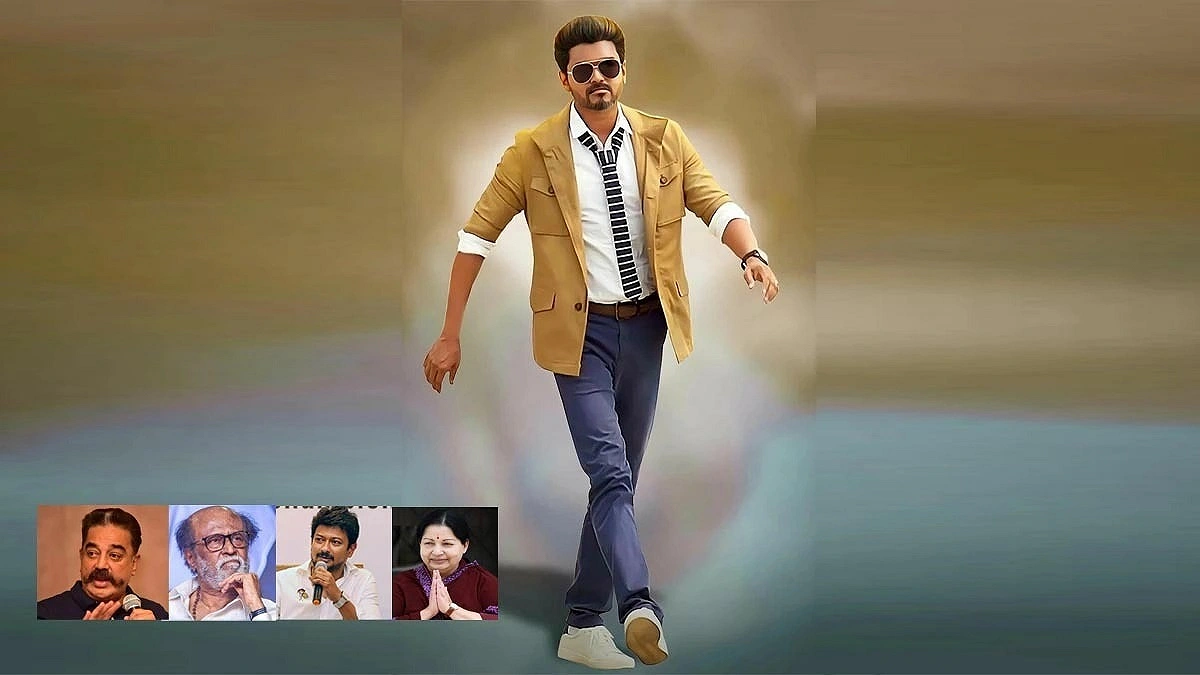
The interplay between Tamil Nadu politics and movie stars has always been a spectacle. It is like an inseparable bond. In this southern Indian state, there is a long history of using cinema’s popularity as a tool to capture political power. The silver became a major medium for promoting political ideology since the 1940s and 1950s, during the Dravidian movement. The latest example of this trend is actor Thalapathy Vijay.
Fans often regard film heroes as real-life saviors, given their portrayal of helping people in times of crisis. Building on this belief, generations of Tamil actors have been drawn to politics. Analysts believe this trend has become even stronger in the political landscape of 2026.
Megastar Vijay is the newest member of this actor-turned-politician club. Just before the announcement of Tamil Nadu election results, opinion polls suggest a possible win for the ruling DMK. Vote counting is underway in all 234 constituencies of Tamil Nadu. The ruling Congress and Left-backed DMK alliance is leading in 56 seats, while the AIADMK is ahead in 72 seats. Vijay’s newly formed party, Tamilaga Vettri Kazhagam (TVK), is reportedly leading in 80 seats.
As a result, actor Vijay is on the path to becoming a new political hero in southern India. This journey began with legendary M.G. Ramachandran (MGR), who left the DMK in 1972 to form AIADMK and served as Chief Minister of Tamil Nadu from 1977 until his death.
Stars like Jayalalithaa later rose to political prominence by using their cinematic popularity. She entered politics in 1982 and served as Chief Minister six times between 1991 and 2016. Actor Sivaji Ganesan was also active in politics but did not achieve the same success as MGR.
Later, in 2005, actor Vijayakanth formed his own party, DMDK, and became the leader of the opposition in the 2011 elections.
Now, the latest major surprise in this trend is superstar Thalapathy Vijay. He officially announced his political party, Tamilaga Vettri Kazhagam (TVK), in February 2024. Focusing on the 2026 state elections, he has fully shifted his attention to politics, even deciding to quit acting at the peak of his career.
Tamil Nadu’s assembly elections were held on April 23, and there is now intense anticipation ahead of May 4, when the results will be declared. Exit polls have already sparked widespread discussion.
The biggest surprise comes from Axis My India, which predicts that Vijay’s party could win between 98 and 120 seats in its debut election, while the DMK alliance may secure 92 to 110 seats. It is believed that a large share of young and educated voters have shifted toward Vijay. If this prediction holds true, it could mark the beginning of a new political era in Tamil Nadu.
However, three other major surveys suggest that the DMK alliance will form the government, though with fewer seats than before.
If no party crosses the majority mark of 118 seats, Vijay could emerge as a “kingmaker.” Exit polls suggest he may win around 10 to 30 seats, making his support crucial for government formation. In a hung assembly, Vijay could hold the key to deciding the next Chief Minister of Tamil Nadu.
Tamil Nadu’s current Deputy Chief Minister Udhayanidhi Stalin entered active politics in 2019 and took on a major administrative role in 2024. Veteran actor Kamal Haasan formed his party, Makkal Needhi Maiam, in 2018 and remains politically active. Actor Sarathkumar also formed a party that later joined larger alliances, while actor-director Seeman founded Naam Tamilar Katchi in 2010, building a Tamil nationalist political identity.
The attraction of Tamil cinema stars toward politics is largely linked to a leadership vacuum over the past few decades. After the deaths of Jayalalithaa in 2016 and Karunanidhi in 2018, a strong charismatic leadership gap emerged in Tamil politics.
Although Rajinikanth hinted at entering politics several times since the 1990s, he eventually withdrew ahead of the 2021 elections due to health reasons. Still, new figures like Vijay and Seeman show that the connection between cinema and politics remains strong. Actresses like Khushbu Sundar and Gautami have also been active in politics since the 2010s.
Hence, in the South, actors often end up becoming the real political leaders.

