
A 50-Year-Old Telephone Office in Banshkhali

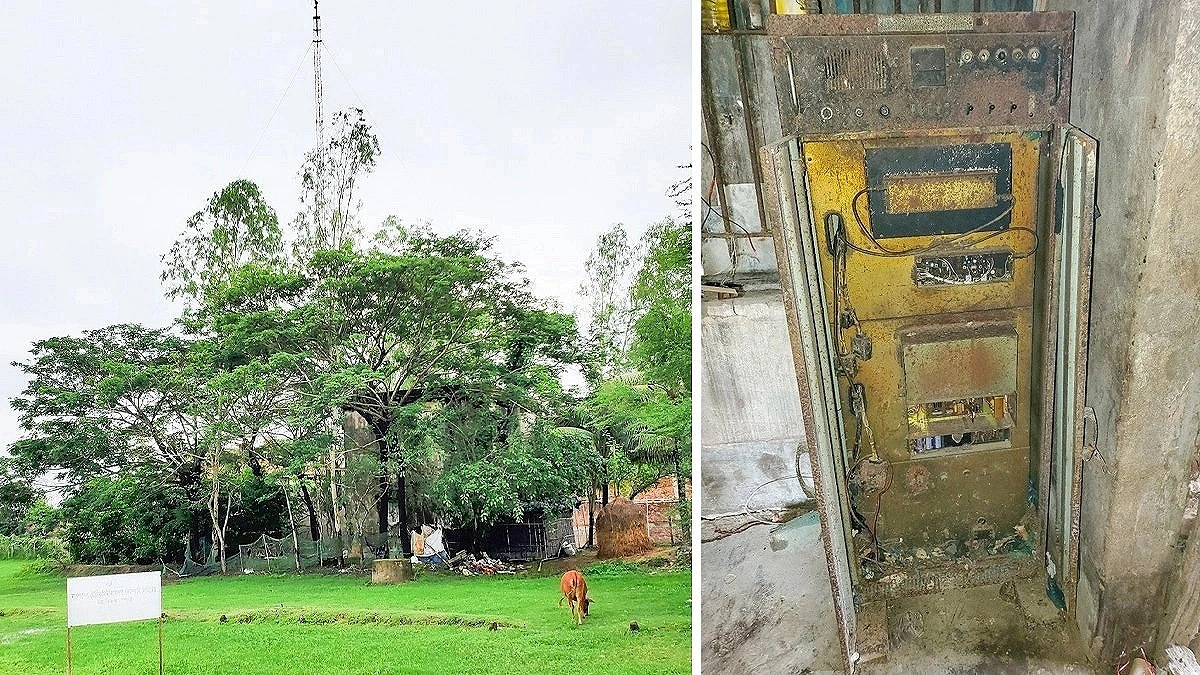
Photo: Agamir Somoy
Khasmahal, a village in Gunagari Union of Banshkhali Upazila, lies about 40 kilometers from Chattogram city. The Kodala canal, which originates from a hill stream in the area, flows westward through Khasmahal. A paved road runs along the canal’s bank. Traveling five kilometers west along that road brings visitors to Mosharraf Ali Mia’s Market. Just beyond the market, a massive lattice tower rises above the surrounding greenery, its directional antenna mounted at the top.
Right beside the tower stands a dilapidated two-story building covered in moss. Inside, a heavy iron machine lies abandoned, blanketed in dust and rust. The relentless advance of technology has rendered it obsolete. Yet the machine still seems to stand as a reminder of its glorious past. In technical terms, it is known as a VHF radio link. To today’s generation, accustomed to 5G smartphones, the rusting iron cabinet may hold little significance. But from the 1970s until the early years of the twenty-first century, this machine served as the sole lifeline for long-distance communication and vital information across this coastal region along the Bay of Bengal.
McNamara’s Secret Documents and the World Bank’s ‘Cyclone Project’
Behind this ordinary lattice tower and rusting cabinet lies the story of a historic international initiative. A review of declassified official documents from the World Bank and the International Development Association (IDA) shows that, in a highly confidential report dated September 19, 1972, then World Bank Group President Robert S. McNamara recommended a special loan package of US$25 million for Bangladesh to the institution’s executive directors.
The document, titled Report No. P-1120, stated that just 60 days after the devastating Bhola Cyclone of November 12, 1970, authorities approved a loan under ‘Credit No. 228-PAK’ to support the reconstruction of the then East Pakistan’s coastal areas. However, the war imposed by the Pakistani military in 1971 and Bangladesh’s War of Liberation prevented the project from moving forward. After independence, the government of Bangabandhu Sheikh Mujibur Rahman requested the World Bank in 1972 to revive the abandoned project. In light of the prevailing circumstances, planners shifted the project’s focus from rehabilitation to cyclone protection and the establishment of an improved communication system for disaster response.
The project allocated US$5.61 million to the telecommunications component. Its primary objective was to establish 22 wireless base stations, 100 Public Call Offices (PCOs), and a 300-channel microwave and radio-link network connecting Chattogram and Cox’s Bazar in communication-deprived coastal areas. The Banshkhali station was one of those 100 Public Call Offices.
From Tokyo to Banshkhali: A Birth Certificate Engraved in Iron
Under the World Bank-funded initiative, the task of building a communication system to help save lives along the coast went to the globally renowned Japanese technology company Fujitsu Limited. Another Japanese industrial giant, Suda Seisakusho, secured the contract to manufacture the tower’s steel structure.
Even today, one of the tower’s iron beams in Banshkhali proudly preserves what could be described as its ‘birth certificate’, a tangible record of its origin. Beneath layers of moss and dark stains, a precise Japanese engraving remains clearly visible, ‘25m triangular tower, date of product: Dec 1974, Manuf: Suda Seisakusho, Fujitsu Limited (Tokyo, Japan)’. The inscription confirms that Japanese engineers erected the 25-meter tower on the soil of Banshkhali in December 1974 as part of the logistics infrastructure of the World Bank’s life-saving coastal communications project.
Only One Telephone Line for the Entire Coast!
Today, the ground floor of the building lies in near-total darkness, damp and neglected. In one corner sits a heavy yellow iron cabinet, buried beneath a thick layer of dust. This is the Fujitsu analog radio-link terminal.
In those days, when people came to the exchange to place long-distance trunk calls, the voice signal would travel from the main exchange through cables into this Fujitsu cabinet. The equipment inside converted human speech into radio waves and transmitted the signal through a thick cable to the antenna mounted atop the tower. The antenna then beamed the signal through the air directly to the main station in Chattogram. In an era when modern networks process millions of calls every second, this entire setup had the capacity for only a single voice channel. In other words, only one telephone line served the entire coastal region of Banshkhali at any given time. Only one person could make a long-distance call at a time. Others had to wait for an ongoing call to end, whether it carried urgent news, emotional moments, or laughter, before they could access the line.
Shouting to Be Heard, Waiting Days for a Line
Officials and operators of the Bangladesh Telecommunications Company Limited (BTCL) still refer to it as the ‘1970 Cyclone Project.’ Mohammad Didar Faruk, who worked at the station as a wireless operator for a total of 20 years in two separate stints between 1984 and 2007, recalled those days. “Authorities established this PCO after the 1970 cyclone killed hundreds of thousands of people,” he said. “Whenever a cyclone struck during the 1980s or 1990s, this single rusting cabinet kept the whole of Banshkhali connected to the rest of the country. We tuned the frequencies by turning the rotary knobs on the cabinet and transmitted all emergency and administrative messages during disasters. Back then, people often had to wait up to four days to get a telephone line to Barishal or other parts of the country.”
People could also send telegrams from this office. Sending a one-word telegram cost 20 paisa. The walls of the aging building still carry memories of the analog era, when people waited for hours to get a telephone call connected.
Ansarul Alam Chowdhury, a local elder and former Union Parishad member, said, “Nobody carried mobile phones in those days. If a relative called from Dhaka or abroad, the message would first arrive at this office. The office peon would come to our homes to inform us, and we would rush to the building. The line was extremely noisy and crackled constantly, so we had to shout to hear one another. Today, when I see my grandchildren making video calls on mobile phones, this abandoned building and tower seem like something out of a fairy tale.”
A Plea to Preserve It Before It Is Sold as Scrap Metal
Modern microwave systems, optical fiber networks, and 5G mobile towers have replaced VHF radio links. As a result, this Public Call Office, established in 1974, no longer has any commercial use in Digital Bangladesh in 2026. Yet while it has lost its technical relevance, its historical and commemorative value remains immense. Vegetation now surrounds the building, while the valuable copper wiring and equipment inside remain vulnerable to theft. At any time, authorities could classify it as abandoned scrap and sell it by weight through routine government procedures.
Prabal De, a collector with four decades of experience, said many countries preserve such early telecommunications facilities and first-generation machines as telecom museums under state initiatives. “This is not merely a piece of iron machinery,” he said. “It is a historical monument. Preserving it is absolutely essential.”
Asked about the matter, Mohammad Ahidul Islam, Deputy General Manager of BTCL’s Chattogram Telecommunications Region, said, “We own about one and a half acres of land at the site. Since the Public Call Office ceased operations, the facility has remained abandoned. We are fencing off the area to preserve it. We do not have a telecom museum. Nevertheless, if we receive instructions, we will preserve the machine.”
