Chittagong and Cox's Bazar
Flood destroys Tk 140 crore worth of vegetables, Chittagong relies on North Bengal

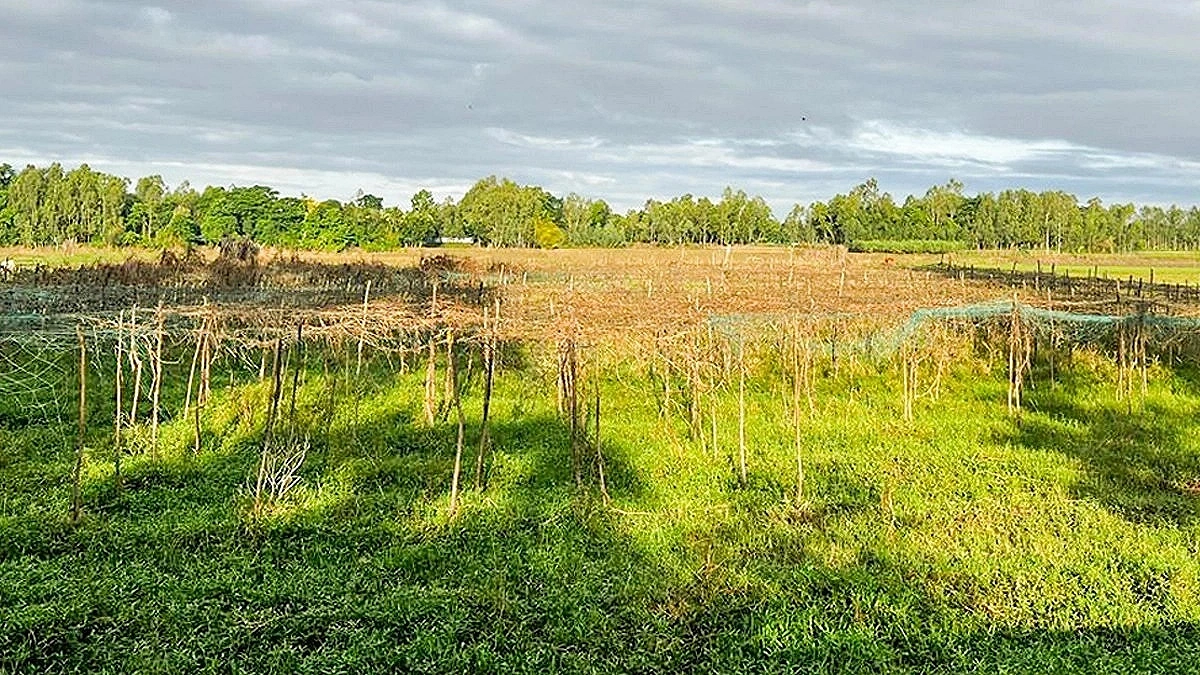
Trellis without any vegetable at a Chattogram location that submerged under water a few days ago. Photo: Agamir Somoy.
The vegetable fields in Chittagong and Cox’s Bazar have been completely destroyed by the floods. There are no vegetables left in the fields. For the past week, North Bengal has been meeting the vegetable demand of this region, forcing consumers to buy at higher prices. Farmers have said that if the weather remains favourable, it will take at least two months for new vegetables to get harvested. Until then, the people of Chittagong will have to depend on vegetables from northern part of the the country.
According to the agriculture department, the floods damaged vegetable production on 9,208 hectares of land in the Chittagong and Cox’s Bazar areas, affecting a total of 56,730 tonnes of vegetables—worth approximately Tk 140.82 crore. Some 73,875 farming families have been affected in this sector. In other words, over 56,500 tonnes of vegetables perished in the fields—enough to supply Chittagong for at least two months.
Md. Ali Jinnah, an agricultural scientist and additional director of the Chittagong Regional Agricultural Extension Directorate, said, “We have sent the damage assessment to the ministry for compensation. We are waiting for approval.”
With the fields wiped out, vegetable prices have soared in retail markets from the wholesale hubs of Chittagong and Cox’s Bazar. At the Riazuddin Bazaar wholesale market in the port city, the cheapest vegetable is papaya, at Tk 22 per kg, while the most expensive is ridge gourd at Tk 100 per kg.
Other wholesale prices include: brinjal Tk 80, pointed gourd Tk 50, bottle gourd Tk 40, snake gourd Tk 35-40, taro flower Tk 35, yardlong beans Tk 90, okra Tk 70, bitter gourd Tk 80, spiny gourd Tk 90, ridge gourd Tk 100, taro stalks Tk 50. Tomatoes imported from India sell for Tk 100 per kg, and chillies for Tk 200. Lettuce leaves, normally Tk 200 per kg, are now being sold at Tk 1,600. Onion leaves, priced at Tk 150, were seen selling at Tk 400. In retail markets, vegetables are being sold at 1.5 to 2 times the wholesale price.
Nasir Uddin, owner of Ekota Traders at Riazuddin Bazaar, said, “Over the past week, vegetable supply has dropped by half. No vegetables are coming from Chittagong or Cox’s Bazar. North Bengal vegetables are now meeting Chittagong’s demand, which has driven prices up. We don’t know how long this will continue.”
At the Riazuddin Bazaar wholesale market, two types of vegetables arrive: from Chittagong, South Chittagong, and Cox’s Bazar’s Chakaria-Pekua areas—these are fresh, slightly more expensive, and tastier; and the rest come from North Bengal, known as "line vegetables", which are cheaper. Previously, only 60 trucks of vegetables came daily from North Bengal to the wholesale market; that has now halved to 30 trucks—equivalent to 450 tonnes. Besides that, vegetables from South Chittagong, surrounding upazilas of Chittagong, and Chakaria-Pekua used to come in trucks carrying 1–3 tonnes, amounting to about 250 tonnes per day. That entire supply has stopped, which is the main reason for the price surge.
The vast vegetable fields of Kakara Union in Chakaria Upazila are now submerged by the floods, with only the trellises visible. Farmer Abu Taher said, “If we plant today, it will take 50 days to get a harvest—provided there is no more flooding and the weather remains favourable. But we don’t even have seedlings ready to plant today. So, after planting seedlings, it will take two months for vegetables to reach the market.”
Previously, vegetables from Chakaria and Pekua also supplied Cox’s Bazar; now North Bengal vegetables are meeting their demand as well.
Mostafa Zaman Kharech, a professor at Pekua Shaheed Ziaur Rahman Coastal College, said, “It will be difficult for the 73,875 severely affected farming families to recover unless we ensure seeds, seedlings, agricultural inputs and financial incentives. Without that, overcoming this crisis will be tough.”