

Says Farida Akhter
'The government is essentially a large NGO'

Graphics: Agamir Somoy
Farida Akhter, a writer, researcher, and activist, most recently served as an advisor to the interim government in the Ministry of Fisheries and Livestock. She sat down with Agamir Somoy to discuss her experiences and the challenges of balancing field-level activism with the government's policymaking. The interview was taken by Sayeed Jubary.
Agamir Somoy: What differences did you observe between your dual roles as a field activist and a government policymaker?
Farida Akhter: That is an excellent question. When working at the field level, our primary role is to review government policies. While working with farmers, we monitored whether government policies were actually benefiting them. If they weren't, we raised demands. Fieldwork generally takes two forms. One is real activism, which involves identifying the government's flaws and pointing out what should not be done. The other involves organizing—that is, mobilizing the affected individuals or real stakeholders to demonstrate alternative, viable solutions that serve the public interest. We were accustomed to this second approach. When I took charge of the Ministry of Fisheries and Livestock, my past experiences proved to be highly useful.
Agamir Somoy: What kind of realities did you encounter at the ministry, and what changes did you try to bring about?
Farida Akhter: I observed that under the pretext of increasing production, milk, or meat, crossbred varieties were being imported from abroad. This caused severe damage to our indigenous breeds. In the fisheries sector, aquaculture or farmed fish now accounts for over 60 percent of the total output. However, the problem lies in the feed used, which contains mixtures of antibiotics and other substances harmful to human health.
Since these issues were on my mind, I tried to revive interest in native breeds. On the positive side, our researchers agreed with this direction. Both the Department of Fisheries and the Department of Livestock Services formally accepted the policy. Although I could not complete the work fully, I was at least able to demonstrate that the demands we used to raise from the outside can indeed be implemented from within the government.
Agamir Somoy: What were the political, administrative, or bureaucratic limitations in implementing these policies?
Farida Akhter: A section of the bureaucrats I worked with understood the issue, though I would not say everyone did. It remains to be seen whether they have upheld these policies after my departure.
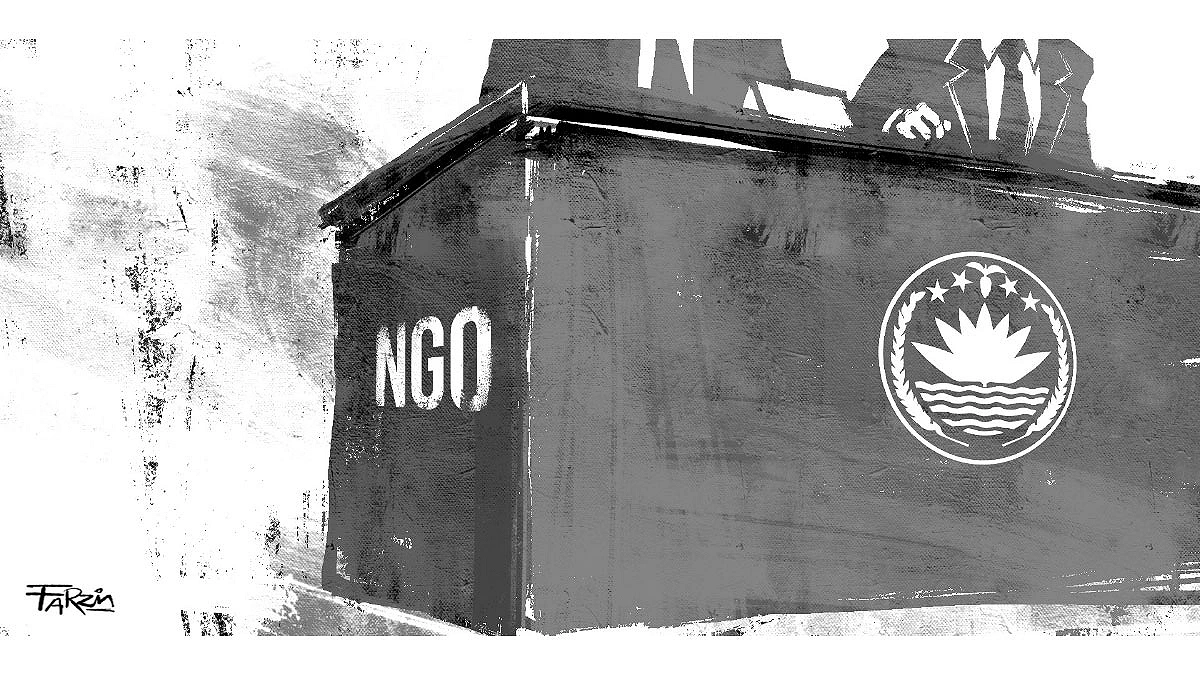
The reality is that I formed a strong impression: the government is essentially a large NGO. It is not that the government does everything according to its own will. Behind a political facade, they also look toward the World Bank or the ADB and adopt their policies. Regarding administrative limitations, whenever I proposed adopting a specific policy, numerous bureaucratic hurdles were brought forward—such as the need to hold stakeholder meetings, consult with upazila administrations, and so on. In my own organization, if I make a decision today, I can implement it tomorrow; but that is not possible in the government. Within this prolonged delay, governments often change, and the entire process goes back to zero.
Agamir Somoy: Which initiatives do you feel you successfully initiated or completed?
Farida Akhter: I was able to accomplish a few things successfully. For instance, establishing the importance of the indigenous Black Bengal goat and native cattle breeds. The current authorities are trying to sustain the initiative regarding the Black Bengal goat.
Additionally, we brought about a major shift in the poultry policy. Previously, due to the pressure of commercial farming (broiler or layer), rural women were discouraged from rearing native chickens. We integrated provisions for keeping native poultry within "family farms" right into the policy framework. We also worked on ensuring feed safety and stopping the use of antibiotics in feed, which is currently ongoing and has created widespread awareness. Another significant achievement involves the leasing of water bodies (jolmohal). We pushed the water body policy forward, which has now led to the declaration of open water bodies. Seeing this makes me feel very good.
Agamir Soomoy: During your tenure, there was a proposal for a fresh-water Hilsa farming (artificial Hilsa) project with assistance from Denmark, which you turned down. Word is out that India has achieved success in fresh-water Hilsa farming. Why did you oppose this project?
Farida Akhter: This issue needs to be understood very clearly. The Hilsa is a migratory fish. It travels from the sea to rivers like the Padma and Meghna to spawn and grow. This silver-colored fish holds a distinct taste and heritage. I believe attempting to turn it into an artificial or farmed fish is a form of injustice. It compromises the genetic diversity of the fish. Hilsa is a Geographical Indication (GI) product of Bangladesh. Doing this through hybrid or artificial methods will destroy its GI status. Why should we produce artificial Hilsa? What India or other countries did is not our concern. Hilsa is a part of Bangladesh's identity.
Secondly, that project did not follow any proper procedure in entering Bangladesh. They suddenly announced they would implement this project in Chandpur. They cannot just launch any project they please simply because they are funding it; this is a matter of national policy. I believe that to let Hilsa remain Hilsa, we need dredging, pollution control, protection of juvenile Hilsa (jatka), and proper food assistance for fishermen during the ban period meant to protect mother fish. If we address these comprehensively, there will be no shortage of Hilsa.
Agamir Somoy: But how do you view the argument that common people could not eat Hilsa at a lower price?
Farida Akhter: The plight of the poor should not be used as an excuse everywhere like this. The fisherman who catches Hilsa is also a poor person. You cannot ruin a country's traditional, natural fish species under the pretext of providing protein to the urban poor and middle class. Does this mean you will feed artificial Hilsa to the poor while the rich enjoy the authentic Hilsa? Why should there be such a divide?
If we can increase the natural supply of Hilsa, everyone will be able to eat the natural fish. Similarly, regarding beef, it is argued that importing meat from Brazil would allow poor people to buy it for 300 Taka. However, this would destroy the livelihoods of our local farmers. This issue cannot be resolved without looking at the bigger picture. Hilsa is a seasonal fish and a part of our culture. There are plenty of other opportunities to increase the supply of alternative fish varieties.
Agamir Soomoy: While working at the field level, you encountered certain issues that felt most urgent. Once in government, were you able to address any of those?
Farida Akhter: I deliberately chose not to drag all of my past work into the ministry and maintained a certain distance. However, based on my field experience, I was well aware of the harmful effects of pesticides. Even though I was heading the Ministry of Fisheries and Livestock, I noticed that pesticides were causing extensive damage to fish and the wetland (haor) regions.
Consequently, we launched a joint initiative involving the Ministry of Agriculture, the Ministry of Water Resources, and the Ministry of Fisheries and Livestock. Committees were formed at both national and district levels to regulate or limit the use of pesticides in Boro rice cultivation within the haor areas. This was a direct, positive outcome of my field experience. Because I knew the reality firsthand, it was possible to hold a dialogue with the then Agriculture Secretary and Adviser, and they took the matter very seriously.
Agamir Somoy: Sitting inside the ministry, what did you see as the root causes or the invisible barriers behind the so-called "syndicate" in the egg, broiler chicken, or feed markets?
Farida Akhter: What we call a "syndicate" from the outside takes a slightly different form on the inside. The production of eggs or day-old chicks, as well as the parent stock, is controlled by just a handful of large corporations. It is essentially an oligarchic system. Beneath them are thousands of small and medium-scale farmers who are entirely dependent on these large companies. As a result, the corporations dictate the prices.
On the flip side, these corporations face their own set of challenges, such as taxes on feed import or complications with the Ministry of Commerce. My experience in government made me realize that this is not a straightforward issue where the syndicate breaks the moment I demand it. It is a complex cycle. While we at the Ministry of Livestock might argue for controlling egg prices or state that importing eggs would hurt local farmers, the Ministry of Commerce would advocate for egg imports to stabilize the supply for regular consumers. This inter-ministerial push and pull is constant. Nonetheless, during my tenure, I managed to leave behind a poultry policy that protects the interests of small-scale farmers and imposes some regulation on the big players. In reality, the primary power and tools to break a syndicate rest heavily with the Ministry of Commerce.
Agamir Somoy: What kind of challenges did you face when it came to law enforcement?
Farida Akhter: We have no shortage of laws, but not all of them are up to date. We had to amend two or three laws, including the Fisheries Act. Previously, many fisheries officers could not take action due to a lack of specific legal authority. For example, fish were being caught using electric shocks in the haor areas. When I instructed the officers to take action, they replied, "Madam, electric shocking is not specifically mentioned in the Fisheries Act. If we try to detain them, they confidently point out the legal loophole." Later, we amended the law to explicitly ban catching fish with electric shocks.
Similarly, many laws related to livestock are incomplete. However, the most crucial factor is that if the correct directives do not come from the ministry itself, nothing gets done. There was no room for lobbying here. Our country has various lobby groups, and many came to me as well. But I did not compromise my principles for any of them.
Agamir Somoy: What kind of lobby groups approached you? Can you share any specific examples?
Farida Akhter: For instance, a major lobby group was highly active in pushing for the approval of Vannamei shrimp cultivation. I personally visited the Khulna region and spoke with local Bagda and Galda shrimp farmers to understand the situation. I realized that if Vannamei shrimp were introduced, it would destroy our indigenous shrimp sector. Cultivating it would require importing post-larvae from India and using heavy chemicals, which would pollute the environment. That lobby group met with me and behaved very cordially, but in the national interest, I refused to approve their proposal. Regrettably, after my departure, that lobby group became active again and is probably trying to get their project approved. We even saw a section of our bureaucrats or secretaries going on foreign trips under the guise of project inspections. These are the kinds of opportunities they try to exploit.
Agamir Somoy: Why is it that the findings of our government research institutes, like BFRI or BLRI, do not seem to benefit the farmers at all?
Farida Akhter: We have excellent, world-class scientists in the fisheries and livestock sectors in our country. However, the most tragic reality is that the budget allocation for research is extremely inadequate. It is becoming difficult for these institutions to even survive. Even if the scientists somehow manage to conduct research, the departments do not have the funds required to disseminate those results to the farmers or the field level. As a result, the research remains confined to paper. Furthermore, there is no proper system to evaluate the careers or publications of these scientists.
Both bureaucracy and politics have entered this space. There should be no partisan politics in the field of research; only merit should be evaluated.
Agamir Somoy: How difficult is it to protect national interests from within the government against pressures to allow harmful food or technology into the country due to various international trade agreements? There was also a lot of discussion regarding the trade agreement with the United States during your tenure.
Farida Akhter: This is a major battle. When the import policy was being finalized during our time, I had extensive discussions with the Commerce Advisor. We stated clearly that importing meat would harm our local farmers, so we would not import meat. It was then pointed out that directly blocking it would violate WTO principles. Consequently, we had to work not just with tariff barriers, but with non-tariff barriers.
We imposed a condition that if meat comes from the United States or any other country, it must undergo testing in our laboratories upon arrival in Bangladesh, in addition to the testing done in their home country. This is because the quality of the meat might change after traveling such a long distance. We have laboratories certified by the World Organisation for Animal Health (WOAH). However, the international pressure is so intense that they do not want to grant us the right to conduct these tests and try to frame it as a barrier to trade.
Similarly, a major issue is brewing in the fisheries sector. The food assistance or VGF (Vulnerable Group Feeding) we provide to fishermen during the fishing ban periods in the sea or rivers is considered a "subsidy" by the international community. According to WTO rules, subsidies cannot be provided beyond a specific threshold. Through the technicalities of international agreements, attempts are being made to stop even the meager food aid we give to our poor fishermen. Negotiating at these tables is exceptionally difficult.

