

21 Lakh Men Unable to Become Fathers in Bangladesh

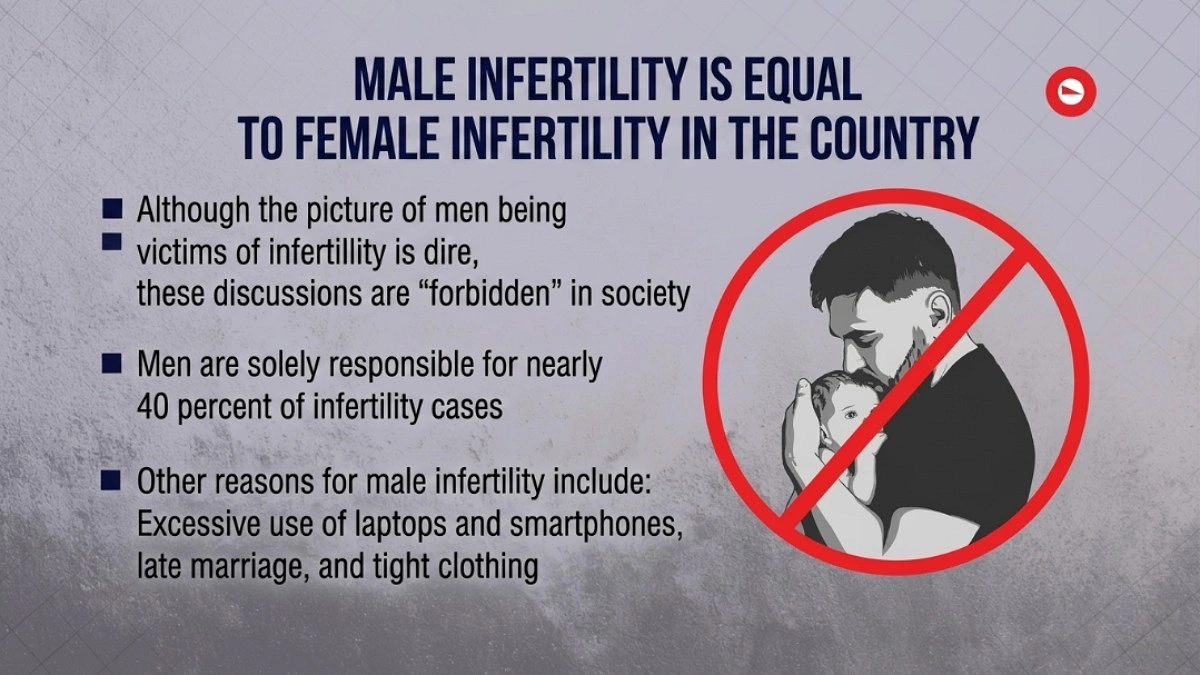
Graphics: Agamir Somoy generated by AI
In Bangladesh, the term 'infertile' has long been socially feminized—used almost exclusively to describe women. Yet medical reality tells a different story. Infertility affects both men and women equally.
According to research by the World Health Organization (WHO), around 8 to 12 percent of couples worldwide face infertility. In Bangladesh, the rate is slightly higher, estimated at 10 to 15 percent. A study conducted at Bangladesh Medical University’s infertility outpatient department found similar patterns, showing that responsibility for childlessness is almost equally distributed between men and women.
Data from the American Society for Reproductive Medicine (ASRM) indicates that in infertility cases, roughly 40 percent are due solely to male factors, 40 percent solely to female factors, and the remaining 20 percent are due to combined or unexplained causes.
This raises a key question: how many infertile men are there in Bangladesh?
With a population of approximately 169.8 million and around 35 million married couples in reproductive age groups, estimates suggest that nearly 2.1 million men in the country are unable to father children due to male-factor infertility. Medical institutions, IVF centers, and clinical observations indicate that male infertility is rising at an alarming rate.
Despite the scale of the issue, male infertility remains a social taboo. As a result, many affected men deny or avoid acknowledging their condition, often sinking into deep psychological distress. In contrast, women facing infertility are more likely to speak about it openly and receive social acknowledgment, even if not acceptance.
Psychologists say many infertile men suffer from severe depression. Some become withdrawn, others turn to substance abuse, and in extreme cases, some even attempt suicide.
There are multiple causes of male infertility. Medical reasons include low sperm count, poor sperm motility, or complete absence of sperm in semen. Doctors note that a significant number of male patients seeking treatment show no sperm in their semen at all.
Beyond medical causes, lifestyle and environmental factors are also contributing. These include excessive use of laptops and smartphones, prolonged laptop use on the lap, smoking and drug use, consumption of adulterated food, delayed marriage, working in high heat, wearing tight clothing, keeping mobile phones in trouser pockets, chronic stress, and irregular sleep patterns.
Last month, a couple visited the Mohammadpur Fertility Services and Training Center for treatment. They had been married for six to seven years and lived in Dhaka. The husband, around 40 years old, held a well-paying job and had diabetes, a heart condition requiring a stent, sexual health issues, and depression. The wife, a homemaker in her mid-30s, had no prior medical treatment history.
Doctors determined that the male partner was infertile. Upon hearing the diagnosis, he erupted in anger inside the clinic, shouting uncontrollably and even blaming his wife.
Dr. Rahima Khatun, Senior Consultant and Head of the Infertility Department at Mohammadpur Fertility Services and Training Center, said that when women learn their husbands are infertile, they usually become emotional and accept it. But most men refuse to accept any fault lies with them, often reacting with anger or denial.
She added that many men first insist their wives undergo fertility tests. Only when no issues are found on the female side do some agree to be tested themselves.
According to psychiatrists, denial of male infertility is driven not only by social conditioning but also by ego. Professor Dr. Md. Wajiul Alam Chowdhury, Senior Consultant at the Psychiatry Department of Square Hospital, said that in some cases, infertility may even be linked to mental health conditions.
However, he noted that the reaction many men display upon learning about their infertility reflects ego-driven defense mechanisms rather than normal psychological behavior. “To protect their ego, some refuse to accept it and may even remarry,” he said. “For them, acceptance feels like defeat in front of a woman.”
He also pointed out that women, even when aware of their husband’s infertility, rarely disclose it publicly and often accept the situation silently.
While awareness is gradually increasing among some men, the number remains very small. Experts believe that with timely diagnosis and treatment, infertility rates in Bangladesh could be significantly reduced.

