
Tk 76 crore wasted on previous uniforms, fresh Tk 77 crore order placed
- Lowest bidder bypassed, contract awarded to fifth lowest bidder

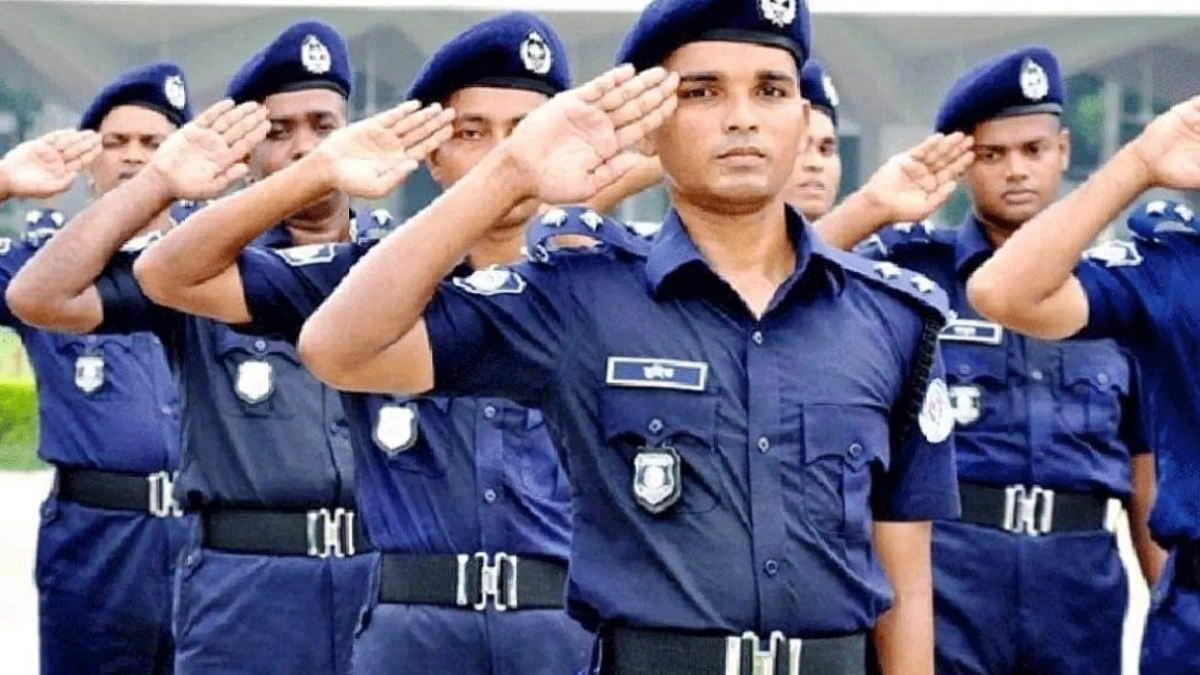
Members of Bangladesh police at a ceremony in the city. Collected photo.
Police officers perform round-the-clock duty in the field, enduring sun and rain. To ensure public safety, they need comfortable clothing. But this clothing has become a source of constant controversy.
The colour of the new uniform have been changes but the quality of the fabric does not. Neither does the familiar syndicate behind the procurement. Complaints were raised about the quality of the previous fabric. Lab tests even found evidence of deficiencies. Yet, bypassing the lowest bidder, the contract for new work worth Tk 55 crore has been awarded to Nais Fabrics Processing Limited, a concern of the Noman Group – the fifth lowest bidder.
In this context, questions have been raised about transparency, accountability, and the proper use of public funds in the government procurement process. On the other hand, despite the massive expenditure, field-level police officers are not getting the comfort they need.
During the tenure of the previous interim government, the distribution of new uniforms to police personnel began on 25 November last year. Meanwhile, on 18 June this year, a gazette was again published regarding the new police uniform. The Tk 76 crore new uniform is being scrapped. However, this time too, police personnel are expressing dissatisfaction with the khaki trousers.
It is learnt that the decision to change the police uniform was made on 20 January 2025. An iron-coloured shirt and coffee-coloured trousers were finalised as the uniform. On 25 November of that year, police took to the field in the new uniform. However, not all members have yet received the new attire. Meanwhile, on 11 June, a work order of nearly Tk 77 crore was issued for new uniforms. Allegations have emerged that the contract was awarded to the fifth lowest bidder, Nais Fabrics Processing Limited, bypassing the lowest bidder.
An analysis of Police Headquarters documents shows that four firms participated in the tender for the purchase of iron TC plain fabric required for making uniform shirts. Among them, Sanjana Fabrics submitted the lowest bid at Tk 522 per yard. On the other hand, Nais Fabrics Processing Limited, a Noman Group concern, quoted Tk 529.99 per yard. Additionally, Unique Traders quoted Tk 531, and Ismail Anjuman Ara Fabrics quoted Tk 549.99.
The same picture emerged in the case of fabric for trousers. In that tender, Sanjana Fabrics quoted Tk 432 per yard. In contrast, Paramount Textile PLC quoted Tk 435. Here too, the lowest bidder was bypassed and the contract awarded to Paramount Textile.
Previously, during the interim government's tenure, a work order worth Tk 76 crore was issued for purchasing fabric for the new uniforms. Of this, Noman Group secured work worth approximately Tk 51 crore, and Paramount Group received the remaining Tk 25 crore. Using that fabric, the new uniforms were introduced in November last year across the Dhaka Metropolitan Police and various specialized units.
However, soon after the new uniforms were deployed in the field, various complaints began pouring into Police Headquarters. Many police personnel said the fabric was stiff and uncomfortable to wear for extended periods, adding that the problem could worsen in hot weather.
A responsible official at Police Headquarters stated that after these complaints were received, the uniform fabric was sent to a laboratory for testing. The test results sparked fresh discussions. According to the contract, the GSM (grams per square metre), or yarn density, for the shirt fabric was supposed to be 205, with a tolerance of +/- 5. This means the acceptable range was 200 to 210 GSM. However, the tests revealed only 193 GSM.
Not only that, but deficiencies were also found in moisture absorption capacity. As per the contract, the fabric's wicking performance was supposed to be 6 to 10 centimetres, but the tests measured only 4.5 centimetres.
Textile experts say this is a critical issue for field-level police officers in a hot and humid country. Low moisture absorption makes it difficult to perform duties while wearing the uniform for prolonged periods. According to them, a lower GSM reduces production costs, allowing more fabric to be produced using the same amount of raw materials.
According to those concerned, bypassing the lowest bidder in government procurement is not impossible, but it requires strong and documented justification. However, the contract once again going to a firm whose quality standards are questionable has created suspicion.
Work order amid ACC case: Another controversy surrounding Noman Group is the ongoing corruption case against its Chairman, Md. Nurul Islam. The Anti-Corruption Commission (ACC) has filed a case against him for acquiring assets worth approximately Tk 19 crore beyond his known sources of income. The court has also imposed a ban on his foreign travel.
According to ACC information, the amount of his undisclosed assets is Tk 18 crore 97 lakh 75 thousand.
However, Noman Group Director Shahaadat Chowdhury claimed they received the new contract because their quoted price and fabric quality were satisfactory. He said, "Police Headquarters awarded us the work because they were satisfied with our rate and quality. They certainly have trust in us. The condition of the work order received on 11 June was that if the colour changed, we would supply the fabric in that colour."
Regarding the ACC case against Group Chairman Md. Nurul Islam, Shahaadat Chowdhury said, "The case is his personal matter. There are no allegations against the company."
However, according to Dr. Iftekharuzzaman, Executive Director of Transparency International Bangladesh (TIB), awarding any contract to a firm owned by an individual under investigation for corruption is unethical. Speaking to Aagameer Somoy, Iftekharuzzaman said, "If a contract is knowingly awarded to a company owned by a person under investigation for corruption, it is absolutely unacceptable. Even if it was done unknowingly, it points to weaknesses in the procurement process. In either case, the matter should be investigated."
A similar view was expressed by Saidur Rahman, Chief Executive of the Human Rights Culture Foundation. He said, "There is no thought given to law and order; the police are preoccupied with uniforms. Awarding work to the same supplier again, even after questions were raised about the quality of their previous products, is a form of authoritarian behaviour. After the mass uprising, we expected transparency, good governance, and human rights from the elected government. We are by no means satisfied with the police's activities."
When asked about this tender work order issued on 11 June, Police Headquarters Deputy Inspector General (DIG) Sarwar Murshed Shameem told Aagameer Somoy, "I cannot remember everything. As far as I recall, all procurements were conducted in accordance with proper rules."
