The Raft That Floats With Border Dead

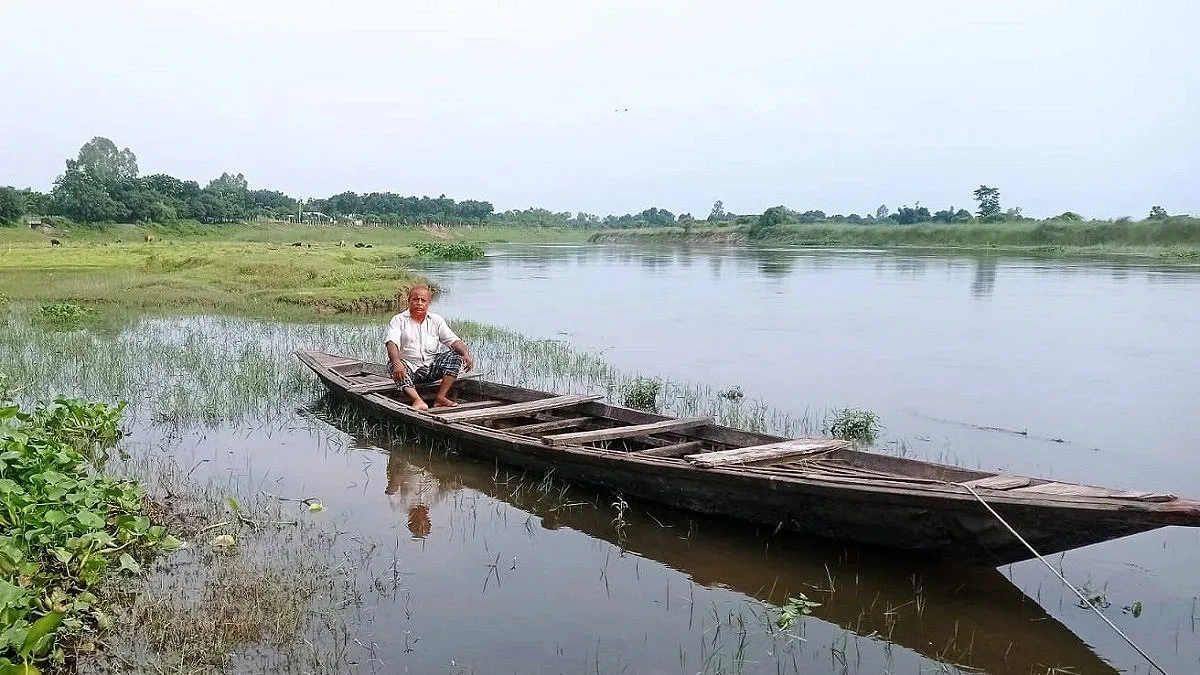
Abdur Rahman ties the bodies of Bangladeshis killed by BSF gunfire on the Indian side to a raft and brings them back to Bangladesh's territory. Photo: Agamir Somoy
As soon as the sound of gunfire at the border falls silent, a difficult task begins. The bodies of Bangladeshis lying on the other side must be brought home. The responsibility was not assigned by the government. Yet, for the past two decades, Abdur Rahman of Thakurgaon has been carrying out this work out of humanitarian duty.
Whenever a body needs to be recovered at the Dharmagarh border in Thakurgaon’s Ranisankail upazila, members of the Border Guard Bangladesh (BGB) and local residents think of him first.
Abdur Rahman’s home is in the Jagdal area of Dharmagarh Union. He runs a small shop in front of Jagdal Rajbari. He lives with his wife and two sons in a small house built on government-owned land. Behind this ordinary life lies the story of a unique experience spanning 20 years.
Rahman said that nearly 20 years ago, a Bangladeshi named Ershad was killed by BSF gunfire at the Jagdal border. His body was lying in the zero line. Because of legal complications, border tensions and fear, no one was willing to retrieve the body. The cries of the victim’s relatives moved him deeply.
That day, he went to bring back the body for the first time. Since then, whenever the body of a Bangladeshi needs to be recovered from a border river or waterbody, he is called.
To recover the bodies, he follows a special method. He cuts banana trees and makes a sturdy raft. He places the body on it and ties the raft to his boat before bringing it into Bangladesh’s territory. After the legal process is completed, the body is handed over to the relatives.
In addition to recovering bodies, Abdur Rahman also carries various official letters on behalf of the BGB, including messages related to flag meetings at the border.
Over his 20 years of experience, he has witnessed countless tragedies along the border. According to him, most of those killed at the border are the sole breadwinners of their families. Some are farmers, some are agricultural laborers, some are fishermen and others are cattle herders. After their deaths, their families fall into uncertainty and hardship.
He said, “The lack of effective justice in border killings has created frustration among people. At the same time, the state needs to play a more active role in the rehabilitation and financial assistance of the victims’ families.”
Incidents of Bangladeshis being killed by BSF gunfire along the Bangladesh-India border frequently draw attention. At high-level meetings, promises are made to bring border killings down to zero. According to people living in the border areas, those promises are rarely reflected in reality.
Sitting in his small shop, Abdur Rahman let out a long sigh and said, “I have been doing this work for 20 years. Now I only want no mother’s heart to be broken by the loss of her child at the border. I hope that no human body will ever again have to be carried on the banana-tree raft that I built.”