

Rainfall Drops 34% in Rajshahi Over Five Decades

Graphics: Agamir Somoy
Seasonal rainfall in Bangladesh’s Rajshahi region has declined by nearly 34% over the past five decades, signaling a growing climate crisis that is increasing water stress, raising temperatures, and threatening agriculture and rural livelihoods, according to a recent study.
The findings were published in April in the Netherlands-based journal Cleaner Water under the title “Extreme Climate and Hydroclimatic Modelling of Water Stress: Implications for Livelihoods in Rajshahi, Bangladesh.” The study warns that if current trends continue, most parts of Rajshahi could face moderate to severe water shortages by 2032 due to climate change and excessive groundwater extraction.
The research was led by Dr. Mohammad Shafiullah, a professor in the Department of Geography and Environment at the University of Dhaka, along with researchers Maliha Haque, Abdullah Al Riyad, and Md. Khairul Islam Tuhin. The team analyzed data from 13 upazilas and conducted field surveys involving 385 households.
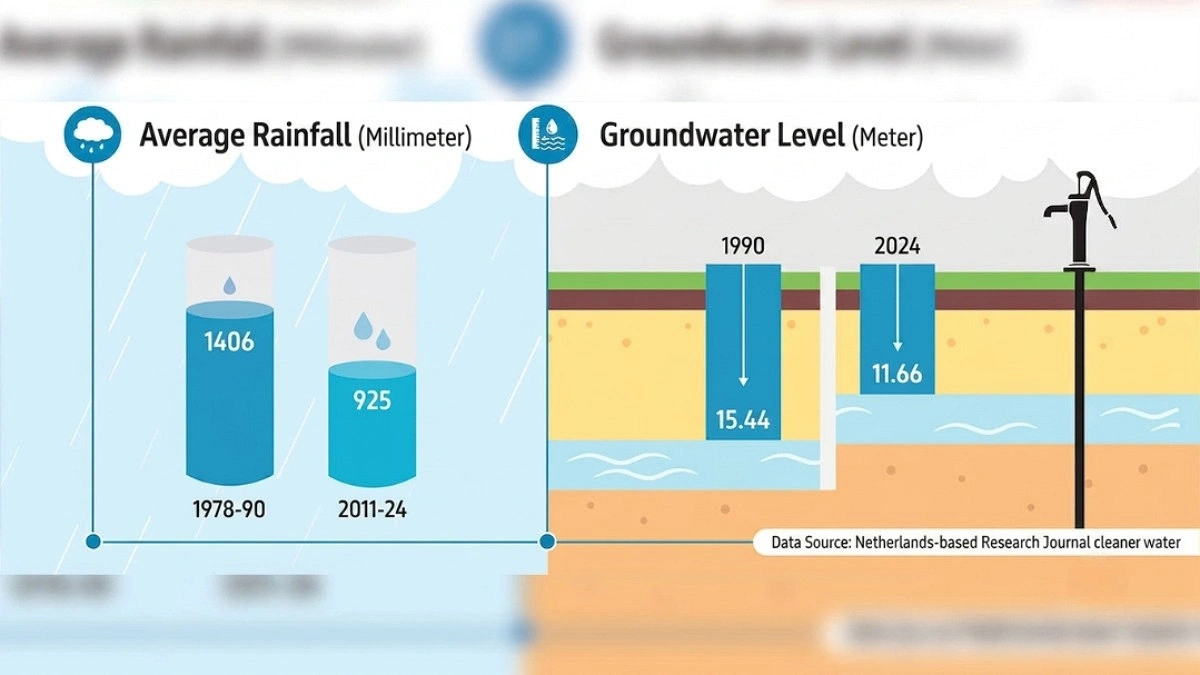
According to the study, average seasonal rainfall fell from 1,406 millimeters during 1978–1990 to 925 millimeters between 2011 and 2024—a decline of 481 millimeters, or about 34%. Researchers estimate that rainfall is decreasing by an average of 12 millimeters per year.
The study also projects a sharp rise in temperatures. Rajshahi could record temperatures above 45 degrees Celsius multiple times before the end of the century, with maximum temperatures potentially reaching 47.17 degrees Celsius by 2088. The number of days with temperatures exceeding 35 degrees Celsius could rise from just 13 days in 2018 to nearly 195 days by 2078, meaning extreme heat could persist for more than half the year.
Groundwater depletion has also intensified. Over the past 35 years, the average groundwater level in the Barind region has dropped by 3.78 meters, falling from 11.66 meters below ground in 1990 to 15.44 meters in 2024. The study identifies heavy dependence on deep tube wells for irrigation as the primary cause.
Dr. Shafiullah said declining rainfall, rising temperatures, and population growth are placing increasing pressure on groundwater resources, reducing soil moisture and vegetation while making access to water more difficult.
“In upazilas such as Tanore, water scarcity has become severe. Families that can afford it use submersible pumps, while poorer households are forced to buy water, spending an average of Tk 1,830 per month,” he said.
To address the crisis, the researchers recommended expanding water-efficient irrigation technologies, harvesting rainwater, artificially recharging groundwater, regulating groundwater extraction, and promoting drought-resistant crops. They also emphasized restoring ponds, canals, and wetlands to improve surface water storage.
Environmentalist Rashed Ripon, chief executive of the organization Poriborton, said development in the Barind region has failed to align with its natural landscape and climate. He noted that Rajshahi city once had nearly 4,000 ponds and water bodies, but fewer than 200 remain today.
He added that 42 unions in the Rajshahi region have now been identified as critically water-stressed, calling for urgent measures to regulate groundwater use, conserve rainwater, and replenish underground aquifers.

