

ROSC Phase-2 Project: Low Benefits, High Expenditure
- No expected impact on real income and employment generation
- Lack of student verification, transparency, and accountability over allowances
- Weaknesses in supervision; limitations in financial and procurement management

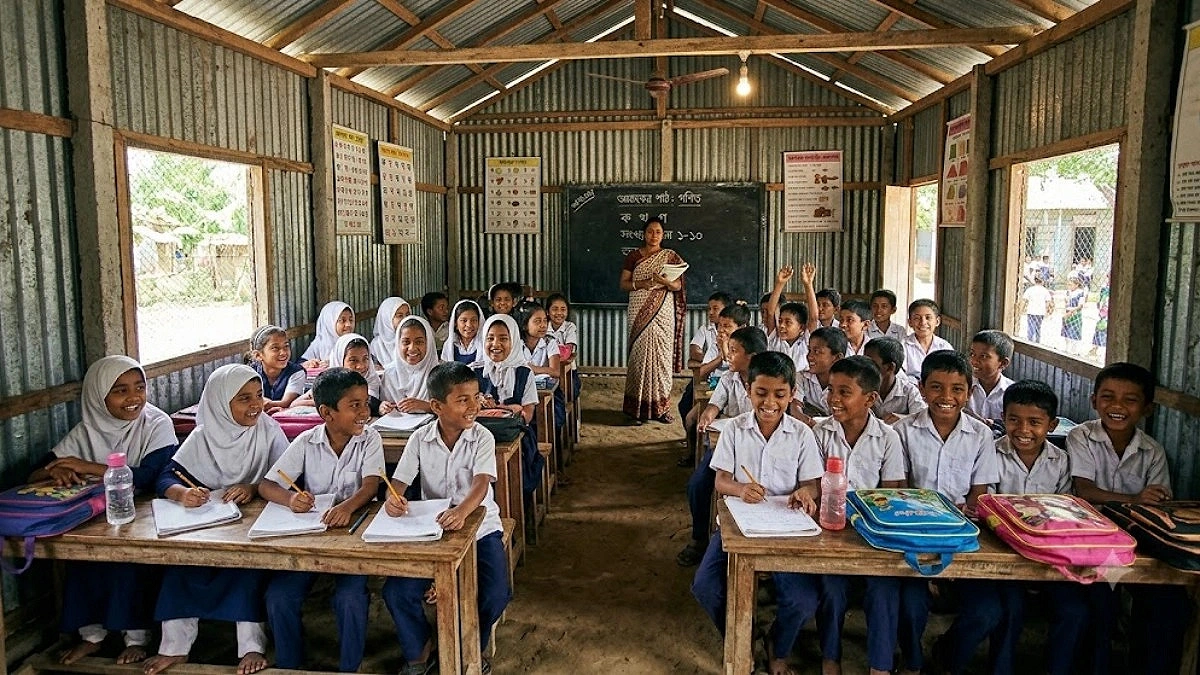
AI generated image.
While the numerical targets were largely met, the project saw higher costs and ultimately delivered less-than-desired success—meaning there is a shortfall in the expected benefits. This refers to the "Reaching Out of School Children (ROSC) Phase-2" project. Implemented from 2013 until June 2021, it took eight and a half years to complete, which was an excess of 70 percent more time than originally planned.
The objective of the project was to ensure opportunity-based primary education. Its initial estimated cost was 1,140.26 crore taka, but the final expenditure stood at 1,250.34 crore taka—an overshoot of 110 crore taka. Although most physical targets were achieved, the resulting benefits have been called into question.
An impact evaluation of the completed project was conducted by the Implementation Monitoring and Evaluation Division (IMED), and these findings were highlighted in their report. The project was implemented nationwide by the Directorate of Primary Education.
Abul Monsur Md. Fayezullah, a former secretary of IMED, told Agamir Somoy, "It is necessary to investigate why the project yielded low benefits and take action against those responsible. Specifically, the responsible Project Directors, implementing agencies, the Project Implementation Committee (PIC), and the concerned ministry must be held accountable. It is unacceptable to spend such a large sum of money and receive so little in return."
The report said on one hand, the project had a positive impact on primary education access, student retention, female participation, community management, and pre-vocational training. On the other hand, it suffered from implementation delays, weak supervision, limitations in financial and procurement management, diversification in education quality, and deficiencies in post-project sustainability.
The report further noted that regarding the inclusion of out-of-school children, monitoring showed that against a target of establishing 21,632 learning centers in rural areas, only 20,239 centers were actually set up. Against a target of enrolling 720,000 students, only 687,556 children were brought under the education coverage. This means the project functioned as an effective model for second-chance education. However, since the 100 percent target was not achieved in all areas, stronger measures were needed for beneficiary identification and center management.
In the education stipend allocation, against a target of 795,000 beneficiaries, some 760,513 individuals received benefits. However, there were deficiencies in transparency and accountability in student verification, stipend distribution, and attendance-based support systems. In the urban slum children's education program, against a target of 50,000 students, 49,478 were enrolled. However, with only 1,647 learning centers established against a target of 2,000 in urban areas, this led to overcrowding at the centers, negatively impacting the learning environment and the quality of education. Additionally, the high mobility tendency of impoverished populations in urban areas also posed a challenge to student retention.
In terms of education quality and academic supervision, against a target of hiring 1,200 pool teachers, only 922 were recruited, leaving the academic support structure partially weak. As a result, while student inclusion and pass rates were positive, more effective monitoring and learning assessments were needed to ensure quality learning outcomes. In the pre-vocational training sector, the target of 25,000 trainees was achieved 100%, but its qualitative and employment-based impact was not satisfactory. According to field-level opinions, trades such as tailoring/stitching, beautification, mobile servicing, electrical work, basic computer skills, food processing, and handicrafts were not aligned with the demands of the local labor market in all areas. The capacity of training institutes, practical equipment, lab facilities, safe environments, and post-training job linkages were insufficient. Consequently, although the training was numerically successful, it failed to have the expected impact on actual income generation and employment creation.
Regarding post-project student tracking, there was insufficient continuous monitoring of how ROSC students progressed after primary education—whether into secondary education, technical training, employment, or self-employment. The long-term follow-up mechanism after the project's conclusion was weak.
Although the project increased educational inclusion, it failed to have the expected impact on child marriage and social behavior change. Primary data showed that among married individuals, the rate of marriage under 18 was nearly identical—29.68% in the program group and 29.73% in the control group. Monitoring the transition from primary to secondary education revealed that challenges remained regarding survival at the secondary level, bearing educational costs, distance, family income pressure, and the risk of adolescents dropping out to enter the workforce. In terms of economic empowerment, the education provided under the project created a foundation for future income; however, due to insufficient training, job linkages, entrepreneurial support, and market-based skills, it did not translate into a strong income-generating impact.
A review of the project's audits and procurement revealed issues such as lapses in following procurement rules in some cases, short deduction of VAT/income tax, overpayment on contracts, fictitious travel expenses, failure to deposit bank interest, and delays in appointing procurement consultants. Although most audit objections have been resolved, these incidents indicate weaknesses in financial discipline, bill verification, preservation of procurement documents, and overall oversight.
Dr. Debapriya Bhattacharya, a Distinguished Fellow at the Centre for Policy Dialogue (CPD), said, "IMED should actually be made effective. It cannot just end with making recommendations. IMED needs reform here."

