
Double Murder Hidden Behind the Mask of Suicide

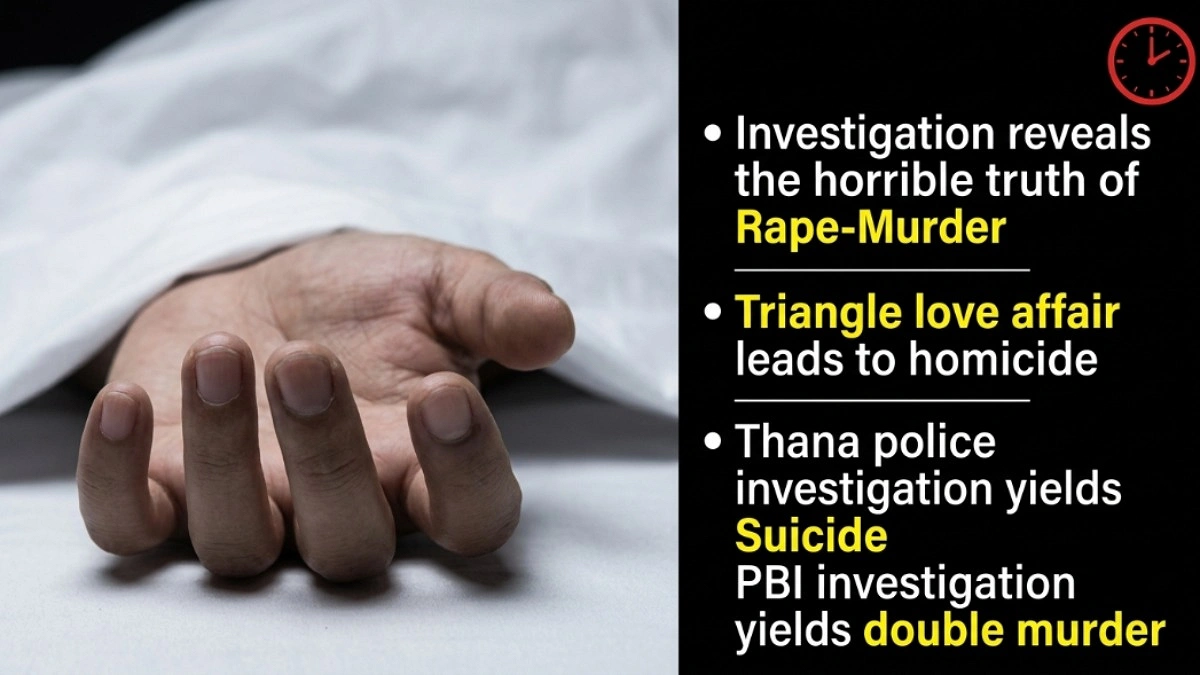
Graphics: Agamir Somoy
The door of a residential hotel room was locked from the inside. The lifeless body of a young man was hanging from the ceiling fan, while the body of a young woman lay motionless on the bed. Seeing the scene, everyone initially believed that the young man had committed suicide after killing the woman over a romantic dispute. After nearly 10 months of investigation, local police also reached the same conclusion.
However, some silent clues at the crime scene seemed to tell a different story. A bloodstained handprint on a white pillowcase, the bound hands of the body hanging from the fan, cigarette filters of different brands found in the room, technological evidence and several inconsistencies at the scene ultimately revealed a horrifying truth.
It was not a suicide. It was a planned double murder.
The young woman was raped by a group and then killed. The young man was murdered and later hanged from the fan to stage a suicide.
The fact that only Mizanur’s DNA was found on Sumaiya’s body had misled the investigation. However, the real events were uncovered through the analysis of other evidence, technological data and witness testimony.
The incident took place on April 22, 2016. The bodies of Sumaiya Nasrin (21), a student of Pabna University of Science and Technology, and Mizanur Rahman (23), a student of Rajshahi University, were recovered from Room 303 of Hotel Nice International in Boalia Police Station area of Rajshahi Metropolitan City. The following day, Sumaiya’s father, police officer Md. Abdul Karim, filed a rape and murder case against unidentified individuals.
After investigating the case, Boalia Police Station submitted a final report to the court on Feb. 18, 2017, citing a ‘factual error.’ The report stated that Mizanur Rahman had killed Sumaiya and then committed suicide. However, the victims’ families and the prosecution were not satisfied with the investigation.
Following an objection by the public prosecutor, the court assigned the Police Bureau of Investigation (PBI), Rajshahi, to conduct a further investigation.
After taking over the case, PBI officers began reexamining every piece of evidence from the crime scene. They first noticed several significant inconsistencies. Six cigarette filters of different brands were found in the room, although neither victim was a smoker. Mizanur’s hands were tied, which was inconsistent with suicide. A bloodstained handprint was found on the white pillowcase beneath Sumaiya’s head, but there was no blood on either victim’s hands. It was also impossible to post a Facebook status suggesting suicide using Mizanur’s basic button phone found at the scene. These clues led investigators to suspect that the case was not a suicide.
A technology-based investigation then began. By analyzing call records, verifying evidence and reconstructing the sequence of events, PBI identified a suspect. During questioning, he confessed to involvement in the killings and revealed the names of other accomplices. Later, three of the arrested suspects gave confessional statements under Section 164 of the Code of Criminal Procedure.
PBI’s investigation found that Rahat Mahmud, a second-year student of the Department of Geology and Mining at Rajshahi University, planned the murders out of revenge stemming from a love triangle. Along with his accomplices, he removed the grill from the back of the hotel and entered the room through a window. At that time, Sumaiya was alone. She was then forced to call Mizanur and ask him to come to the room.
The investigation found that after Mizanur entered the room, he was beaten and killed. Sumaiya, meanwhile, was gang-raped and struck on the head with a stool. She was later suffocated to death with a pillow.
To make the killings appear to be a suicide, Mizanur’s body was hung from the ceiling fan using Sumaiya’s scarf.
Before the murders, the attackers had threatened Mizanur and obtained the password to his Facebook account, from which they posted a status suggesting suicide. The suspects took away the smartphone used to post the status. They then locked the main door of the room from the inside and escaped through the window.
After a lengthy investigation, PBI filed charges on April 15, 2019, against six people under the Women and Children Repression Prevention Act. They are the alleged mastermind Rahat Mahmud; Ahsan Habib, also known as Rony; Borhan Kabir, also known as Utsho; Al-Amin; and Hotel Nice International employees Bakhtiar and Nayan Hossain.
The investigating officer, Rajshahi PBI Sub-Inspector Mohidul Islam, said it was a clue-less murder case. However, evidence from the crime scene ultimately changed the course of the investigation.
In his words, although the police report described Mizanur’s death as a suicide, various pieces of evidence found at the scene did not match that conclusion. His hands were tied while his body was hanging from the fan. There were marks on both sides of his neck, and his pants had been pulled down below his waist. These signs had raised suspicions of murder from the very beginning.
“A love triangle motivated Rahat Mahmud, a second-year student of the Department of Geology and Mining at Rajshahi University, to plan the murders as an act of revenge.”
He also noted that the fact that only Mizanur’s DNA was found on Sumaiya’s body had confused the investigation. However, the real events were uncovered through the analysis of other evidence, technological information and witness testimony.
PBI Superintendent of Police (Legal and Media) Abu Yousuf said that if every piece of evidence at the scene had been carefully analyzed from the beginning, it would not have taken so long to solve the mystery. The investigation by local police went in the wrong direction because it focused solely on one issue — that the room had been locked from the inside — and remained confined to the assumption of suicide.
In his words, the possibility of entry through the window, the bound hands, the bloodstained handprint, technological evidence and the victims’ personal relationships were important factors that were not properly examined.
