
Controversy feeds FB posts: 'Awami League is Back'

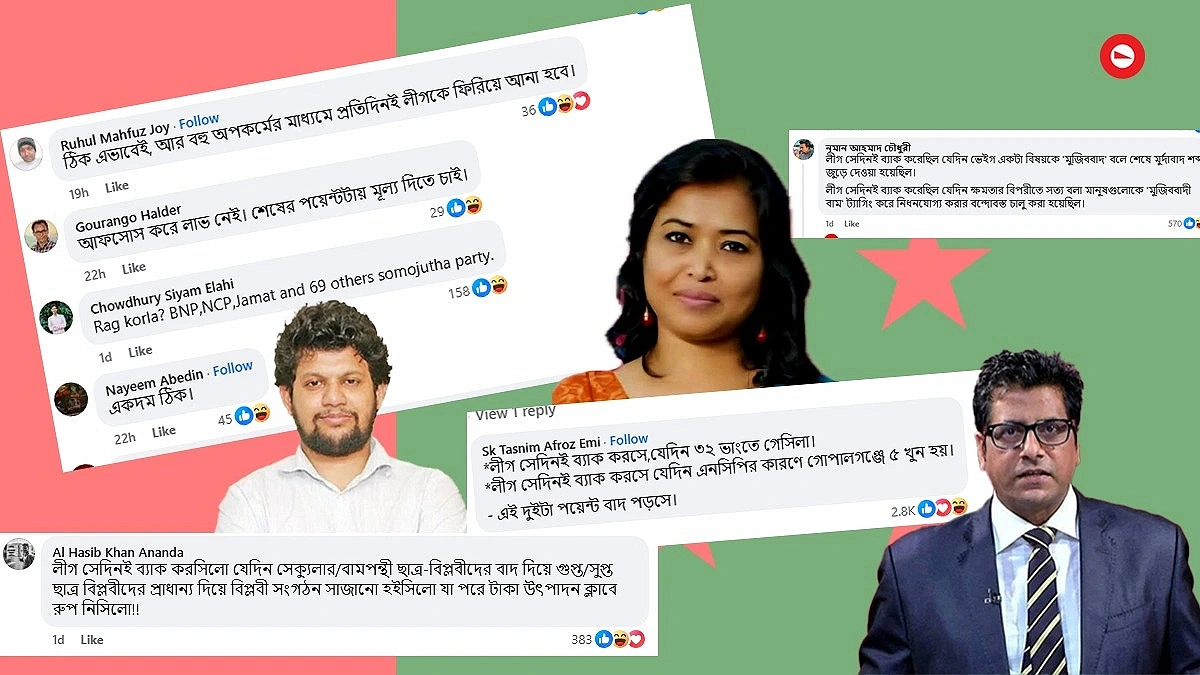
Graphics: Agamir Somoy
Facebook’s newsfeed has suddenly turned into a volatile political battleground. Some are writing "League is back," others are saying "League never left," while some are arguing that it is not the party itself returning, but rather the old political culture. It all started with a lengthy Facebook post.
Mahfuz Alam, a former adviser to the interim government, wrote on Facebook, "Awami League has made a comeback, haven't you noticed?" This line by Mahfuz spread across thousands of timelines within moments. Many initially thought he was referring directly to the organizational resurgence of the Awami League. However, in a later detailed explanation, Mahfuz Alam clarified that he was actually referring to the return of a specific political culture.
In Mahfuz's words, the day "mob-stars were turned into heroes," the day "the spirit of '24 was pitted against '71," and the day the politics of division began reclaiming its space—that was the day the political shadow of the Awami League became visible once again.
There was a tone of frustration in Mahfuz's post. He feels that the new political dream, the hope for state reform, and the aspiration for change that emerged after the July uprising are gradually drowning in old political behaviors. His post hinted that treating opponents as enemies, social division, cultural warfare, and normalizing a "mob" culture are ultimately paving the way for the old forces to return.
Several individuals left comments under Mahfuz's post. Among them was Sheikh Tasnim Afroz Emee, former VP of Shamsun Nahar Hall Union, who served two months in jail over a program to play the March 7 speech in front of Shahbagh Police Station. In the comment section, she wrote, "The League returned the very day you went to demolish 32 [Dhanmondi 32]. The League returned the day five murders took place in Gopalganj due to the NCP. These two points were missed." Abu Baker Majumder, a former coordinator of the Anti-Discrimination Student Movement and currently a leader of Jatiyo Chhatra Shokti, wrote, "Brother, the financial scandals of some of the advisers were missed. It would be good if you could add that."
Mahtab Uddin Ahmed, a member of the Democratic Rights Committee, commented on Mahfuz's post, saying, "You are now criticizing the interim government, but why didn't you resign when you yourself were a part of it? You owe an answer to this. When you saw that the interim government was patronizing far-right elements, you could have honestly stepped down, acknowledging your failure to stop it. By not doing so, you have lost your credibility."
Within hours of this unfolding situation, Asif Nazrul, another former adviser, took a stance seemingly on the opposite end of the spectrum. He wrote, "Awami League has not made a comeback. They were always here. What has returned is their arrogance, lies, and the audacity to mislead people."
It is as if the same reality is being viewed through two different lenses. While Mahfuz Alam sees the rebirth of Awami League's old political culture within current political trends, Asif Nazrul argues that a situation allowing for Awami League's actual return to realpolitik has not yet emerged. Instead, he views it as a form of psychological propaganda—a political "hype."
Following this, the entirety of Facebook seemed to split into two camps. Mohammad Sakib, the organizational secretary of Chhatra Shokti, wrote that creating an "Awami League back" panic is precisely what keeps their political culture alive. In his view, comparing anyone with a differing opinion to the Awami League, and exhibiting fascistic behavior in personal life while preaching liberal democracy, is what reopens doors for the old style of politics.
Dilshana Parul, a leader of Chhatra Shokti, spoke in a similar vein. She wrote that a new space is created for the Awami League when political forces busy themselves with "revolutionary rhetoric" instead of pursuing actual reforms. She also views returning to the old divisive politics of 'Freedom Fighters vs. Razakars' as a repetition of that same old cycle.
Journalist Anis Alamgir raised questions from a different angle. He wrote that the potential of the July uprising has gradually eroded due to weaknesses in real political strategy and a lack of foresight. Today's debate is merely a reflection of that failure.
On the other hand, online activist Mohammad Ishrak views the entire issue as a battle of "soft power." He claims that the Awami League has not returned in reality; rather, they are trying to create a psychological impact by capitalizing on political instability and divisions. He believes that if forces like BNP, Jamaat, and NCP remain united, a real comeback for the Awami League will not be easy.
Political analyst Ainul Islam connects the entire debate to a much larger reality. According to him, when a new, acceptable political alternative does not rapidly materialize, people naturally start thinking about the old forces again. The country's current political uncertainty, administrative weakness, and social polarization have created a sense of unrest among the public. It is from this unrest that discussions like "Awami League is returning" are gaining traction.
In Ainul Islam's words, this is not just a debate about the return of a political party; rather, it is an expression of people's deep uncertainty regarding the future of the state and politics. After the July uprising, people wanted something new—new state philosophy, a new political settlement, and a new language. However, because a clear blueprint for that expectation is not yet visible, various rumors, fears, and counter-political messages are coming to the forefront.
As time passes, the question becomes increasingly clear to many: Is something genuinely new being forged, or is the old story just returning under a new name?
