
Migrant Workers Dying in Their Prime Working Years

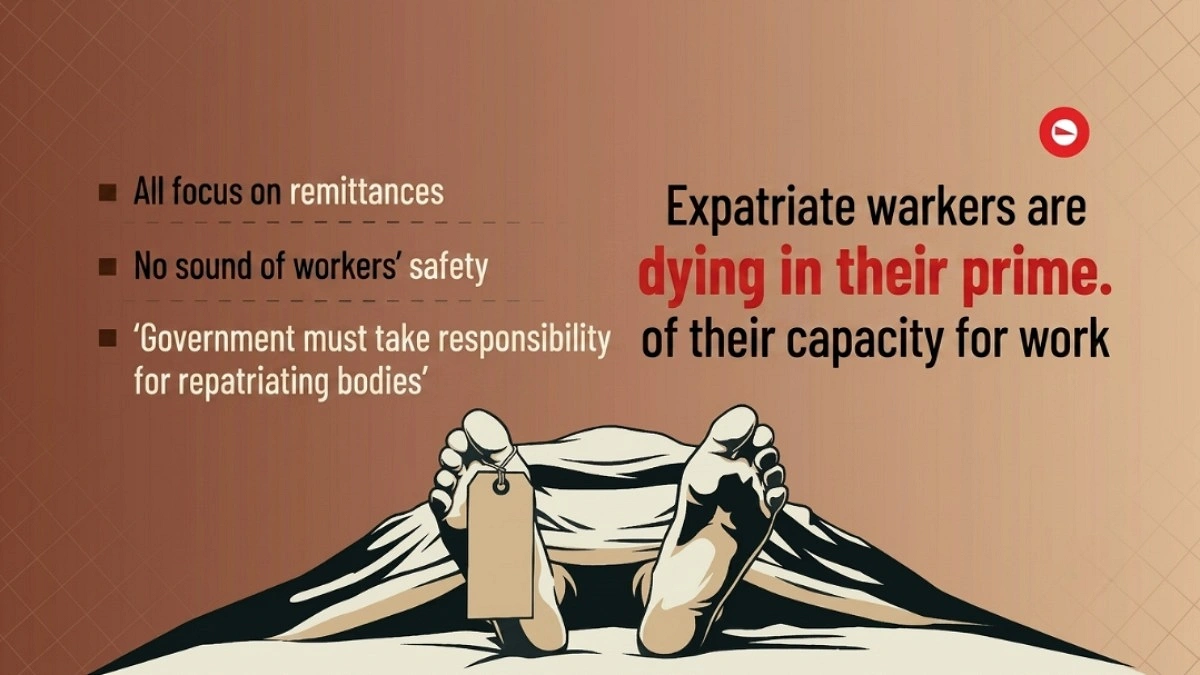
Graphics: Agamir Somoy generated by AI
Bangladeshi migrant workers are increasingly dying during the most productive years of their lives. Every year, hundreds of thousands leave the country in search of better livelihoods, yet many never return alive. Harsh working conditions, health risks, and various challenges abroad are claiming the lives of young workers, strengthening calls for safer working environments for expatriate Bangladeshis.
At the age of 27, Saiful Islam from Barishal traveled to Malaysia hoping to improve his family’s financial situation. A short time later, he died of a heart attack.
Like Saiful, millions of young Bangladeshis leave home to fulfill their families’ dreams and contribute to the country’s economy. However, many lose their lives overseas. One such worker was Md. Milon, who went to Kuwait in September 2015 at the age of 25. Three years later, he suffered a heart attack and died there.
Experts say people are generally at their peak working capacity between the ages of 20 and 40. A study by the Refugee and Migratory Movements Research Unit (RMMRU) found that the average age of Bangladeshi migrant workers who died abroad in 2024 was only 38 years, indicating that most were in their prime working years.
Researchers have questioned why healthy young migrant workers are dying at such an early age and why the actual causes of many of these deaths remain unclear.
Migration expert Tasneem Siddiqui told Agamir Somoy that nearly 27 percent of migrant worker deaths are considered unnatural. In many cases, families allege torture or workplace accidents, yet death certificates simply list ‘heart failure’ as the cause. She said that if signs of physical injury are found after the bodies are returned to Bangladesh, authorities should conduct fresh autopsies to determine the real cause of death and formally raise the issue with the respective foreign governments.
While news of a migrant worker’s death may reach families within minutes or hours, bringing the body home often becomes a long and painful struggle.
The experiences of the families of Saiful, Milon, and many others are remarkably similar. After Milon died in Kuwait, his family contacted the Bangladeshi embassy but received little assistance. Ultimately, through the combined efforts of the Ministry of Expatriates’ Welfare and Overseas Employment, Bangladeshi expatriates in Kuwait, and relatives, his body was repatriated after 43 days.
The family of Rony Mir from Barguna endured similar hardship. Following his death in Kuwait on April 24, it took more than a month for his body to be returned to Bangladesh.
Tasneem Siddiqui said financial assistance for repatriating deceased migrant workers should be increased. She also argued that regardless of whether a migrant traveled abroad legally or illegally, if they contributed to Bangladesh through remittances, the state should assume responsibility for bringing their body home.
According to the Wage Earners’ Welfare Board, operating under the Ministry of Expatriates’ Welfare and Overseas Employment, 4,438 bodies of Bangladeshi migrant workers were repatriated with government assistance between 2010 and June 2026. During this period, approximately Tk 4.13 billion was provided as financial assistance.
In April this year alone, the bodies of 34 migrant workers were returned from Kuwait, Malaysia, and Libya, with each family receiving Tk 35,000 in assistance.
The highest number of repatriated bodies under the Board’s assistance was recorded in 2025, when 1,278 deceased migrant workers were brought home and their families received Tk 114.3 million in financial support. By June this year, 499 bodies had already been repatriated.
According to the Ministry of Expatriates’ Welfare, 4,813 bodies of Bangladeshi migrant workers were returned home in 2024, the highest annual figure in the country’s history. The number was 4,552 in 2023, 3,904 in 2022, and 3,818 in 2021. Since 1993, more than 56,000 deceased migrant workers have been repatriated to Bangladesh.
Data from the Bureau of Manpower, Employment and Training (BMET) show that 617,209 Bangladeshi workers went abroad in 2021. The figure rose to 1,110,034 in 2022 and reached a record 1,303,453 in 2023. Although it declined slightly to 1,011,969 in 2024, Minister for Expatriates’ Welfare and Overseas Employment Ariful Haque Chowdhury said 1,132,519 Bangladeshis secured overseas employment in 2025, including 62,352 women.
According to BMET, remittance inflows totaled US$13.73 billion through May 2025. Bangladesh received US$26.89 billion in remittances in 2024, US$21.94 billion in 2023, and US$21.29 billion in 2022.
In June this year, Shafiqur Rahman, Ameer of Bangladesh Jamaat-e-Islami and the Leader of the Opposition, called in Parliament for the formation of an effective and accountable task force to address the problems faced by Bangladeshi migrant workers and protect their rights.
He said, “If any remittance warrior dies abroad, the government should bear the full cost of repatriating the body and provide state assistance to the bereaved family.”
