


Mental Health in the Digital Age
Human Connection Shrinks in a Pocket-Sized World

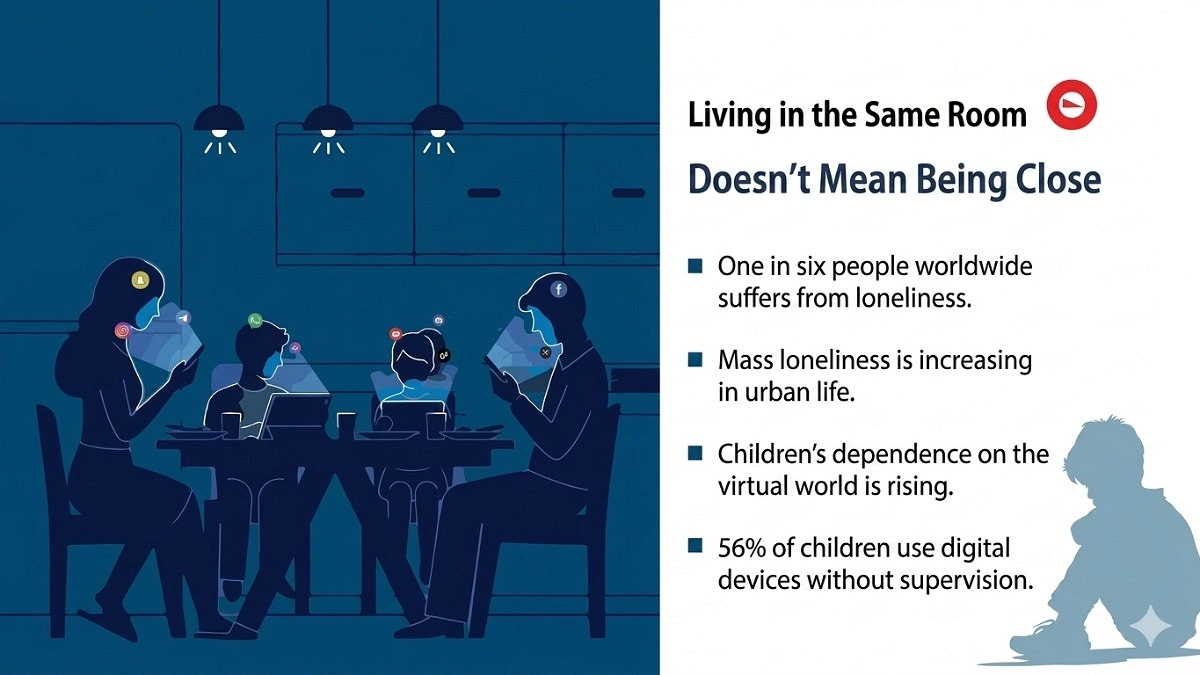
Graphics: Agamir Somoy
It is around 11 pm. A mother has finished cleaning the dining table and gone into her room. A father lies half-reclined on the bed, eyes fixed on his mobile screen. The son plays games with headphones on. The daughter scrolls through endless videos on her phone. Four people live under the same roof, yet they seem far apart, as if each inhabits a separate world.
The world has shrunk so much that it now fits in the palm of a hand. A mobile phone can take a person across the globe in seconds. Distances of thousands of miles disappear on a glowing screen. Yet this same glowing screen is widening the distance between people. The situation mirrors that of the four-member family, where dinner tables no longer carry the stories of the day, the laughter, or the shared fatigue. As a result, family bonds are weakening, and people are becoming isolated.
However, many have not realized this growing distance. One such example is Nusrat Jahan, a resident of Mirpur in the capital.
The working woman said that earlier, after returning home from work, the family would spend some time talking together. That habit has now disappeared. Every member of the household remains busy with their own phone. Nusrat Jahan expressed regret that she did not even realize when such distance developed within her family or when she became so alone.
According to the World Health Organization, one in every six people globally, like Nusrat Jahan, currently suffers from loneliness. The trend is most prevalent among young people and is gradually turning into a public health concern, as loneliness is linked to depression, anxiety, heart disease, and even premature death.
A report by the organization’s Commission on Social Connection states that social isolation and loneliness cause around 871,000 deaths every year, about 100 deaths per hour.
However, psychiatrists say strong family bonds and personal relationships can reduce such deaths. They also emphasize that time has no substitute when it comes to building trust, understanding, and connection in relationships.
They say people may live under the same roof, but they inhabit separate worlds. Mentally, they remain distant from one another. They largely blame this on technology use habits.
Psychiatrist Dr Mekhla Sarkar said that technology is not only taking away people’s time but is also gradually creating distance within close relationships.
However, she placed more responsibility on human habits than on technology itself. She said that people often remain absorbed in their mobile phones even while sitting at the same dining table. Time that should be shared with family members is instead spent in the virtual world. As a result, the time and attention family members receive are shrinking. Society is becoming smaller, while feelings of emptiness and isolation are growing.
Children’s carefree childhood is also getting trapped in this cycle of emptiness. Uncontrolled device use is having severe harmful effects on children and adolescents, for which parents bear significant responsibility.
A study on screen time and parental supervision among schoolchildren in Dhaka found that 56 percent of children aged 6 to 14 use digital devices without parental supervision. The study was conducted between 2022 and 2024 on 420 students from six schools in Dhaka. It found that children with prolonged screen use were more likely to suffer from headaches and sleep problems, along with noticeable behavioral issues in many cases.
According to the study, English-medium students spend an average of about 5 hours and 30 minutes on screens daily, while Bangla-medium students spend around 3 hours and 40 minutes.
Psychologists and sociologists say reducing children’s screen time alone will not solve the problem. They stress the need to restore time, attention, and conversation within families, as many children now feel more comfortable in the virtual world than in real life even while staying in the same room. This tendency is particularly strong in urban areas.
Associate Professor Muhammad Mahbub Kayser of the Department of Sociology at the University of Dhaka said that urban life is now witnessing a growing trend of mass loneliness. People are becoming mentally isolated even while living with their families.
He argued that the decline of joint families is not the only reason; changing social values are also increasing distance. Earlier, children had alternatives such as playgrounds, friends, or television. Now, mobile phones and social media have taken over that space.
Kayser also said that even when parents are at home, meaningful communication with children often does not take place. As a result, children feel lonely even while living in a family.
Although this change is affecting the younger generation the most, its impact is felt most strongly by older people. Sixty-year-old Abdul Kader from Gazipur recalled the past, saying that people would gather in courtyards in the afternoon to talk, and tea stalls were full of conversation. Now everyone remains busy with their phones, and neighbors no longer keep in touch. He added with regret that even family members now live separate lives, and when he tries to talk to his grandson, he finds him busy with his mobile phone.
Once, evenings used to bring people together in courtyards where storytelling sessions took place. Grandparents and grandchildren would sit together, joined by neighbors. In between, they shared stories of daily joys and sorrows, weaving human relationships through conversation.


