
Digital Lab Class
Schools Get Tech, Students Miss Learning

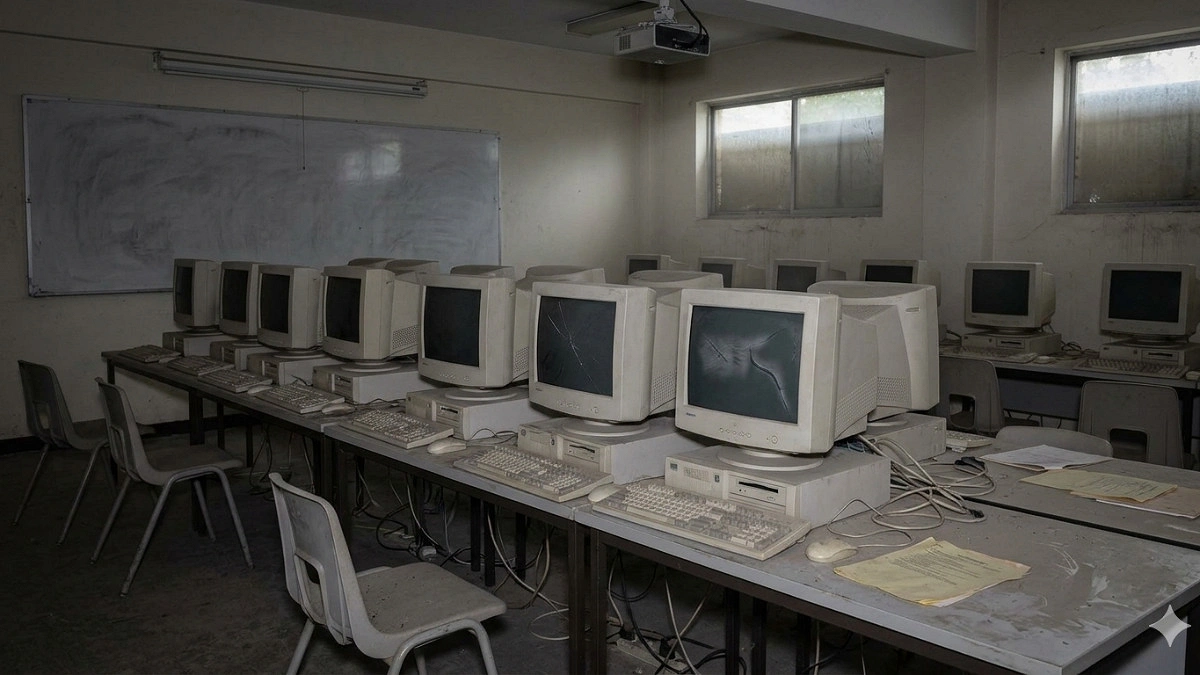
Representational image generated by AI.
"There is a computer lab in our school, but I have never been able to operate a computer properly," said a tenth-grade student from Jamalpur Zilla School. Out of 27 computers in this institution, only seven are functional. The rest of the machines have been lying broken for a long time. There are no teachers, and regular classes do not take place either. Consequently, "digital education" remains confined merely to a chapter in a textbook for them.
With the goal of building a "Smart Bangladesh" from a "Digital Bangladesh", modern digital labs have been set up in thousands of educational institutions across the country over the last decade. Under the Department of Information and Communication Technology, the first phase saw the establishment of labs in 4,001 educational institutions in 2014 through the project "Establishment of Computer and Language Training Labs in Educational Institutions Across the Country".
Later, the "School of Future" project was gradually expanded to thousands of other educational institutions. The objective was to build technology-based skills among students and prepare them for the future digital job market.
However, reality paints a different picture. These labs, set up at the cost of millions of takas in schools across different regions of the country, are now practically useless. In some places, computers lie damaged; elsewhere, there is no internet connection; and in some schools, despite having a lab, there is no ICT teacher. In many institutions, teachers of other subjects conduct lab classes in between their own schedules. Due to the pressure of their respective subjects, regular teaching is not possible.
Recent visits to several educational institutions in Jamalpur, Tangail, and Bandarban revealed that a major portion of the computers in most labs are non-functional. Out of 24 computers at Jamalpur Government Girls' High School, 10 are out of order. Meanwhile, in several schools in Bandarban, only 8 to 11 out of 17 laptops are functional.
Aside from the equipment, there is a severe crisis of ICT teachers. In one school in Jamalpur, no new recruitment has been made for a long time after the sole ICT teacher passed away. In several schools in Tangail, there are no government-appointed ICT teachers. Trained teachers of other subjects conduct classes once a week or shortly before examinations. In the hilly district of Bandarban, accounting or English teachers are conducting lab classes in some schools.
Students complain that due to the lack of regular classes, they are learning the ICT subject only by reading textbooks, but they get no opportunity to use computers in reality. Students from several schools in Tangail stated that they do not even know for certain whether their school has a digital lab. In some places, classes are held only a few days a year, while in others, a few practical classes are suddenly arranged just before exams.
Crowded Rooms and Budget Constraints Affect Tech Education
In many schools, the lab rooms are so small that there is not enough space for all students to sit together. For instance, at Balaghata Bilkis Begum High School in Bandarban, no more than 30 students can attend a class at the same time. As a result, many students are left out of hands-on learning opportunities. There are also allegations that this limitation is even more severe for female students.
School headmasters have expressed their frustration over the infrastructure remaining unused. They explained that due to the high cost of spare parts and limited budget allocations, it has not been possible to repair the broken computers for a long time. Consequently, the labs are lying practically useless. Furthermore, while many institutions keep the equipment stored away in anticipation of funding, they are unable to take any effective action.
In the national budget for the 2024-25 fiscal year, 44,109 crore BDT was allocated for the Secondary and Higher Education Division, and 2,873 crore BDT for the Information and Communication Technology (ICT) Division. Despite such large allocations, a major portion of these digital labs is not being utilized effectively at the field level.
Mohammad Saiful Hasan, Director General of the Department of Information and Communication Technology, told Agamir Shomoy, "We have assigned some officials to assess the current condition of the previously allocated computers. Once they submit their report, further steps will be taken".
However, the reality on the ground shows that even though numerous labs have remained in the same condition year after year, no effective intervention has been seen.
Educationist Aktar Banu believes the issue lies not just within the infrastructure but also in policy weaknesses. She stated, "Having an ICT teacher must be made mandatory for every school. Electronic equipment will break down, but students cannot be deprived of using them out of that fear. If we do not emphasize digital education, they will lag behind in global competition in the future".
According to education experts, this disparity in tech education could widen the digital divide between urban and marginalized students in the long run. While one group of students is becoming skilled in using modern technology, others are still deprived of even basic computer education opportunities.
Multiple attempts were made to contact Abdul Khaleq, Secretary of the Secondary and Higher Education Division of the Ministry of Education, and Professor Dr. Khan Moinuddin Al Mahmud Sohel, Director General of the Directorate of Secondary and Higher Education (DSHE), but they could not be reached.
Experts point out that merely creating technological infrastructure is not enough. Unless regular maintenance, teacher recruitment, and practical utilization are ensured, this investment will quickly become ineffective.
In many schools today, million-taka digital labs are nothing more than locked rooms filled with piles of broken machines. Thus, the question remains: is constructing infrastructure the true success of digital education, or is ensuring its effective use the real challenge?
• Report contributed by Moyna Akand (Jamalpur Correspondent), Abu Zubair Ujjal (Tangail Correspondent), and Monirul Islam Moni (Bandarban District Correspondent).
