

Education allocation rises, but Bangladesh still lags behind in South Asia

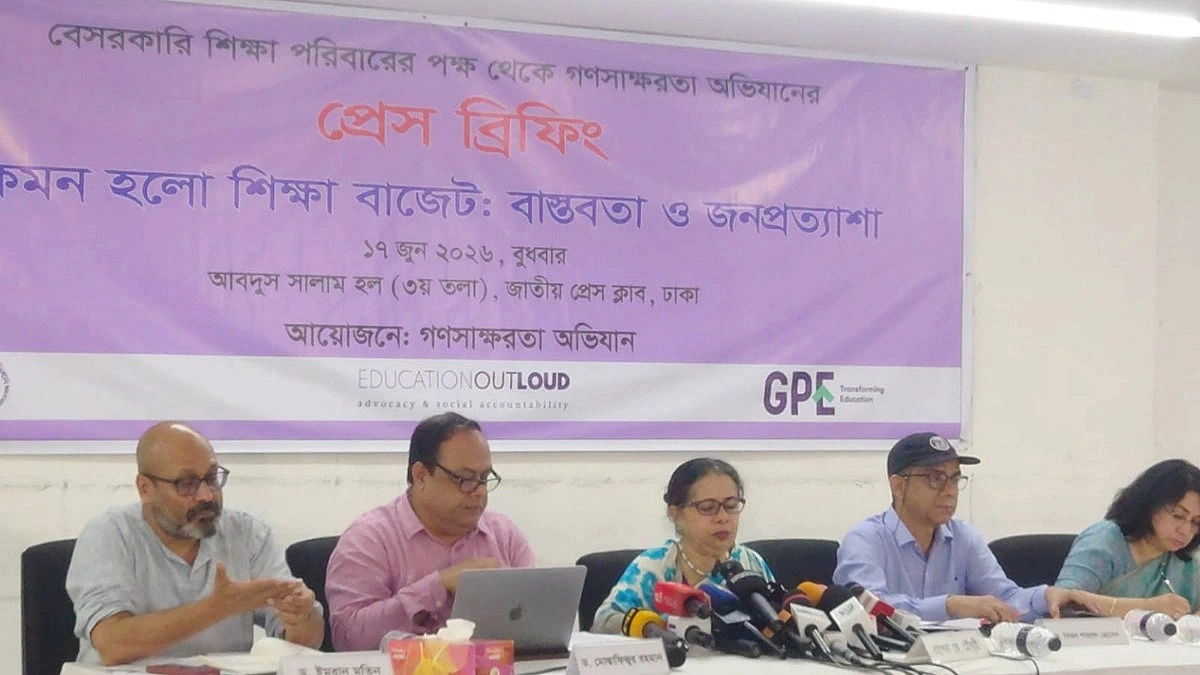
Collected Photo
In the proposed national budget for the 2026-27 fiscal year, development allocation for the education sector has increased by nearly 153 percent compared to the previous year. However, despite the substantial increase in the development budget, distinguished personalities believe that Bangladesh still lags significantly behind in total education expenditure when compared to international standards and other South Asian countries.
This information was revealed today (Wednesday) at a press conference titled "How is the Education Budget: Reality and Public Expectations" held at the National Press Club in the capital.
The press conference was organized by Gonosaksharata Abhijan (Mass Literacy Campaign), where the keynote presentation was delivered by the organization's Deputy Director, Dr. Mostafizur Rahman. The event was moderated by Rasheda K. Chowdhury, Executive Director of Gonosaksharata Abhiyan.
Presenting a comparative picture of the education budget at the press conference, it was stated that allocation for the education sector has been significantly increased in this year's budget compared to the previous fiscal year. In the last fiscal year (2025-26), the development budget for education was Tk 20,750 crore, which has been raised to Tk 52,597 crore in the proposed budget for 2026-27. Similarly, total expenditure in the education sector was 1.41 percent of GDP last year, which has now increased to 1.79 percent. However, the biggest change in education has come in the development budget.
In his keynote address, Dr. Mostafizur Rahman noted that according to UNESCO's recommendations, a country should spend 4 to 6 percent of its GDP on education. Compared to that, Bangladesh's total allocation is still much lower.
Giving examples of other South Asian countries under SAARC, he said that Bhutan spends 7 percent of GDP on education, the Maldives 5.2 percent, Nepal 5 percent, India 4.6 percent, Pakistan 2.7 percent, and Sri Lanka 1.97 percent. Every country in this region allocates a higher percentage of its budget to education than Bangladesh. However, he mentioned that the government has committed to raising this education budget to 5 percent within the next five years.
The press conference highlighted several positive and commendable steps in this year's budget. The government has decided to provide free school dresses, shoes, and bags for students. Additionally, several effective measures have been proposed, including mid-day meals, multimedia classrooms in schools, free Wi-Fi, and training for teachers on Artificial Intelligence (AI).
However, alongside these good initiatives, speakers also pointed out several shortcomings in the education budget. They stated that a significant disparity still exists between the quality of digital education in rural and urban areas. Furthermore, the budget did not reflect any clear vision on how to bring back those who are currently outside the formal education system or outside the school framework. To address this crisis, they demanded the announcement of a specific roadmap for allocating a substantial portion of the national budget to the education sector by 2030.
At the press conference, Dr. Imran Matin, Executive Director of BRAC Institute of Governance and Development (BIGD), commented that we are currently going through a deep learning deficit or learning crisis, which is becoming more severe. Even though a student in the country attends school for an average of 10 years, they only receive the necessary or quality education for about 6 years. The remaining 4 years that are being wasted represent our major crisis. It is possible to overcome this crisis by strengthening the student-teacher relationship, considering both empathy and accountability together.
Criticizing the government's policy-making process, Rasheda K. Chowdhury said that decisions in the education sector are often made hastily. For example, recently exam fees were imposed on students, only to be withdrawn amid intense criticism. The government must refrain from making such unintended and unplanned decisions in the education sector.
Dr. Fahmida Khatun, Executive Director of the Centre for Policy Dialogue (CPD), emphasized the efficiency of budget implementation and said that merely increasing budget allocations is not real development; the key issue is how that money is spent. Increasing government allocation does not automatically improve the quality of education. Often, it is seen that the entire allocation is not spent by the end of the year, getting stuck in bureaucratic pipelines. So we must increase our spending efficiency. While giving importance to visible physical infrastructure development projects, we must ensure that invisible yet essential developments like the quality of education do not lose priority, and strict monitoring must be maintained throughout the year.

