
Vice-Chancellor Appointments: Govt Changes, Process Remains Same

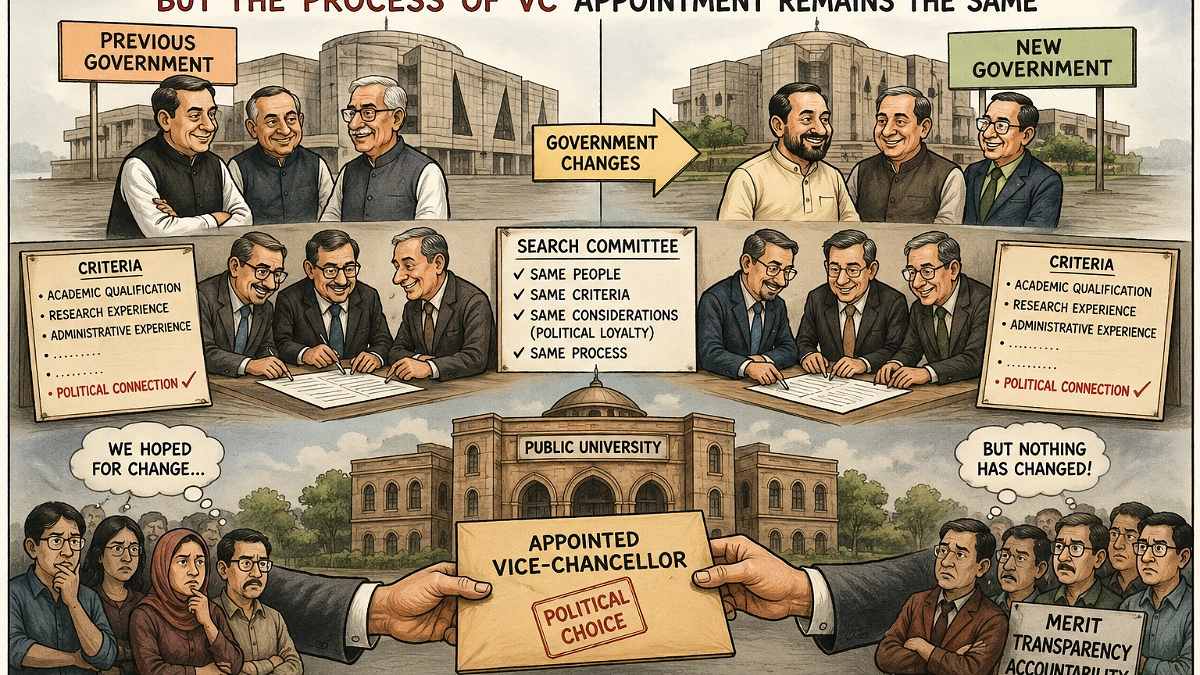
Representational Image generated by AI.
There is no clear or effective standard for academic qualifications, research credentials, or administrative experience in appointing vice-chancellors (VCs) at public universities in Bangladesh. For more than two decades, partisan considerations have been the primary basis for such appointments—an allegation that has persisted despite changes in government.
After the July 2024 mass uprising, there were signs of a different approach in university administration, including initiatives to form search committees. However, according to stakeholders, those processes did not prove effective. While overt political influence appeared to lessen briefly, most appointed VCs still had links to one political group or another. Since the new political government took office, that trend has become even more pronounced.
Following the formation of the government in February, major changes were made across higher education administration. New vice-chancellors were appointed at institutions including University of Dhaka, University of Rajshahi, University of Chittagong, Jagannath University, Khulna University of Engineering & Technology (KUET), Bangladesh Open University, and Dhaka Central University. Around the same time, the chairmanship of the University Grants Commission (UGC) was also changed. Most recently, last Thursday, the government appointed new VCs at 11 public universities simultaneously. In total, 18 vice-chancellors have been appointed since the Bangladesh Nationalist Party (BNP) formed the government.
Those involved say that despite expectations of reform in higher education governance, the old pattern continues. Most newly appointed VCs are known as BNP-aligned teachers. Some previously participated in the party’s election campaigns, while others held formal party posts. Multiple sources say that political considerations are influencing not only VC appointments but also the selection of pro-vice-chancellors, treasurers, and even deans.
Under the 1973 ordinance governing four autonomous universities—Dhaka, Rajshahi, Chittagong, and Jahangirnagar University—their respective laws stipulate that vice-chancellors should be elected by the university senate and then appointed by the President. In practice, this provision is rarely followed. For other universities, there are no defined criteria for VC appointments. While the President formally appoints vice-chancellors, the Ministry of Education sends a shortlist of candidates, which is finalized with the Prime Minister’s approval—a process that has remained unchanged for more than two decades.
Who Has Been Appointed
On March 16, Professor ABM Obaidul Islam was appointed Vice-Chancellor of the University of Dhaka. He is a professor in the Department of Physics at Dhaka University and serves as the BNP’s education affairs secretary. After the July uprising, the interim government had appointed him Vice-Chancellor of Bangladesh Open University. He was also seen participating in election campaigning during the 2026 parliamentary election period and had purchased a nomination form to contest the 2018 election from the Bagerhat-4 constituency on a BNP ticket.
On the same day, Professor Mamun Ahmed, Pro-Vice-Chancellor of the University of Dhaka, was appointed Chairman of the University Grants Commission (UGC). He had previously served as convener of the White Panel, an organization of BNP-leaning teachers. A professor of the Department of Biochemistry and Molecular Biology, Mamun Ahmed was also an adviser to BNP Chairperson Khaleda Zia and served as president of Jatiyatabadi Samajik Sangskritik Sangstha (JASAS), the BNP’s social and cultural affiliate. It is also known that he sought BNP nomination from the Lakshmipur-1 constituency in the 2018 election.
Professor Abdus Salam was appointed Pro-Vice-Chancellor (Academic) of the University of Dhaka. He is currently a joint convener of the Dhaka University White Panel. Professor Dr Mohammad Almojaddedi Alfeshani was appointed Pro-Vice-Chancellor (Administration). He is an adviser to the Ziaur Rahman Foundation, a former convener of the White Panel of the Faculty of Biological Sciences, and former secretary general of the Nationalist Research Foundation.
At University of Rajshahi, Professor Md Faridul Islam of the Department of Marketing was appointed Vice-Chancellor. He is the general secretary of the university’s Zia Parishad. The new Vice-Chancellor of the University of Chittagong is Mohammad Al-Forqan, a professor of the Department of Genetic Engineering and Biotechnology and senior vice-president of the Nationalist Teachers’ Forum.
At Jagannath University, Professor Rais Uddin, chair of the Department of Islamic Studies, was appointed Vice-Chancellor. He is currently president of the Teachers’ Association and general secretary of the White Panel.
Professor AKM Matinur Rahman of the Department of Public Administration was appointed Vice-Chancellor of Islamic University. He was the founding convener of the White Panel there. At Comilla University, Professor MM Shariful Karim was appointed Vice-Chancellor. He currently serves as vice-president of the central committee of the University Teachers’ Association of Bangladesh (UTAB). In addition, most newly appointed treasurers, deans, and other senior administrative positions across universities have also gone to BNP-leaning teachers.
Questions Over the Search Committee
In May 2025, a “search committee” was formed to recommend vice-chancellors for all public universities in the country. Based on its recommendations, a vice-chancellor was appointed at Khulna University of Engineering & Technology. However, the process was not followed thereafter. After the BNP formed the government, the Ministry of Education reconstituted the search committee in April.
The six-member committee is chaired by Abdul Khalek, Secretary of the Secondary and Higher Education Division. Other members include Dhaka University Vice-Chancellor Obaidul Islam, Rajshahi University Vice-Chancellor Md Faridul Islam, UGC member Professor Mohammad Tanzimuddin Khan, and Dhaka University Marketing Department professor Md Morshed Hasan. The Additional Secretary (University) of the Secondary and Higher Education Division serves as member secretary.
The composition of this search committee has also drawn criticism. Controversy has arisen over appointing a government secretary as its chair. Educationists argue that assigning the role of chair to the UGC chairman would have been more logical, as the UGC is the central authority for higher education in the country and is typically led by experienced academics. Such leadership would be more familiar with universities’ real challenges, research constraints, and academic needs. Similarly, appointing a reputed retired professor or an internationally recognized researcher could have made the committee more neutral and credible.
What Experts Say
Experts say that although many of the newly appointed teachers are individually well-regarded as researchers and academics, the visible influence of political identity in the appointment process raises concerns about the administrative neutrality of universities.
According to them, if political considerations dominate top university positions, there is a risk that academic freedom and space for dissent could be undermined. This could also increase partisan influence in administrative decisions and, in the long run, damage the overall quality of higher education.
Educationist Dr. Monsur Ahmed said, “It is not enough for someone to be a good teacher or researcher. The process by which they are appointed is equally important. If political identity becomes the main criterion for appointments, universities will gradually lose their character as independent institutions. Without reducing political influence, it will be difficult to build merit-based and accountable administration in universities.”
To improve the quality of higher education in Bangladesh, Professor Kamrul Hasan Mamun of University of Dhaka said there is a need for a dedicated higher education ministry and a higher education commission composed of qualified individuals. According to him, a search committee under such a body should handle vice-chancellor appointments, including both local and international members, from which honest and qualified candidates could be selected.
He further said, “Elected processes will never produce the most qualified vice-chancellors. To win elections, candidates must make various promises, and in fulfilling those promises, the quality of education will inevitably be compromised.”
Prominent educationist and political thinker Professor Abul Kashem Fazlul Haq said that whichever party comes to power in Bangladesh has historically appointed its close associates to top university positions. In his words, “Governments have changed, parties have changed; but the culture of university appointments has not changed.”
Responding to journalists’ questions on whether vice-chancellor appointments were politically influenced, Education Minister A. N. M. Ehsanul Haque said, “Is being involved in politics a crime?” He added that educational qualifications were given the highest importance and that appointments were made based on the best performance indicators for each university.
