
Any attempt to pull strings will be recorded in personal file.
- Government adopts zero-tolerance policy against administrative lobbying
- Cabinet Division issues letters to Secretaries, DCs, and UNOs to take action

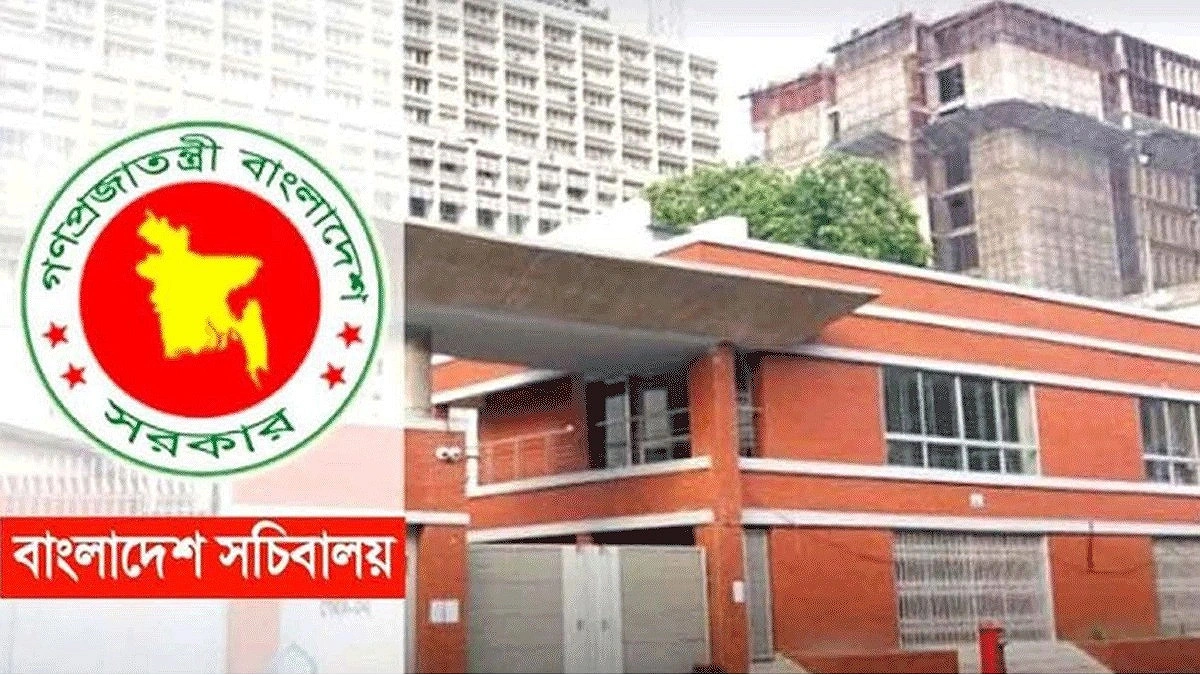
Graphics: Agamir Somoy
The Secretariat's Building No. 7 serves as the hub of the administration. Inside the office of a Minister of State, dozens of people—including Members of Parliament and District Council administrators—are sitting and standing; the room is packed to capacity. The minister's staff struggles to manage the crowd outside. Pointing to an official, one MP said to the minister, "He is my relative; post him in my constituency. The current official isn't listening (to me)." Another MP present remarked, "Change the engineer in my district. He is completely useless." Visibly frustrated, the minister muttered to himself, "Brother, what should I do? If I approve a posting at the request of one MP, another MP asks to cancel it—and I am forced to do that as well. I can't take this anymore."
A similar scene plays out at the Ministry of Health and Family Welfare.
Every day, this ministry receives at least two hundred applications for transfers, postings, and current-charge duties. However, not all applications make it onto the official record. Only those endorsed by a Minister, Minister of State, Advisor, or one of the two Secretaries are considered. A random check of seven applications in this ministry revealed that four involved nurse transfers recommended by an influential minister. The remaining three carried recommendations from powerful ruling-party ministers, whips, or state ministers.
The government is taking strict measures to stop such unwanted lobbying. The Cabinet Division has ordered departmental action against government employees who engage in unauthorized solicitation regarding service matters. Additionally, detailed information about lobbying done by third parties on behalf of an employee must now be recorded in their service dossier.
The Cabinet Division sent a memo with these instructions to all Senior Secretaries, Secretaries, Divisional Commissioners, Deputy Commissioners, and Upazila Nirbahi Officers. It states that employee conduct is governed by the Government Servants (Conduct) Rules, 1979. Recently, it has been observed that some government employees are sending outside individuals to authority figures to lobby for service-related matters. Such actions clearly violate Rule 20 of the 1979 rules and constitute misconduct under Rule 2(b) of the Government Servants (Discipline and Appeal) Rules, 2018.
The Cabinet Division emphasized that departmental proceedings must be initiated against any employee seeking unauthorized lobbying through third parties. Furthermore, details of any such attempts must be preserved in their dossier. However, employees remain permitted to submit formal requests regarding service matters through proper channels to their controlling ministry, division, or authority, which must logically resolve the application within one month.
The letter requests relevant authorities to issue necessary instructions to their respective subordinate offices and agencies regarding this matter.
Public administration expert A. K. M. Abdul Awal Mazumder welcomed the government's initiative. Speaking to Agamir Somoy, he said, "I view this initiative by the government positively. Lobbying and unauthorized solicitations are among the primary reasons for the degradation of the civil service. Although similar initiatives were taken in the past, they proved ineffective. If the government truly wants to curb lobbying, anyone on whose behalf lobbying is done must be deemed 'unqualified.' It is not enough to be financially honest; one must remain morally upright as well."
Investigations reveal that illegal transactions and lobbying are most prevalent in the education sector's transfer trade. Solicitation also surrounds the approval of infrastructure for educational institutions, often involving political party leaders. Lobbyists frequently use the names of journalists, senior officials from the Prime Minister's Office, or political affiliations. There have been several instances where the Education Secretary angrily left his office to escape such lobbyists.
A nearly identical scenario exists in other major ministries. Open lobbying occurs for recruitment, transfers, promotions, settlement of departmental proceedings, and clearance of tender bills. Ministries such as Home Affairs, Land, Public Administration, Law, Communications, and Housing and Public Works are constantly managing lobbying pressure. In these ministries, pressure begins as early as 10:00 AM at the offices of ministers, secretaries, and key officials. Lobbying under political identity far outweighs requests from ordinary citizens—people identify themselves as associates of ministers, MPs, political leaders, or relatives of MPs. Beyond general requests, bureaucrats face severe difficulties under pressure from influential circles.
Additionally, ministries face immense pressure when assigning officers to preferred postings. The Ministry of Public Administration experiences the highest volume of lobbying for positions such as Deputy Commissioners (DC), Upazila Nirbahi Officers (UNO), and officiasls on deputation roles. Officials actively leverage their respective networks to secure lucrative postings.
