
Hilsa switches its route

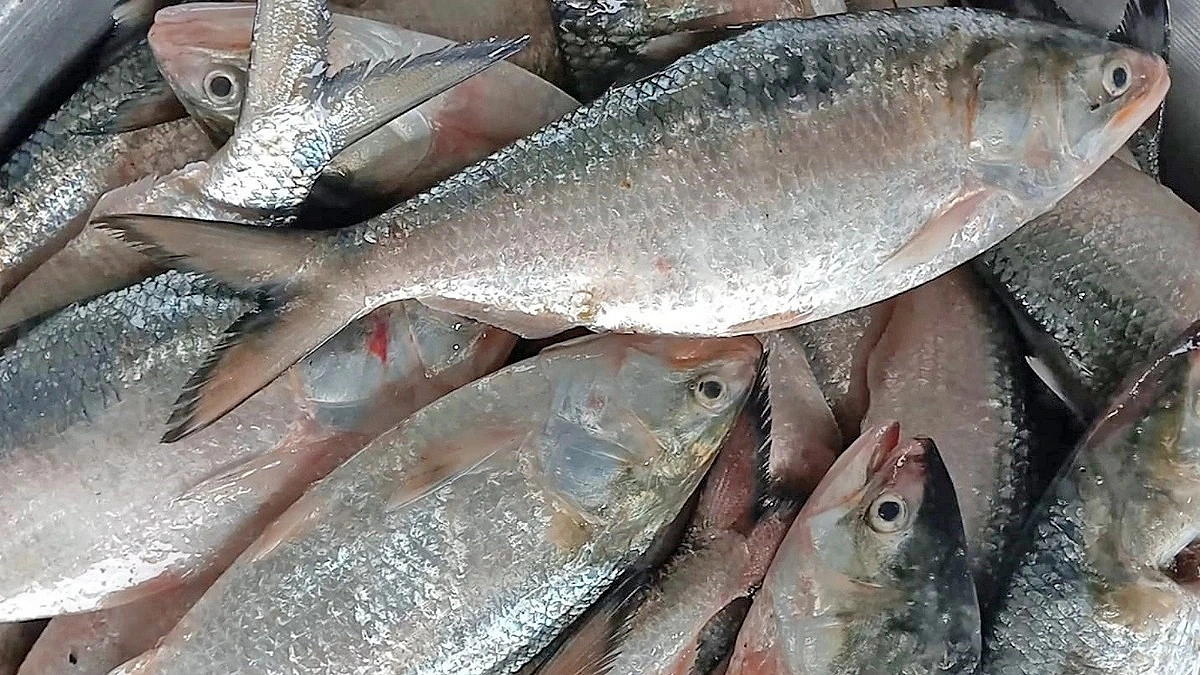
Photo: Focus Bangla
Researchers' fears seem becoming reality. Silver hilsa is changing its movement path, leaving the coastal regions for the deep sea—a crisis highlighted by the unprecedented import of hilsa from India.
Analysis of the Department of Fisheries' annual catch statistics reveals a worrying trend. Over the last three fiscal years, hilsa production has consistently declined. In FY 2022-23, catch stood at 571,342 tonnes. The following year saw a drop of 41,855 tonnes, and FY 2024-25 recorded a further decrease of 29,199 tonnes.
Senior hilsa researcher Dr. Anisur Rahman said that over the past three years, hilsa populations in Bangladesh's marine and inland waters have steadily dropped, nearly vanishing in many areas. Prof. Dr. Md. Sajedul Haq of the Department of Fisheries Technology at Patuakhali Science and Technology University (PSTU) shared similar views, calling the decline alarming. According to Prof. Haq, who has researched hilsa and marine fisheries for years, the lower catch compared to previous years is part of a global issue driven by climate change and rising temperatures. Hilsa are migratory fish that travel to lay eggs and return. If conditions are not right, they will neither stay nor spawn. Key factors like water salinity, food availability (plankton), and water temperature directly affect their lifecycle. High salinity prevents egg laying and hatching, lack of food stunts growth, and non-optimal temperatures prevent egg fertilization.
He added that river courses are changing and sandbars are forming, disrupting hilsa breeding. As a result, the fish migrate wherever conditions are suitable—gradually shifting deeper into the sea, toward international waters, or near India, a process known as population dynamics.
Dr. Anisur Rahman added that the traditional migration routes from the sea to rivers are disappearing due to siltation, shallow shoals, and sand extraction, forcing hilsa to seek new shelters in the deep sea. Meanwhile, Patuakhali District Fisheries Officer Bijon Kumar Nandi cited industrial and plastic pollution as major factors driving hilsa and other marine species away from the coasts.
While Bangladesh historically produced over 80 percent of the world's hilsa and exported it to neighboring countries, recent shortages led to an unprecedented import of around 500 tonnes of hilsa from Gujarat, India, to stabilize the domestic market. Indian media reported that tons of Gujarati hilsa entered Bangladesh through the Petrapole land port over recent months.
Yusuf Majhi, a Kuakata fisherman with 40 years of experience, shared his perspective: "People who used to eagerly await our hilsa—where it was even a special feature on Durga Puja menus in West Bengal—are now supplying hilsa to our country. From what I understand, that fish doesn't taste as good. Although it comes from the Arabian Sea, the point remains that hilsa has become abundant around Gujarat over the past few years."
He added, "The researchers are right. There are fish in the deep sea, but mainly along the India-Bangladesh border area. It isn't possible for us to fish there, but there is no doubt that hilsa is shifting elsewhere."
Alongside natural climate change, human activity poses the greatest threat to hilsa reproduction. Local fishermen, trawler owners, and fish traders point primarily to uncontrolled and illegal fishing. The number of illegal trawling boats at sea has grown significantly. Trawling boats are relatively large wooden craft powered by high-capacity engines. Fishermen attach illegal behundi (set bag) nets to these engines and drag them through the sea for hours. These nets capture both adult fish and juvenile jatka, destroying the primary breeding grounds for hilsa and other marine species.
Yusuf Majhi from Rangabali sub-district explained, "There is a net called nandu. Forget about fish—even tiny insects get destroyed in their nets. If the fish cannot reproduce, what will be left for us to catch?"
Afzal Molla, president of the Patuakhali Mohipur Fisheries Association, stated, "Fishermen in Kuakata, Alipur, Mohipur, Rangabali, and Patharghata are getting no catch solely because of these illegal trawling boats. Trawlers actively pull nets in the exact spots where local fishermen work. They go out to sea with 40 to 50 barrels of fuel and operate around the clock, targeting small fish and juvenile stocks that swim near the surface in deep waters. General fishermen cannot set their nets because trawlers tear them apart."
He claimed that dishonest local traders collaborate with trawler owners from Chittagong, Bhola, and Banshkhali to run trawlers in this region, escaping heavy Coast Guard enforcement in those home districts.
The government's annual 22-day ban during the peak hilsa breeding season begins next month to protect mother hilsa migrating toward coasts and rivers to spawn. Without strict monitoring, the ban risks remaining a rule on paper alone. Hilsa researcher Dr. Anisur Rahman warned that if illegal nets capturing jatka and small fish are not properly controlled, the region's overall marine fishery reserves could soon face collapse.
