Redrawing the Map: Asia's New Maritime Reality
Grab, Dredge, and Defend: The New Rules of the South China Sea

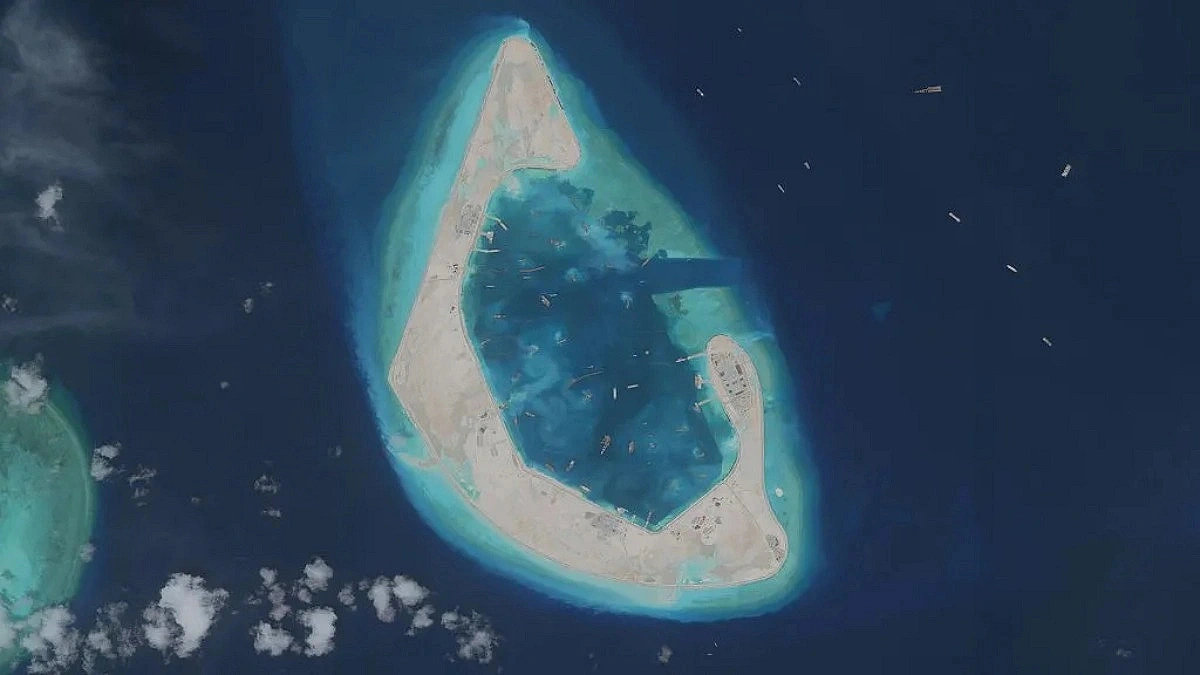
Satellite Image of Antelope Reef in the South China Sea.
A power struggle is ongoing over the occupation of coral reefs in the South China Sea. Artificial islands are being constructed one after another in this maritime region, through which various countries are strengthening their presence.
Vietnam and the Philippines have now joined this competition, which was initiated by China. As a result, rather than the discussion table, the competition of dumping sand on the sea surface to reclaim new land seems to have become the primary means of dispute resolution.
In this reality, a new principle is being established in the South China Sea: whatever one can control becomes the basis of one's power.
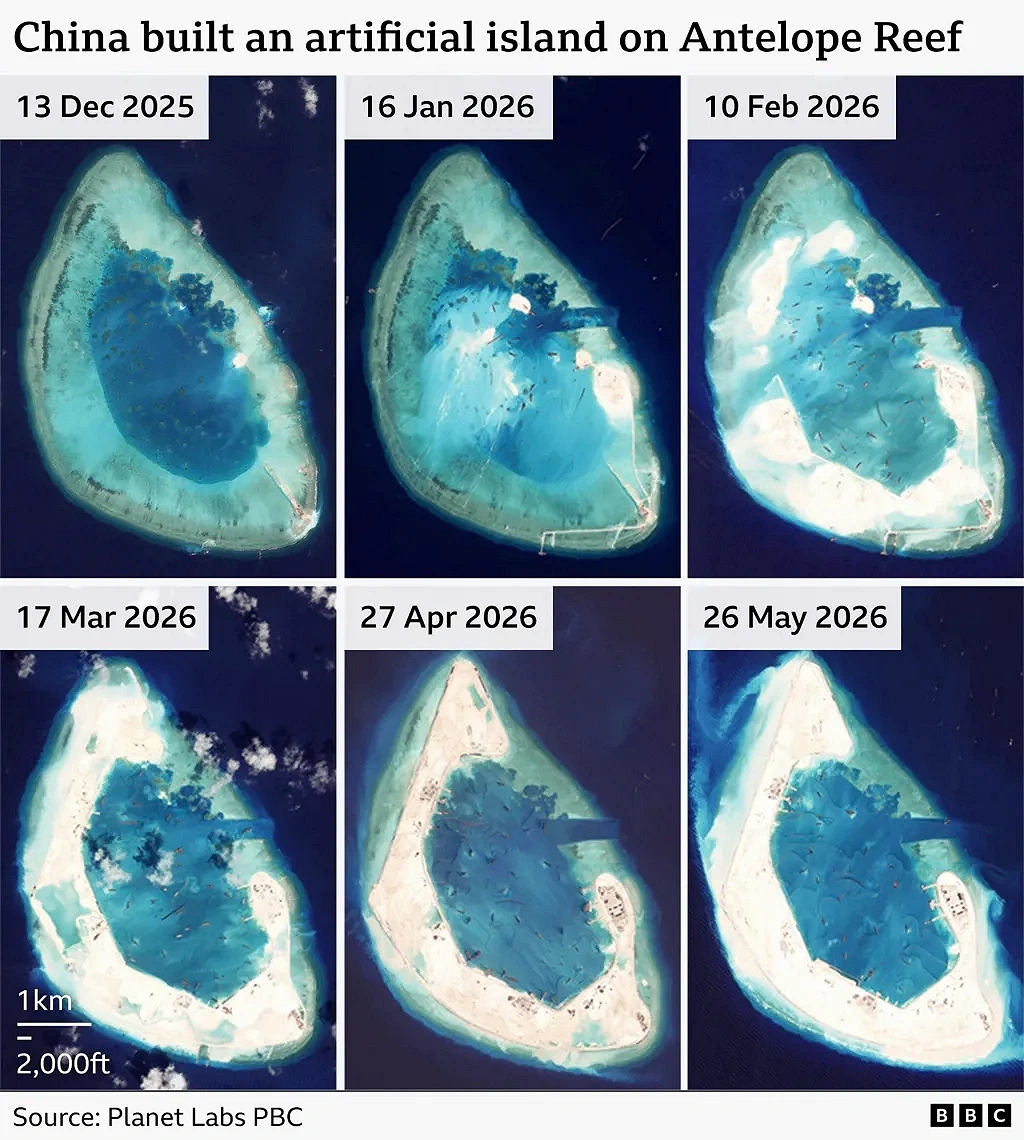
Antelope Reef is located in the northwestern corner of the South China Sea. It is a teardrop-shaped coral reef, most of which used to remain submerged underwater. But within just six months of this year, a dramatic transformation has occurred on this reef.
Millions of tons of sand have been dredged from the seabed and dumped to create new land. Previously, it was just a tiny turquoise dot on the map. Now, Antelope Reef has turned into a bright white, crescent-shaped island of approximately 6 square kilometers. Several structures have already been built at one corner of the island.
Numerous vessels can be seen in the shallow lagoon created inside the new land. Most of these are likely cutter suction dredgers, the largest fleet of which belongs to China. Several of these dredgers are capable of extracting up to 6,000 cubic meters of sand per hour—equivalent to filling about two Olympic-sized swimming pools.
This rapid land reclamation activity is probably close to a world record. But China is not the only one doing this.
After long observing China's aggressive land reclamation activities, Vietnam has now begun expanding the coral reefs under its control in the South China Sea. Although on a relatively smaller scale, the Philippines and other claimant countries are also following the same path.
A New Chapter in the Dredging War
Antelope Reef is located in the Paracel Islands. The Paracel and Spratly Islands have long been considered disputed areas among China, Taiwan, Vietnam, the Philippines, Malaysia, and Brunei. Most of these islands were previously submerged coral reefs with no permanent human habitation. After a bloody clash with South Vietnamese forces in 1974, China took control of the Paracel Islands.
Later, China carried out massive land reclamation in the Spratly Islands region—on Mischief Reef, Fiery Cross Reef, and Subi Reef—transforming them into artificial islands suitable for building airports and military bases. At the same time, based on the "Nine-Dash Line," China began claiming almost the entire South China Sea as its sovereign territory.
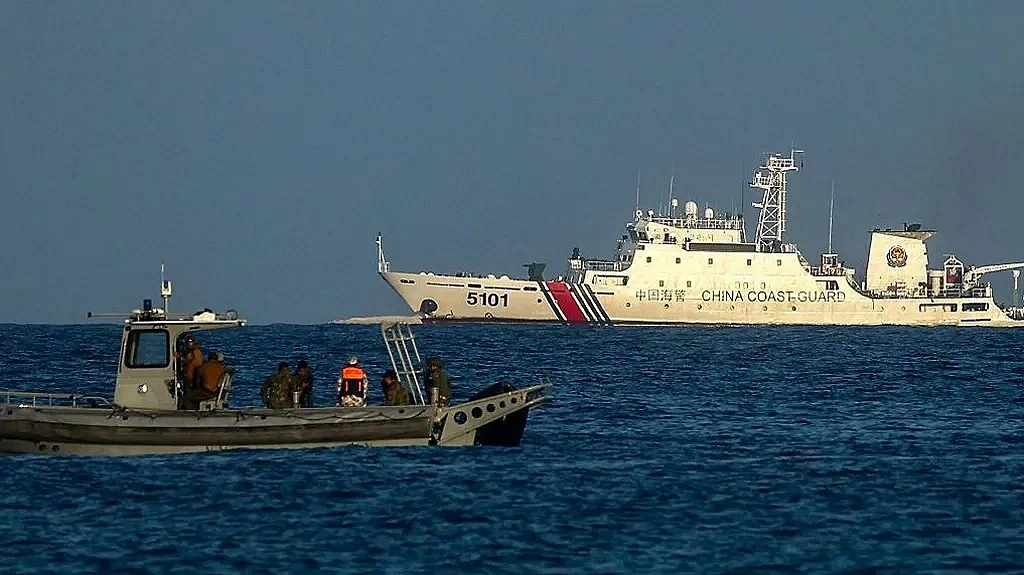
Currently, numerous Chinese coast guard and maritime militia vessels regularly patrol the region. This poses a challenge for other claimant countries. In recent years, multiple clashes have also occurred with the Philippine coast guard.
Looking at the straightforward design of a section of the newly built beach on Antelope Reef, it is speculated that China may construct a new military-grade runway there. However, they already have a functioning airbase on nearby Woody Island. This raises questions about the need for a new runway.
According to analysts, the purpose of this project is more about sending a political message to Vietnam than about military necessity.
Vietnam's Counter-Strategy
The South China Sea is known as the East Sea in Vietnam. The dispute between the two countries over this region is long-standing.
However, in recent years, Vietnam's Communist leadership has reduced its overt anti-China rhetoric. They have focused on improving relations with Beijing.
This year, newly elected President and Communist Party General Secretary To Lam made his first state visit to China. During that visit, both countries mentioned their differences over the Paracel and Spratly Islands in relatively flexible language.
Vietnam has lodged a formal protest against China's construction work on Antelope Reef, but it was diplomatic and restrained in tone.
Meanwhile, in practice, Vietnam is also using similarly powerful dredgers to expand the coral reefs under its control.
Over the past three years, the country has reclaimed land by dumping sand on at least 20 reefs. According to the Washington-based Asia Maritime Transparency Initiative (AMTI), they have also constructed 11 new ports.
Currently, the amount of reclaimed land under Vietnam's control exceeds 11 square kilometers—approximately half of the area reclaimed under China's control.
Vietnam has now begun constructing military infrastructure such as navigation beacons. According to many analysts, Vietnam's strategy is: "If you can't beat China, follow its strategy."
Greg Poling, director of AMTI, said, "Vietnam did not want to be at the forefront of the propaganda war against China. They instead allowed the Philippines to take that role. But in practice, they have taken a much firmer stance against Beijing at sea."
China's Message
According to Ray Powell, director of the Stanford University-based monitoring group Cilite, China's main focus recently has been on the Philippines. Vietnam took advantage of this opportunity to advance its rapid land reclamation activities.
In his words, China's new project on Antelope Reef can be seen as a message to Vietnam, meaning: "China is still the strongest player in this area."
Diplomatic Stalemate
For three decades, the Association of Southeast Asian Nations (ASEAN) has been trying to create a code of conduct between China and concerned member states regarding the South China Sea.
A relatively weak declaration was adopted in 2002, but it was not binding and has largely been ignored by China.
Every year at ASEAN summits, commitments are made to an effective code of conduct, but no significant progress has been made in practice.
In this situation, the Philippines took the matter to the Permanent Court of Arbitration in The Hague, Netherlands, in 2013.
The court ruled in favor of the Philippines, stating that the "Nine-Dash Line" is a fictional boundary for China's historic claims to the South China Sea. Based on this, China's claim to sovereignty is not historically valid. At the same time, activities such as transforming coral reefs into artificial islands violate international law and have infringed upon the Philippines' exclusive economic zone rights.
But China has rejected that ruling.
After that, the Philippines, with its relatively weak navy and coast guard, adopted a strategy of challenging China's presence and drawing international attention. Although multiple clashes have occurred, the balance of power has not changed significantly.
At the same time, the Philippines has strengthened military cooperation with the United States, Japan, and Australia. The US has provided the country with new military equipment, including $500 million in military aid.
Additionally, the US and its allies regularly conduct naval patrols in the South China Sea through "Freedom of Navigation Operations." These are meant to demonstrate that these waterways are still recognized as international sea routes. However, these operations are largely symbolic in significance.
Meanwhile, the Philippines is also strengthening its positions under its control. Work is ongoing to expand the runway on Pagasa (Thitu) Island, establish coast guard bases, and reinforce the BRP Sierra Madre vessel stationed at Second Thomas Shoal.
The New Reality
According to analysts, the possibility of implementing the long-discussed binding code of conduct in the South China Sea is becoming increasingly slim.
In Greg Poling's words, "China continues to do whatever it wants at sea and is gradually eroding the sovereign rights of others. So, in the end, a non-binding understanding might be achievable rather than a binding code."
In his view, in that situation, Vietnam, the Philippines, Malaysia, and other countries may seek more effective negotiation paths outside of ASEAN.
The current reality of the South China Sea seems to send only one message: every country is busy protecting the areas under its control, and everyone accepts that the strongest and most aggressive power in the region is still China.
Source: BBC