


Nepal scrambles for answers as deadly flash flood ravages border region

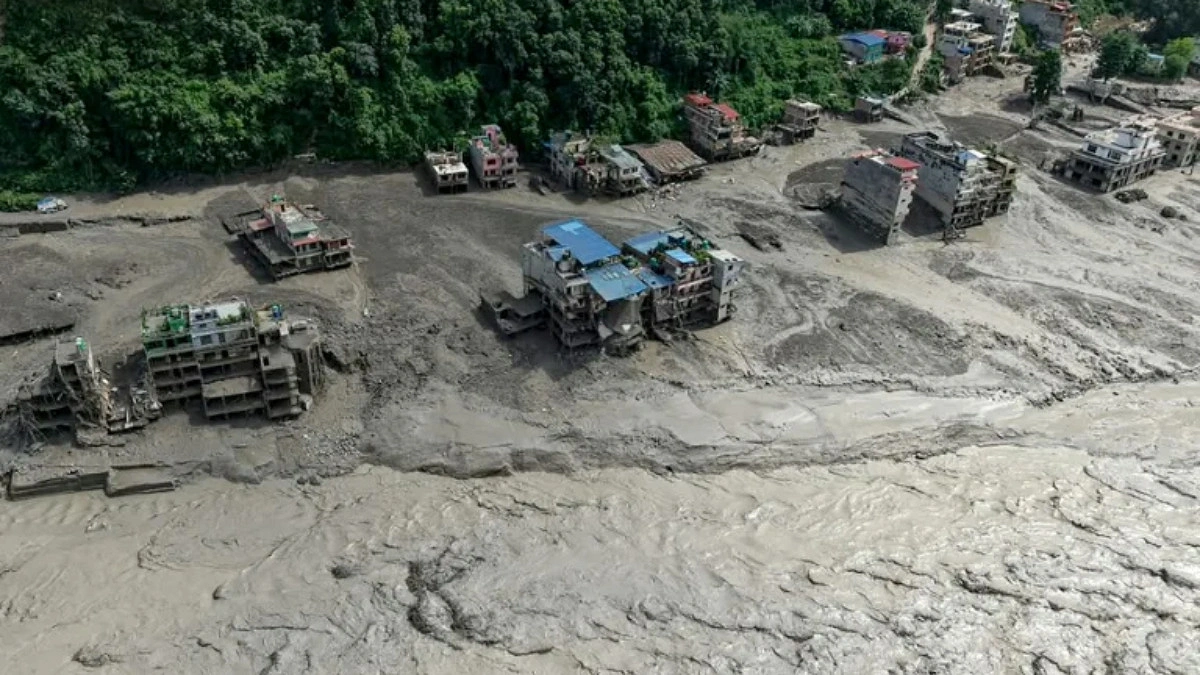
Photo courtesy: BSS.
A catastrophic flash flood tore through Nepal's Bhotekoshi river basin on Wednesday, killing 162 people, destroying villages, and crippling infrastructure along the Nepal-China border. Yet, officials on both sides remain baffled by what triggered the disaster—one of the country's worst since the 2015 earthquakes.
The leading theory points to a glacial outburst possibly set off by a magnitude 4.4 earthquake that struck neighbouring Tibet at 8:37 am, according to the US Geological Survey. The flood was reported just three minutes later, at 8:40 am, Foreign Minister Shisir Khanal told Parliament. But he cautioned: "We, however, need to verify this."
Preliminary satellite imagery from Planet Labs, analysed by Nepal's National Disaster Risk Reduction and Management Authority, suggests a glacial-rock slide along the border—roughly 20 kilometres northeast of the Rasuwagadhi crossing—sent a torrent of debris and water into the Lhende river. The surge then barrelled through Timure and into the Trishuli river, sweeping away everything in its path, reports Nepal's English daily, The Kathmandu Post.
Despite these clues, authorities have not established the exact cause. It is the second such event to strike the region in under a year, raising concerns about glacial stability and seismic risks in the high Himalayas.
"We are seeking real-time data from Chinese authorities and Nepali research institutions," Khanal told the Post, explaining that bad weather has grounded scientific teams and cut off access to the remote border area. "Since there is no one at the border point and no information is available from the scientific community, we are reaching out to every possible source."
Laxmi Prasad Niraula, Nepal's consul general in Lhasa, said communication blackouts have compounded the confusion. Roads, internet, and phone networks are down across the affected zone, and neither side has been able to contact security personnel stationed along the frontier.
"The Chinese are also clueless about the reason behind the outburst," Niraula said. "We suspect it may have been a glacial outburst, but that has not yet been confirmed. The scientific community is struggling to narrow down the cause."
As rescue and relief efforts intensify, international support has poured in—offers of assistance have come from India, China, the United States, and the World Bank. But for now, the fundamental question remains unanswered: what unleashed the deadly wall of water, and what does it mean for a region already bracing for more climate-driven disasters?
The flood, one of Nepal's worst since the 2015 earthquakes, ravaged villages, swept away bridges, and claimed multiple lives along the Nepal-China border. While early suspicions pointed to a glacial outburst possibly triggered by a magnitude 4.4 earthquake in Tibet on Wednesday morning, that theory has yet to be confirmed.
Satellite Scans and Rainfall Theories
Laxmi Prasad Niraula, Nepal's consul general in Lhasa, said Tibetan authorities are now using satellite data and information from ground contacts to determine the cause. One emerging possibility is heavy rainfall in the Manasarovar and Ali areas on Tuesday, which may have contributed to the surge.
"The Chinese side is currently investigating this possibility," Niraula told the Post.
But he conceded that investigators have not even established where the flood originated. "They haven't yet been able to determine not only the cause of the flood, but also where and from what point it originated," he said.
Communication blackouts are compounding the confusion. Roads, internet, and phone networks remain severed across the affected zone, and neither Nepali nor Chinese officials have been able to reach their own security personnel stationed along the border. Beijing-based scientists are also working to narrow down the triggers, according to Foreign Minister Shisir Khanal, but bad weather has hampered field access.
A Familiar Pattern—and a Broken Promise
The disaster has revived painful memories of a nearly identical event in July last year, when a glacial lake burst about 35 kilometres upstream from the Rasuwagadhi border point. That surge tore down the Lhende Khola and Bhotekoshi, affecting communities over 80 to 100 kilometres downstream, killing at least 11 people, and washing away the Miteri (Friendship) Bridge at Rasuwagadhi.
Following that tragedy, Nepal and China agreed to share real-time cross-border data on floods, landslides, and glacial lake outburst risks. But no formal agreement has ever been signed to operationalise that mechanism. The issue was raised again during Khanal's visit to China in May, yet the two sides remain without a binding arrangement.
The absence of a functioning early-warning system has sparked fresh concern among disaster experts, especially as climate change accelerates glacial melt in the high Himalayas.
Warnings and Evacuations
After Wednesday's floods, Nepal's government issued multiple alerts to communities along the Bhotekoshi, Trishuli, and Narayani rivers, urging residents to move to safer locations in case of further surges. So far, no secondary flooding has been reported.
International Support Pours In
As rescue and relief efforts intensify, Nepal's neighbours and global partners have stepped forward with offers of assistance. India, China, the United States, and the World Bank have all expressed readiness to support rescue, relief, and reconstruction.
Indian Prime Minister Narendra Modi conveyed his condolences to Prime Minister Balendra Shah in a phone call, saying the people of India stand with their Nepali "brothers and sisters." According to diplomatic sources, Indian Air Force C-17 and C-130 aircraft, loaded with earthmoving equipment, relief supplies, and medicines, are on standby, along with disaster response teams.
Foreign Minister Khanal confirmed that India has already communicated its readiness to send immediate relief materials. China has also offered support, Khanal said, adding that Nepal is currently assessing its specific requirements before formally requesting aid.
For now, however, the fundamental question lingers: what exactly triggered the wall of water—and how can two countries that share this fragile mountain frontier prevent the next one from becoming another tragedy?
International Aid Mobilizes for Nepal Following Devastating Floods
Foreign governments and global financial institutions are moving quickly to coordinate emergency aid and financial assistance for Nepal as the country reels from widespread flooding.
In a Cabinet meeting on Wednesday, the Nepali government officially declared affected municipalities across Rasuwa, Nuwakot, and Dhading as "crisis-hit zones," clearing the legal path to mobilize both domestic and international support.
Global Relief Efforts Underway
India: Relief supplies are expected to arrive in Kathmandu shortly. Indian authorities have requested an urgent list of required supplies from Nepal. High-level discussions—involving Prime Minister Khanal, Finance Minister Swarnim Wagle, and other senior officials—are active to streamline the delivery.
China: The Chinese government has committed immediate cash assistance, with Ambassador Zhang Maoming urging Nepal’s Finance Ministry to initiate the payout process.
United States: American officials have contacted Prime Minister Khanal to confirm readiness to back Nepal's disaster response.
World Bank: Country Director David Sislen notified Finance Minister Wagle that up to Rs 25 billion could be mobilized from various channels for emergency relief. It remains unconfirmed whether these funds will arrive as grants, loans, or alternative financing.
China Mobilizes High-Level Disaster Response
Following extreme weather impacts in the region, top Chinese leadership has initiated a full-scale emergency response:
Xi Jinping, Chinese President said: "Make every effort to search for and rescue missing people, relocate those at risk, and promptly treat the injured to minimize casualties."
Chinese Premier Li Qiang echoed the directives, ordering swift damage assessments, scientific rescue operations, and strict protocols to prevent secondary disasters. Premier Li also instructed China's Foreign Ministry to collaborate closely with affected neighboring countries.
In response to directives from Beijing, Chinese Vice Premier Zhang Guoqing has been tasked with leading a dedicated team of officials directly to the disaster sites to oversee relief operations. Additionally, authorities in neighboring Tibet mobilized active search-and-rescue teams on Wednesday to assist with the crisis.
(Kathmandu Post)

