
Xi to Visit North Korea After Seven Years, Kim Confident

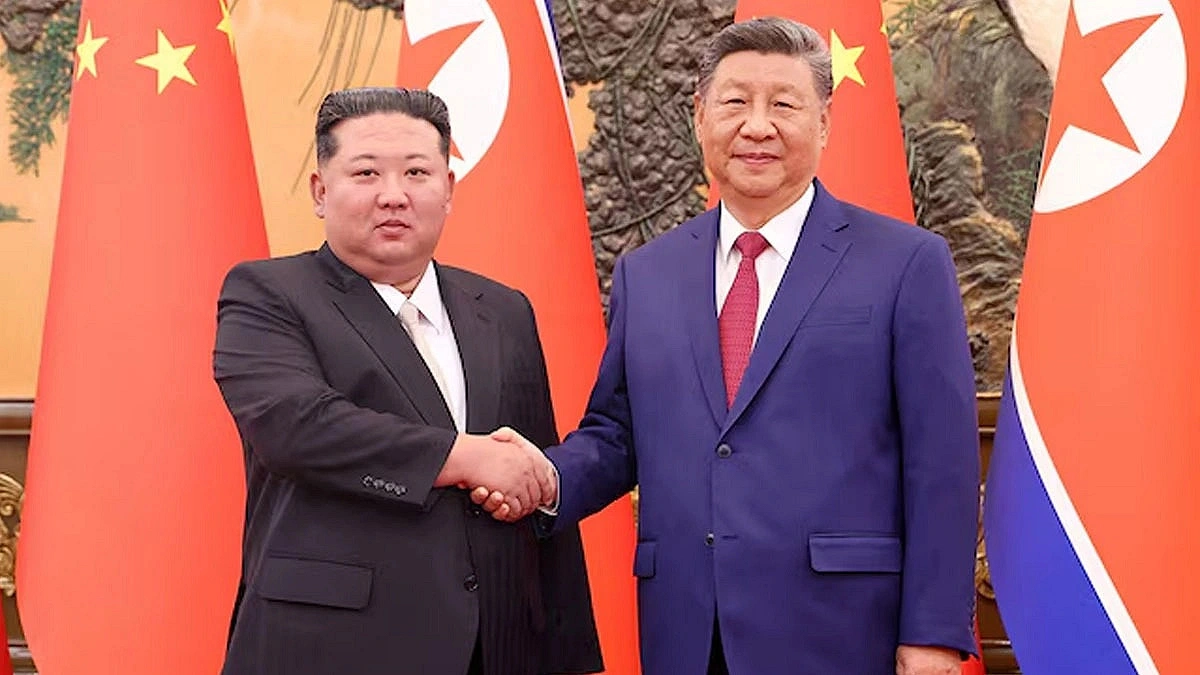
Photo: Agamir Somoy
Chinese President Xi Jinping is set to visit North Korea on a two-day trip. On Monday, he will be welcomed in Pyongyang by the country’s leader Kim Jong Un. With strong backing from a powerful ally like Russia, a large nuclear arsenal, and little interest in talks with Washington, Kim now sees himself in a position of considerable strength.
China is the world’s second-largest economy, and this two-day visit by its top leader to a neighboring country is highly significant. It will be Xi Jinping’s first visit to North Korea in seven years. The main objective is to bring Pyongyang back firmly into Beijing’s sphere of influence.
Last year, Xi hosted Kim and other world leaders at a massive military parade in Beijing. Since then, passenger train and flight services between the two countries have been partially resumed. This week’s high-level meeting is taking place in a completely different context from Xi’s first visit to North Korea in 2019. At that time, talks between Kim Jong Un and Donald Trump on North Korea’s nuclear program and the lifting of sanctions had collapsed. A few months later, the Chinese president visited Pyongyang.
Kim’s ‘Comeback’ and the Significance of Xi’s Visit
Since 2019, Kim has significantly expanded military and trade ties with Moscow. There have even been reports that he has sent troops to fight on Russia’s side in the war in Ukraine. Defying United Nations sanctions, North Korea has increased its nuclear capabilities and taken measures such as completely sealing its borders to prevent mass defections.
Just ahead of Xi Jinping’s arrival, North Korea sought to demonstrate its strength by announcing plans last Saturday to build a 10,000-ton naval destroyer. On Sunday, it also referred to itself as a “nuclear-armed state.”
Andrew Gilholm, an analyst at the consultancy Control Risks, commented, “Xi Jinping’s visit to Pyongyang is a very big deal. It essentially represents the culmination of Kim’s successful comeback over the past few years.”
In 2019, Kim gave the Chinese president a grand, almost royal reception. Thousands of people held placards forming Xi Jinping’s image and the Chinese flag, and the song “I Love You, China” was performed. However, relations between Beijing and Pyongyang have at times been strained over the nuclear program. Beijing has publicly opposed North Korea’s nuclear tests and called on it to abandon its nuclear weapons.
North Korea has always been cautious about becoming overly dependent on China, with which it shares a 1,400-kilometer border. In this regard, support from Russia helps Pyongyang maintain a balance.
According to John Delury, a senior fellow at the Asia Society, “By providing military support to Russia, North Korea is clearly benefiting economically. This has boosted its confidence to the point where it now feels comfortable expanding trade and investment with China as well.”
Focus on Tourism, Kim Firm on Nuclear Program
According to a regional diplomat, the real outcome of this meeting is likely to emerge in the area of economic cooperation. North Korea has currently adopted a five-year development plan that includes goals such as housing construction and developing tourism as a strong industry. At the start of 2020, due to the COVID-19 pandemic, North Korea imposed some of the world’s strictest border restrictions, completely halting the arrival of foreign tourists. Tourism had been one of the country’s main sources of foreign currency earnings.
Before the pandemic, Chinese tourists were the main driving force behind North Korea’s tourism sector, accounting for about 90 percent of all foreign visitors. In the post-pandemic period, in February 2024, a group of 100 tourists from Russia’s Far East became the first to be allowed to visit North Korea. Last month, after returning from a visit to North Korea, Singapore’s foreign minister said the country had made notable economic progress. Pyongyang, however, has shown no interest in holding talks with the United States or South Korea.
North Korea has recently officially abandoned its long-standing goal of reunifying the two Koreas, which have been divided since the Korean War of 1950–53. South Korean President Lee Jae-myung, however, remains interested in dialogue and has sought Xi Jinping’s mediation and cooperation on the issue.
Moon Chung-in, a professor at Yonsei University in Seoul and a former national security adviser, said, “Improving inter-Korean relations is possible through President Xi Jinping’s mediation. We are hopeful that President Xi will play such a role.”
However, Kim has drawn clear “red lines” on sensitive issues such as his nuclear program. Alongside Sunday’s announcement, he also ordered last Thursday that the country’s nuclear weapons stockpile be increased at a “geometric rate.”
Yang Moo-jin, president of the University of North Korean Studies in Seoul, believes that Kim will continue to expand the production of fissile nuclear material, deploy nuclear weapons, and promote the legitimacy of North Korea’s nuclear deterrent.
Christopher Green, a Korea expert at Leiden University in the Netherlands, commented, “Kim is now far more confident. He knows that as long as he does not create major instability in the region, Beijing will not stop him from expanding his nuclear arsenal. This assurance is what allows him to push forward his nuclear program openly and with extreme confidence.”
