

No Alternative to Building Skilled Human Resources to Stay Competitive: Prime Minister

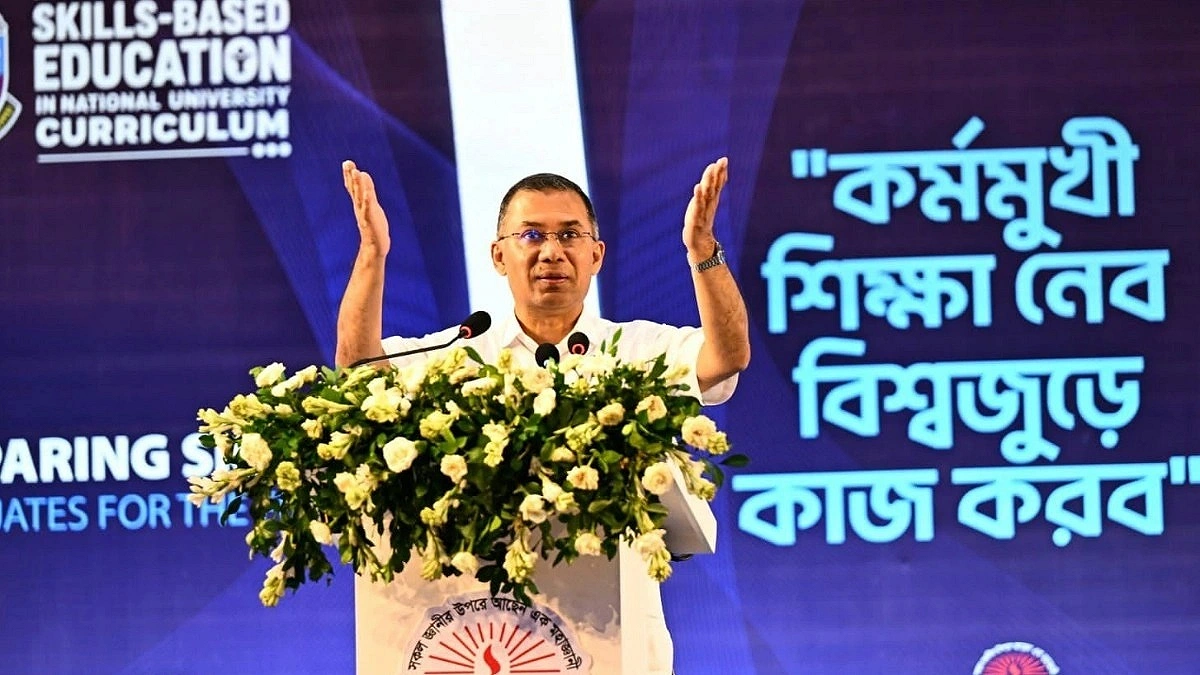
Photo: Prime Minister’s Office
Prime Minister Tarique Rahman has said that there is no alternative to developing skilled human resources in knowledge, science, and technology to remain competitive in the global arena.
The Prime Minister made the remarks on Sunday during the inauguration of a teacher training programme on “Skills-Based Education” in the curriculum of the National University in the capital.
He noted that although millions of students graduate from higher education every year, many remain unemployed due to a lack of practical and technological skills. To address this challenge, the government has taken various initiatives to prepare students to become employable and entrepreneurial from an early stage of education.
Criticising the previous administration, the Prime Minister claimed that more than a decade and a half of authoritarian rule had not only deprived people of democratic political rights but had also severely damaged the country’s education system and constitutional institutions.
He stressed that there is no substitute for building skilled human resources in science, knowledge, and technology to compete globally. He noted that more than 4 million students are currently studying in over 2,000 colleges under the National University.
Highlighting the importance of the university in expanding higher education, he said the institution was established in 1992 by former Prime Minister Khaleda Zia to ensure access to higher education for students in both urban and rural areas. Since then, more than 10 million students have completed higher education through the university.
The Prime Minister said the world has entered the era of the Fourth Industrial Revolution, where artificial intelligence and automation are eliminating some traditional professions while simultaneously creating many new opportunities. He emphasized that fundamental changes in the education curriculum are necessary to address this technological transformation.
He added that subjects such as artificial intelligence, cybersecurity and forensic science, programming, digital motivation, digital communication, and financial literacy should be integrated into curricula as essential soft skills. At the same time, he stressed that emerging fields like genetic engineering, biotechnology, quantum computing, Industrial Internet of Things (IIoT), nanotechnology, 3D printing, and 5G wireless technology must not be overlooked.
According to him, the government has already begun efforts to make education more employment-oriented from the primary to the highest levels.
Addressing teachers, the Prime Minister said the success of the education system depends on educators’ knowledge, skills, and integrity. He urged teachers to serve not only as instructors but also as role models and agents of social change.
He also called on the National University authorities to place equal emphasis on moral education, mental health, social inclusion, and environmental conservation, alongside technology-based learning, in order to help students grow into compassionate and responsible individuals.