Bodies Everywhere, Even Morgues Are Full

City Echoes With Cries for Missing Loved Ones
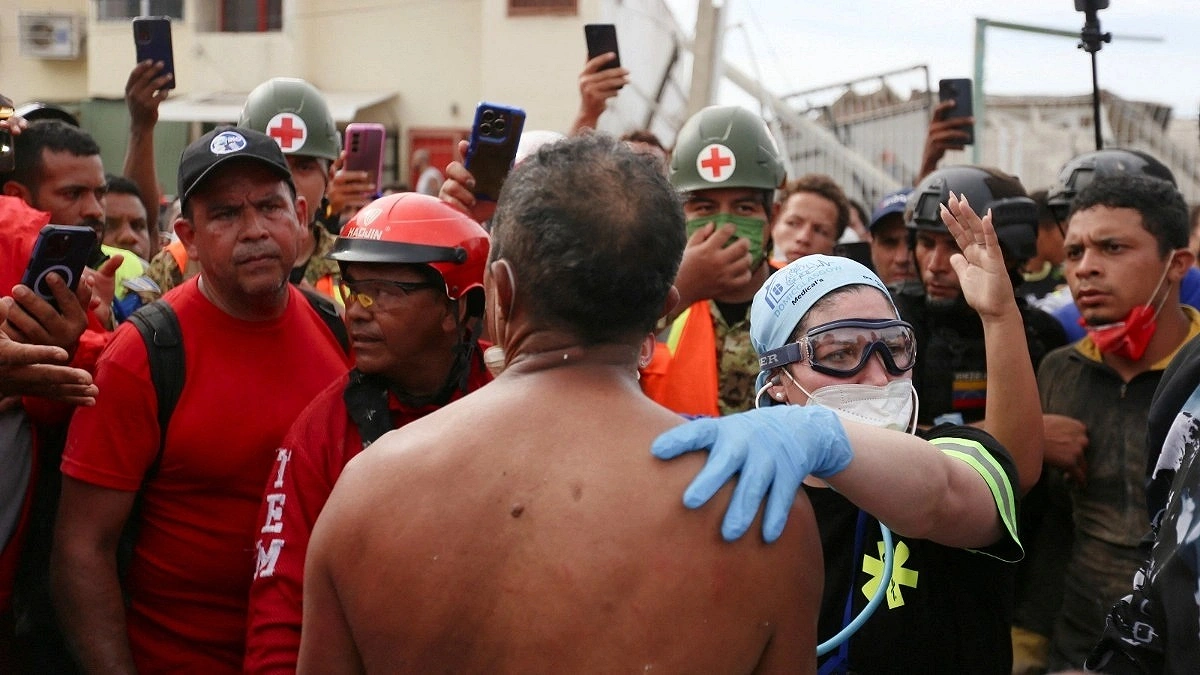
Bodies continue to arrive at Caracas' Bello Monte morgue by motorcycle, private car and pickup truck as families desperately search for loved ones killed in Venezuela's devastating earthquake.
The capital has turned into a city of mourning. Victims recovered from the rubble are arriving one after another, but the morgue is no longer able to keep up with the growing number of dead.
Two powerful earthquakes struck Venezuela's Caribbean coast on Wednesday, killing at least 1,430 people, according to official figures. Hundreds of apartment buildings collapsed, while tens of thousands of people remain missing. Authorities say it is the country's deadliest earthquake disaster in 126 years.
Outside the Bello Monte morgue, grieving families wait with photographs in hand, scanning lists of victims in hopes of finding missing relatives.
Camila Rodriguez, a psychology student volunteering at the site, has been providing emotional support to grieving families.
“Yesterday, the entire street was packed with people,” she said.
Among those waiting was Marjorie Cedeño, who lost her mother, father and brother when their four-story apartment building collapsed in Caracas' upscale Los Palos Grandes neighborhood.
By Friday night, she had identified only the body of her 44-year-old brother, Jose Ruiz. Family members said he had been outside when the earthquake struck but rushed back into the building to rescue his parents. He never made it out.
The bodies of his mother, 72-year-old Zoila Cedeño, and father, 74-year-old Jacinto Ruiz, remain trapped beneath the rubble.
“The scenes inside the morgue cannot be described,” Marjorie said. “I hope no one ever has to experience a tragedy like this.”
Belkis Cedeño is enduring a similar ordeal. She came from the coastal state of La Guaira searching for her 56-year-old relative, Maria Elena Moreno, after a 10-story apartment building collapsed.
Initially, the family was told Moreno had been rescued alive. But confusion caused by a false tsunami warning circulating on social media disrupted rescue operations, and she died before reaching the hospital.
As the crisis deepens, ordinary citizens have stepped in to help. Funeral service workers from across the country have donated more than 200 coffins, body bags and other supplies. Volunteers are distributing food, water, coffee and psychological support to survivors and grieving families.
Hundreds of families have taken shelter in tents across the city, with many too frightened to return to their homes.
Frustration is also growing over the government's response. Many residents say they were largely left to fend for themselves during the critical first hours after the disaster.
Despite the destruction, the smell of death and the long wait for news, acts of compassion continue to emerge.
“There may not be enough government assistance,” Marjorie Cedeño said outside the morgue. “But people have never stopped helping one another. In this difficult time, humanity has stood by humanity.”