
Patriot Missile Production: Ukraine faces tough challenge despite Trump's pledge

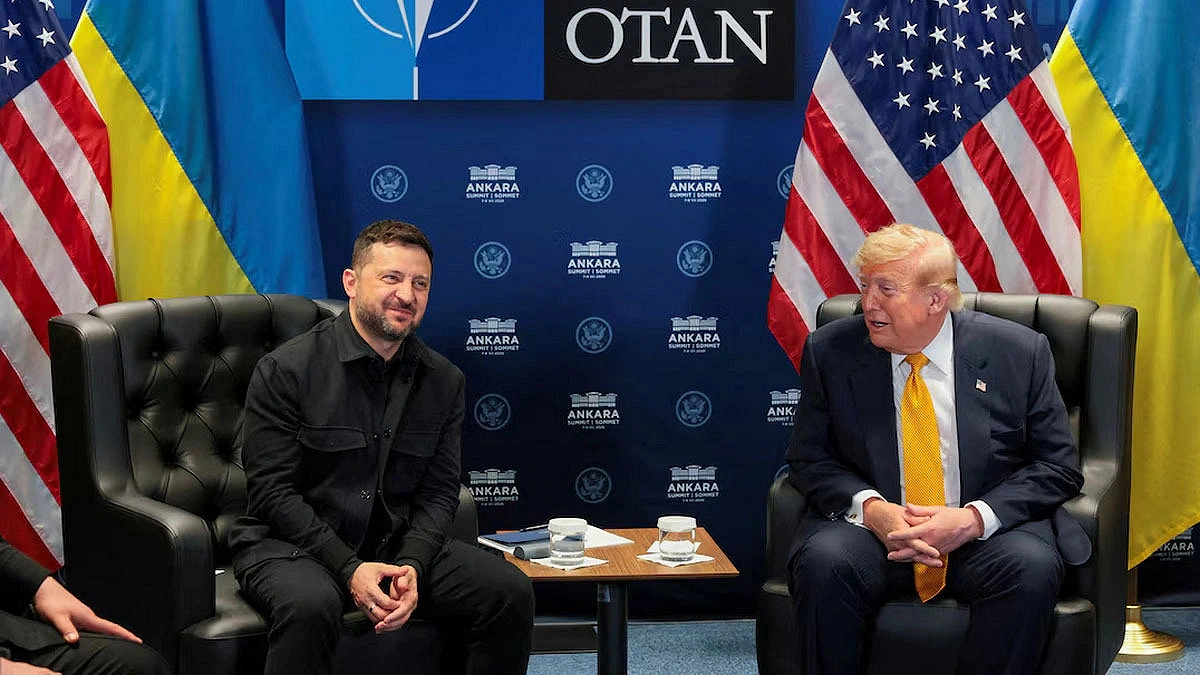
Zelenskyy and Trump on the sidelines of the NATO summit in Turkey – Reuters
Ukrainian President Volodymyr Zelensky has secured a pledge from U.S. President Donald Trump to support the production of Patriot air defense missiles, a move widely seen as a major diplomatic victory for Kyiv. However, defense experts warn that it could take at least a year—or even longer—before production begins. In the meantime, Ukraine is expected to continue facing a severe shortage of interceptor missiles, forcing difficult decisions over which critical assets to protect from Russia's ongoing missile attacks.
Trump made the commitment during a meeting with Zelensky on the sidelines of the NATO summit in Ankara on Wednesday. The pledge carried significant geopolitical weight, signaling a dramatic improvement in relations following their strained White House meeting in February 2025.
Patriot missiles remain crucial to Ukraine's defense. According to Zelensky, Russia has shifted its focus to ballistic missile strikes after failing to gain a decisive advantage on the battlefield. The Patriot system is currently Ukraine's only effective defense against Russian ballistic missiles. This month, Kyiv managed to intercept only four out of 54 hypersonic ballistic missiles launched by Russia.
Despite the announcement, uncertainty remains over how the plan will be implemented. Trump acknowledged that he had not yet discussed the proposal with Patriot manufacturers Lockheed Martin and Raytheon. Defense analysts say establishing a new assembly facility and organizing subcontractors would take considerable time, making it unlikely that production of Raytheon's PAC-2 or Lockheed Martin's more advanced PAC-3 interceptors could begin quickly.
Fabian Hoffmann, a missile expert at the Norwegian Institute for Defence Studies in Oslo, said the short-term impact would be very limited.
"I would be surprised if production starts in less than 12 months," Hoffmann said. "My expectation is that it will take even longer."
A comparable example is Raytheon's agreement with European defense manufacturer MBDA in 2024 to produce PAC-2 missiles in Germany. The first deliveries from that project are not expected before 2027.
Since Russia's full-scale invasion in 2022, Ukraine has rapidly expanded its domestic military technology capabilities. However, defense experts note that developing systems capable of intercepting missiles traveling several times the speed of sound remains one of the greatest challenges in missile engineering.
Serhii Beskrestnov, an adviser to Ukraine's Defense Ministry, said there is still uncertainty over how long subcontractors will need to increase production of the scarce components required for the missiles.
Germany could play an important role in accelerating the process because it already has a PAC-2 production chain. According to two sources familiar with the matter, the new interceptors could initially be manufactured in Germany or another secure European country before production is eventually transferred to Ukraine after the war.
Zelensky said technical teams would finalize the details as quickly as possible. He added that Ukraine hopes to begin domestic production at the earliest opportunity and expects a shipment of PAC-3 interceptors from the United States to arrive within the next few days.
According to defense experts, global production of Patriot missiles remains far below what would be required to counter Russia's ballistic missile threat. Russia is estimated to manufacture between 700 and 800 Iskander and Kinzhal ballistic missiles each year. Since it typically takes at least three Patriot interceptors to ensure the destruction of a single ballistic missile, Ukraine would require roughly 2,400 interceptor missiles annually to defend against such attacks.
Hoffmann said that even with a licensed production facility in Ukraine, reaching that level would be impossible. Lockheed Martin produced only around 600 PAC-3 interceptors last year and aims to increase annual production to 2,000 by 2030. By comparison, a Ukrainian production facility would likely be capable of manufacturing only 200 to 300 missiles a year.
Acknowledging these realities, President Volodymyr Zelensky said Ukraine needs an alternative strategy. He expressed hope that European allies, led by the Ukrainian defense company Fire Point, would soon meet in France to discuss additional options.
Analysts say Ukraine has little room for error as it confronts Russia's sustained aerial assault. With limited air defense resources, protecting every potential target is impossible. Instead, Ukraine will have to prioritize the defense of its most critical infrastructure.
Ukraine has already begun moving key energy facilities and military production sites underground or into reinforced concrete structures to reduce their vulnerability. However, some defense experts argue that, rather than relying solely on defensive measures, Ukraine's most effective option at this stage may be to intensify strikes against targets inside Russia.
