
From Isolation to Engagement
Is the World Normalizing Relations with the Taliban?

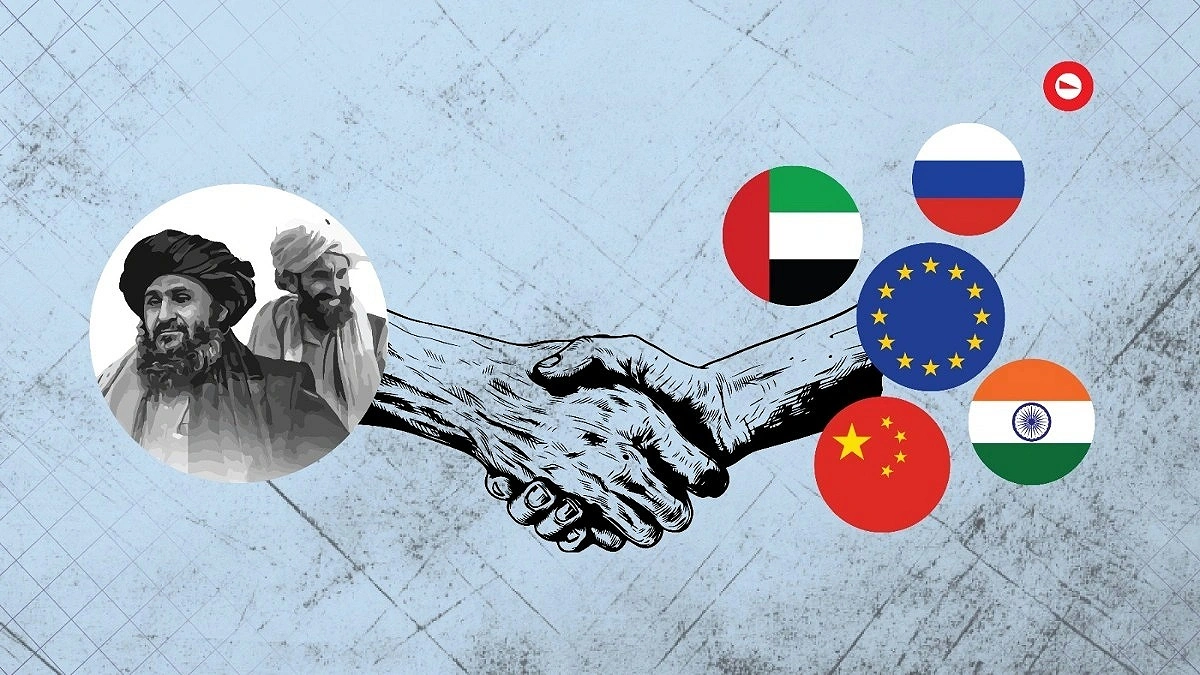
Countries Around the World Are Gradually Expanding Ties With the Taliban . Graphics: Agamir Somoy
When the Taliban seized power in Afghanistan in August 2021, the regime quickly became the focus of international criticism over widespread human rights violations. In response, the United States, European countries, and most of the international community adopted a policy of diplomatic isolation. The expectation was that denying the Taliban international recognition and economic cooperation would pressure them to improve women’s rights, uphold human rights, form an inclusive government, and combat terrorism.
Nearly five years have passed since the Taliban returned to power. The world is now reassessing whether this strategy of isolation has actually worked.
Despite years of international pressure, the Taliban has made little meaningful change to its policies. Nevertheless, countries around the world are gradually increasing engagement with the group. While formal diplomatic recognition remains largely absent, governments are moving toward more practical relations driven by security concerns, migration, trade, and diplomatic realities. According to analysts, international policy is shifting from ‘isolation’ to ‘engagement.’
Has the Isolation Policy Failed?
Following the Taliban’s return to power in 2021, Western governments sought to pressure the regime by withholding diplomatic recognition, freezing Afghanistan’s foreign assets, and restricting economic ties.
However, the Taliban tightened restrictions on women even further. Girls remained barred from secondary and higher education, women were excluded from most workplaces, freedom of expression continued to shrink, and the leadership showed little willingness to establish an inclusive government.
As a result, many countries have concluded that diplomatic isolation alone has failed to change Taliban behavior. Instead, cutting off engagement has also reduced the international community’s influence inside Afghanistan.
Security Has Become the Top Priority
Despite continuing ideological differences, many governments are now adopting a more pragmatic approach driven by security concerns. There are growing fears that ignoring Afghanistan could strengthen ISIS-K, cross-border terrorism, arms and drug trafficking, and transnational militant networks.
For Russia, Afghanistan is closely linked to security in Central Asia. China is primarily concerned with stability in Xinjiang. Pakistan remains worried about attacks by armed groups operating along the border, while Central Asian states are focused on securing their frontiers.
As a result, maintaining direct communication with the Taliban is increasingly viewed not as ideological acceptance but as a security necessity.
Europe Is Also Changing Course
Perhaps the most significant shift is taking place in Europe. After the Taliban returned to power, European countries largely suspended official engagement with Kabul. However, the issue of returning rejected Afghan asylum seekers has since become a major political concern across Europe.
Against this backdrop, the European Union invited a Taliban delegation to Brussels for the first time this month. Officials from 15 EU member states discussed deportation procedures, consular services, and migration management with Taliban representatives.
Nobel Peace Prize laureate Malala Yousafzai strongly criticized the move, arguing that Europe should not legitimize ‘a regime responsible for one of the world’s worst human rights crises.’
The EU, however, insists that the meeting does not constitute political recognition but rather a technical dialogue with Afghanistan’s de facto authorities. Even so, many analysts see the meeting as a significant policy shift, marking the first official Brussels meeting involving the Taliban since 2021.
Meanwhile, millions of Afghans continue to suffer from food shortages, poverty, and inadequate healthcare. The United Nations and international humanitarian organizations require at least minimal coordination with the Taliban administration to deliver food, medicine, and emergency assistance.
For this reason as well, many countries continue limited engagement with the Taliban authorities.
Economic and Geopolitical Considerations
Afghanistan occupies a strategic position connecting Central and South Asia. China is interested in the country’s vast mineral resources and regional connectivity projects. Pakistan and Central Asian countries hope to expand transit trade, while Russia and India see opportunities in energy cooperation, commerce, and regional influence.
The US military withdrawal has also triggered a new phase of geopolitical competition over Afghanistan. Many governments believe that completely disengaging from Kabul could leave them at a strategic disadvantage.
An important concept in international diplomacy is de facto engagement.
Since the Taliban now controls Afghanistan’s administration, borders, airports, customs, police, and government institutions, countries seeking visas, consular services, trade, security cooperation, or humanitarian access must inevitably deal with the authorities in Kabul.
Many governments argue that it is impossible to pursue an effective long-term policy while completely ignoring the administration that exercises actual control over the country.
Signs of a Policy Shift
This evolving approach is already evident in several developments.
The EU’s Brussels meeting is perhaps the clearest example. Although the bloc has not recognized the Taliban, formally inviting its representatives to Brussels would have been almost unimaginable just a few years ago. Practical issues such as migration and deportation have now reshaped Europe’s approach.
Russia went a step further by officially recognizing the Taliban government in 2025. Since then, the two countries have further strengthened their diplomatic relations.
China has accepted the Taliban-appointed ambassador and expanded high-level contacts, investment, and economic cooperation with Kabul, although it has not formally recognized the government.
The United Arab Emirates has also accepted a Taliban-appointed ambassador while increasing cooperation in Afghanistan’s civil aviation and infrastructure sectors.
India effectively closed its embassy after 2021 but later reopened a technical mission in Kabul, resumed humanitarian assistance, and began holding regular meetings with Taliban officials. Although formal recognition remains absent, communication between the two sides has grown considerably.
Formal Recognition Remains a Long Way Off
Despite this trend toward normalization, most countries have yet to officially recognize the Taliban government.
Restrictions on women’s education and employment, allegations of human rights abuses, the absence of an inclusive government, and continuing concerns over terrorism remain major obstacles.
The recent Brussels meeting has also drawn sharp criticism from human rights organizations, which argue that such engagement grants international legitimacy to the Taliban and contradicts Europe’s stated commitment to human rights.
Brussels-based policy analyst Shagofah Ghafoori argues that even without formal recognition, Europe is gradually ‘normalizing’ the Taliban.
According to her, “Normalization does not require signing an agreement. It happens through issuing visas, organizing meetings, and gradually replacing principle-driven policies with practical transactions.”
Five years ago, the international community’s message was clear: “No recognition, no engagement.” Today, that position has evolved into: “No recognition, but necessary engagement.”
In other words, while most countries still refuse to formally recognize the Taliban government, they are increasingly normalizing practical relations in areas such as security, migration, humanitarian assistance, trade, and regional stability. This represents one of the most significant shifts in international policy toward Afghanistan since the Taliban returned to power.
