
AI Cracks 80-Year-Old Math Mystery

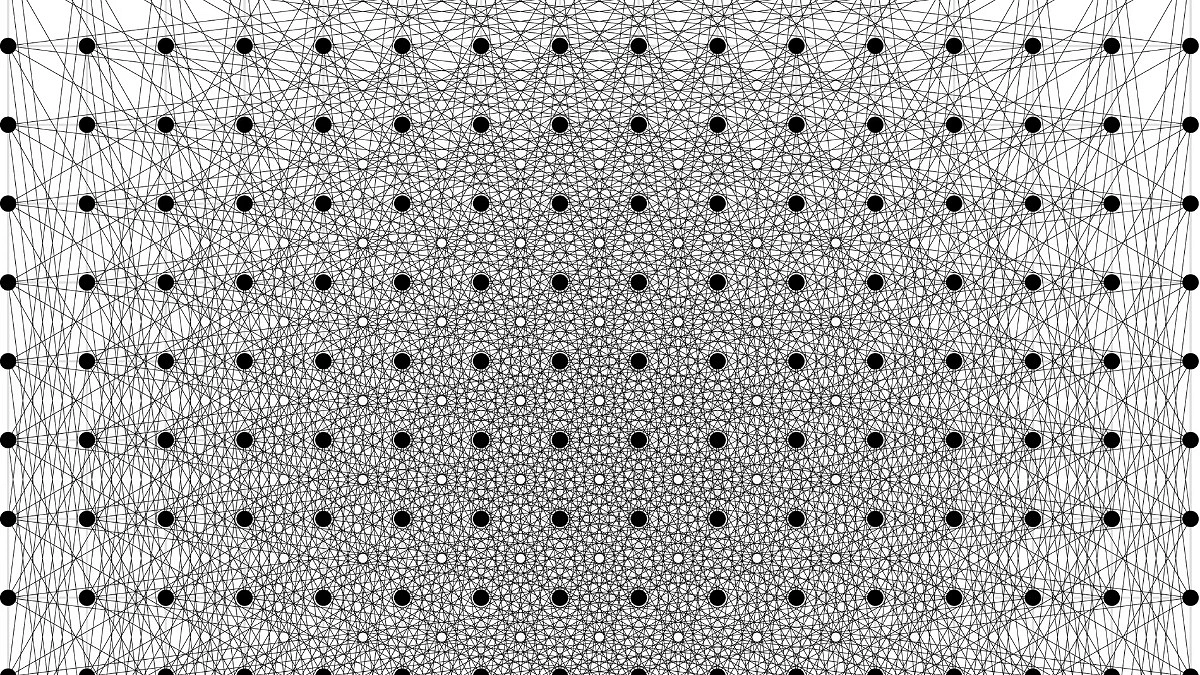
If you take a sheet of paper and add some dots, how many pairs can be the same distance apart? Illustration: OpenAI
OpenAI says one of its artificial intelligence models has solved a mathematical problem that challenged researchers for nearly 80 years, marking what experts describe as a major breakthrough in AI reasoning and scientific discovery.
The problem was first proposed in 1946 by renowned Hungarian mathematician Paul Erdős. It asks a deceptively simple question: if dots are placed on a sheet of paper, how many pairs can be positioned exactly the same distance apart? Erdős believed there was a limit to how efficiently this could be done and proposed a mathematical formula to describe it. For decades, mathematicians largely agreed with his idea, but despite repeated efforts, no one could prove whether he was right or wrong.
That changed when OpenAI's general-purpose reasoning model, developed in the United States, examined the problem and reached a different conclusion. Instead of following the grid-like arrangements favored by generations of mathematicians, the AI discovered a new way of organizing points that produced better results than Erdős had predicted. According to OpenAI, the system generated hundreds of pages of calculations and logical reasoning before arriving at its answer.
The finding has attracted significant attention in the mathematics community. Several independent experts reviewed the AI's work and concluded that it successfully disproved Erdős's long-standing conjecture.
Timothy Gowers, a mathematician at the University of Cambridge, described the achievement as a milestone in AI mathematics. Daniel Litt of the University of Toronto said it was the first AI-generated mathematical result that would likely be considered important even if it had been produced entirely by human researchers.
Experts said the AI's strength was not necessarily superior mathematical knowledge, but its willingness to explore difficult and unconventional paths that human researchers might have abandoned. While many mathematicians spent years trying to prove Erdős correct, the AI pursued alternative possibilities and eventually found a counterexample.
OpenAI said the work was carried out by a general reasoning model rather than a system designed specifically for mathematics. The company believes the achievement demonstrates how advanced AI systems can contribute to scientific research by uncovering ideas that humans may overlook.
The broader problem, however, remains unsolved. Although the AI showed that Erdős's proposed limit was too low, it did not determine the exact answer to the puzzle. Mathematicians will now continue searching for the true limit.
Researchers also emphasized that human expertise remains essential. Independent mathematicians reviewed, verified and refined the AI's findings before presenting them to the wider academic community.
Even so, the result is widely being viewed as a landmark moment. It suggests that artificial intelligence is moving beyond answering questions and generating text, and is beginning to contribute to original scientific and mathematical discoveries.
