

When Organizer is The Guest
Bureaucracy-centric commemorations rise in country

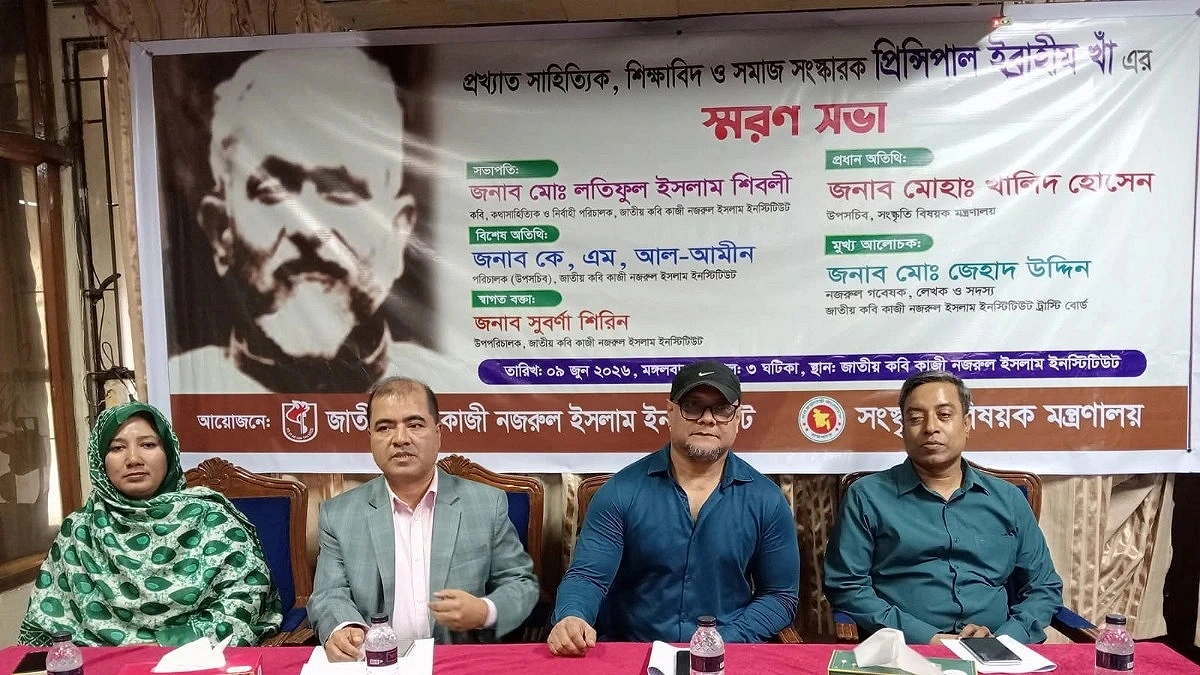
Photo: Agamir Somoy
During the Awami League government's tenure, an official from the Ministry of Culture was speaking at a thematic seminar at Bangla Academy. Researcher and cultural organizer Mofidul Hoque, annoyed by his irrelevant speech, expressed his anger right there on stage. He said, "Experts should be invited as speakers for thematic seminars. Otherwise, there is no point in spending government money on such events."
After the mass uprising of 2024, many assumed the tendency of ministry officials to give speeches at thematic seminars and events would decrease. However, the opposite has happened. Instead, directives have been issued to mandatorily invite ministry officials. At some events, officials of the organizing body themselves are seen in guest chairs. It's as if the organizer is also the guest. Mofidul Hoque describes this as a "regrettable trend."
The National Poet Kazi Nazrul Islam Institute organized an event last Tuesday to commemorate the literary figure and educator Principal Ibrahim Khan. The chief guest at this event was Md. Khalid Hossain, Deputy Secretary of the Ministry of Culture. And, the chair for the special guest was occupied by the institute's own director, K. M. Al-Amin.
The main discussant, Jehad Uddin, is also a member of the institute's trustee board. The welcome speech was given by Deputy Director Subarna Shirin. Executive Director Latiful Islam Shibli presided over the event. Music instructor Chhanda Chakraborty and institute students performed songs. The event was moderated by Assistant Director Md. Fakhrul Alam.
Mosaddiq Habib, grandson of Ibrahim Khan, has alleged that no family members were invited to this commemorative event. He is the son of Ibrahim Khan's daughter, Khaleda Habib. He also serves as the president of the Ibrahim Khan Foundation.
Mosaddiq Habib told Agamir Samay, "No one from our family, as descendants of Ibrahim Khan, received an invitation. My mother was the president of the Ibrahim Khan Foundation; now I hold that position. Usually, when events are held about Ibrahim Khan, the foundation is invited. We were not informed about this event."
When asked about this, K. M. Al-Amin, director of the Nazrul Institute, told Agamir Somoy, "Whether anyone from Ibrahim Khan's family is still alive is not within our knowledge." He did not comment on the fact that he, as the institute's director, was a special guest at the event.
Meanwhile, Mosaddiq Habib said, "My sister, Gultekin Khan, is a known name in literary circles. She was not invited either."
It is not just the Nazrul Institute; for almost every event organized by the 18 departments or agencies under the Ministry of Culture, inviting ministry officials as guests now seems almost mandatory. An official of Shilpakala Academy, speaking on condition of anonymity, said although Shilpakala is an autonomous institution, it is now completely controlled by the ministry. All events are held on the ministry's directives, and ministry officials are made guests on various occasions.
Recently, Shilpakala Academy organized a 10-day event commemorating 44 distinguished individuals. The chief guest at the inauguration was the ministry's secretary, Kaniz Mowla. Additionally, at each day's event, officials of the rank of additional secretary, joint secretary, and deputy secretary from the ministry could be seen as guests.
Researcher Mofidul Haque told Agamir Somoy, "This is a regrettable trend. No one can claim authority in the intellectual world based on their official position. An official may be talented in the intellectual sphere. They also receive due respect. But that should be for their intellectual work. I hope this sensibility will be instilled in our administration."
Last Saturday, Bangla Academy organized a seminar commemorating poet Jibanananda Das, poet Al Mahmud, writer and translator Moniruddin Yusuf, and novelist Rashid Karim. The Secretary of the Ministry of Culture, Kaniz Mowla, gave the chief guest's speech at the inaugural session. Questions have also been raised as to why four thematic seminars were held in a single day. Some believe that seminars are being hurriedly organized to spend budget money before the fiscal year ends, which is having no impact on building an intellectual society.
Minutes from a meeting held at the ministry on November 19 reveal that a list of 382 distinguished individuals was compiled from the ministry's 18 departments or agencies as of September 1, 2025. From these, 182 names were finalized. It was then decided to organize 'Tribute to Luminaries' events for them at various departments or agencies. The meeting decided that ministry officials must be invited to the tribute events for luminaries.
After the BNP government took office, another meeting on May 20 reviewed the selected list for tribute events and the event budget. In that meeting, only one name was changed from the previous list. Decisions were made to give commemorative mementos to family members of the luminaries, organize events at the birthplaces of the luminaries, and arrange events involving school and college students at the district or upazila level.
However, in reality, most of these events are being held in the internal auditoriums of the various departments or agencies under the ministry. Apart from the employees of the relevant department or agency, not many audience members are attending. Even at many events, family members of the luminaries are not being invited.
Regarding the events commemorating distinguished individuals, the ministry's secretary, Kaniz Mowla, was called several times but did not respond. The Minister of Culture, Nitai Roy Chowdhury, also did not answer his phone.
However, in her speech at the inaugural session of the seminar series organized by Bangla Academy last Saturday, the Culture Secretary said, "The Ministry of Cultural Affairs has undertaken a year-long series of programs to commemorate the pioneering luminaries of the country's art, literature, and culture sector. The institutions under the ministry, including Bangla Academy, have started implementing commemoration programs through seminars, discussion events, etc., in the capital and beyond, in areas associated with the memories of these luminaries."

