

Farewell Mustafa Monwar: The Architect of a Generation’s Imagination

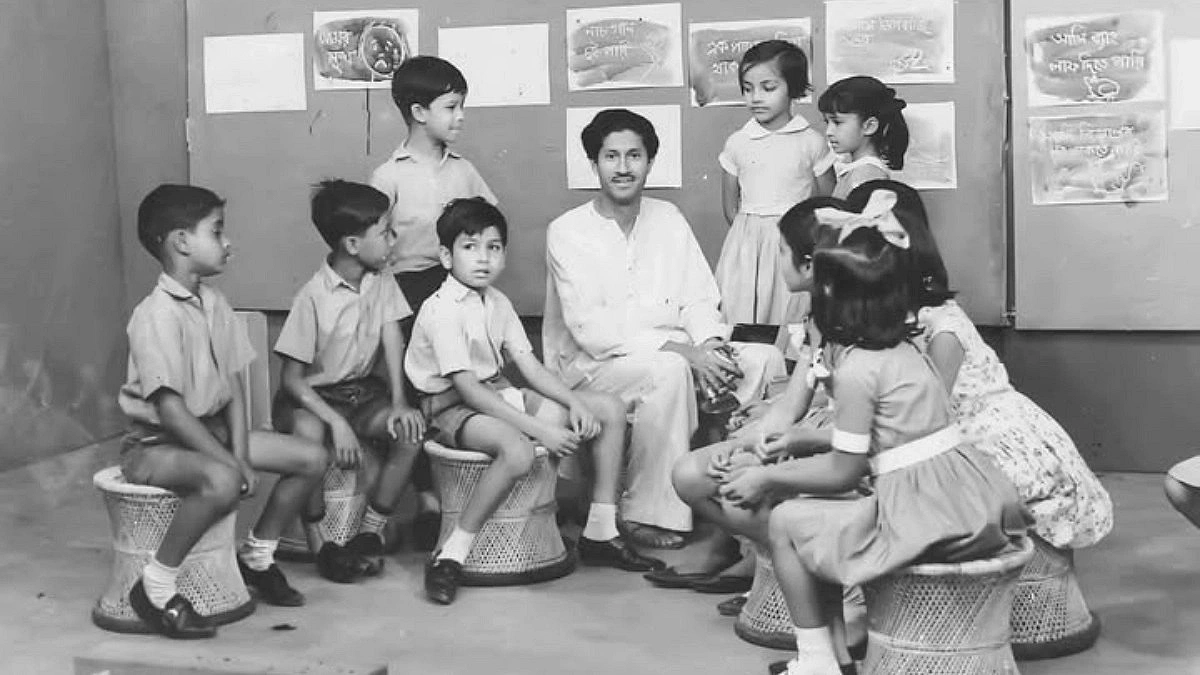
Mustafa Monwar was in a television programme in his younger years
Bangladesh’s cultural history has produced a handful of extraordinary individuals whose identities cannot be confined to a single profession. Mustafa Monwar was one of them. He was a painter, sculptor, teacher, television personality, pioneer of puppetry, cultural organizer, and one of the foremost architects of creative education for children. With his passing, Bangladesh has lost not only a distinguished artist but also a cultural visionary who brought art into the fabric of everyday life. His death was confirmed by several news outlets today.
A familiar image of Mustafa Monwar shows him sitting in a circle with young children. It is more than a classroom scene. It symbolizes his philosophy of education. To him, art was never about memorization; it was a social process built on conversation, imagination, participation, and creativity.
From a Poet’s Son to an Artist
Mustafa Monwar was born on September 1, 1935. His father was the renowned Bengali poet Golam Mostofa. Although he initially studied science, he later enrolled at the Government College of Art & Craft in Kolkata on the advice of Syed Mujtaba Ali. Graduating with first-class first honors, he established himself as a promising artist at a remarkably young age.
His Importance as an Artist
Mustafa Monwar’s artistic language embraced modernism while remaining deeply rooted in Bengal’s folk traditions. He believed that modern art was not about imitating the West but about expressing one’s own culture through a contemporary visual language.
He worked across a wide range of media, including watercolor, oil painting, graphics, and sculpture. Yet perhaps his greatest achievement lay beyond the canvas—bringing art into public life and making it accessible to ordinary people.
Bangladesh’s ‘Puppet Man’
If there is one identity that will forever define him, it is that of the father of puppetry in Bangladesh.
During the Liberation War of 1971, he used puppet theatre in refugee camps in India to raise awareness, inspire children, and spread messages of hope and resistance. After independence, he transformed puppetry from a form of children’s entertainment into a powerful educational medium promoting ethics, health, environmental awareness, and social responsibility.
Saat Bhai Champa
In the history of Bangladesh Television (BTV), Saat Bhai Champa and Moner Kotha were far more than television programs, they became cultural memories for an entire generation.
Countless children who grew up during the 1990s experienced art, storytelling, imagination, and moral education for the first time through these puppet productions. Long before the digital age, Mustafa Monwar understood a simple truth: to educate children, one must first inspire and captivate them.
Mustafa Monwar the Teacher
He taught for many years at the Institute of Fine Arts, but his philosophy of education extended far beyond the classroom.
For him, learning art meant learning how to observe, ask questions, imagine freely, and embrace mistakes without fear.
The well-known photograph of him surrounded by children reflects this philosophy. There is no visible hierarchy between teacher and students—only shared participation in the creative process.
His Contribution as a Cultural Administrator
Mustafa Monwar was not only an artist but also an accomplished cultural administrator. Throughout his career, he served as Director General of Bangladesh Television, Director General of the Bangladesh Shilpakala Academy, Director General of the National Institute of Mass Communication, and Managing Director of the Bangladesh Film Development Corporation, among several other important public institutions.
He played a significant role in modernizing Bangladesh’s cultural institutions and expanding their public reach.
Architect of Children’s Culture
Any history of quality cultural content for children in Bangladesh must place Mustafa Monwar at its center.
He believed that “children are not merely the citizens of the future; they are citizens of the present.”
For that reason, creating art for children was never a secondary concern for him. It was one of the essential foundations of nation-building.
Awards and Recognition
In recognition of his immense contributions, Mustafa Monwar received numerous national and international honors, including: Ekushey Padak (2004), Zainul Abedin Gold Medal, Gold Medal at the All India Fine Arts Competition, Lifetime Achievement Awards , Numerous other national and international distinctions.
What Made Him Unique?
Bangladesh has produced many remarkable painters. Yet Mustafa Monwar stood apart for three important reasons:
1.He took art beyond elite galleries and brought it closer to ordinary people.
2.He recognized children as active cultural citizens deserving meaningful artistic engagement.
3.He successfully united art, education, mass media, and public institutions within a single lifelong mission.
A Personal Reflection
Mustafa Monwar’s legacy lives not only in his paintings but also in the childhood memories of millions of Bangladeshis.
Those who grew up watching BTV’s puppet shows, and those who learned to see art not as something intimidating but as a source of joy and imagination, continue to carry his influence within their cultural consciousness.
Bangladesh has produced many artists. But very few have managed to become, at once, a visionary creator, an inspiring teacher, a cultural organizer, and an architect of children’s imagination.
With Mustafa Monwar’s passing, Bangladesh has lost an extraordinary individual. Yet the cultural language he created, the educational philosophy he championed, and the child-centered artistic tradition he nurtured will continue to shape the country’s cultural landscape for generations to come.
Author: Anthropologist, Teacher, and Researcher.

