Wim Hof speaks: inside the strange, contested science of iceman

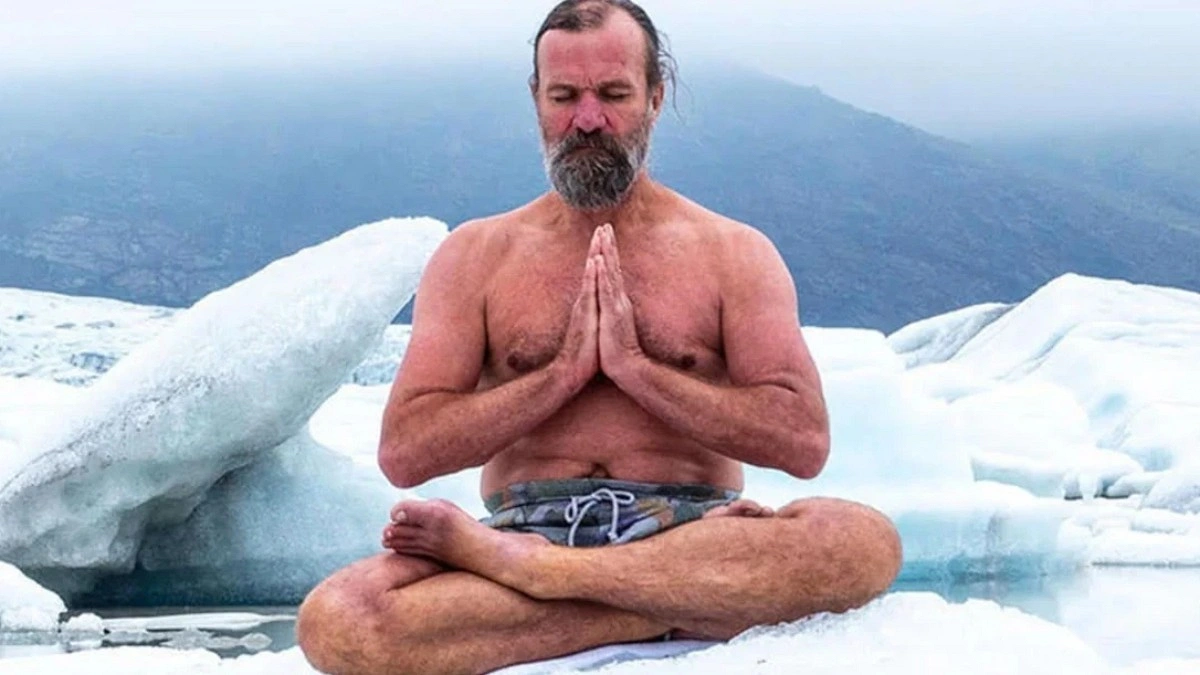
Picture: Wim Hof
On a gray morning on Iceland’s Diamond Beach, a bare chested man in his mid sixties wades into water that would send most people into cardiac shock within minutes. He does not gasp. He does not shiver. He stands among floating chunks of glacier ice, palms pressed together, breathing in slow, deliberate cycles, looking for all the world like a man meditating on a warm veranda rather than one submerged in near freezing seawater.
This is Wim Hof, known to millions simply as The Iceman, and for three decades he has built a global following, a body of peer reviewed research, and no shortage of controversy around a simple claim: that the human body has more control over itself than modern medicine assumes, and that cold, breath, and willpower are the keys to unlocking it.
From Grief to the Ice
Hof was born on April 20, 1959, in Sittard, a small town in the southern Netherlands, one of a set of triplets in a large family. His relationship with cold began early and, by his own account, almost by accident. As a young man he found that plunging into icy water quieted his mind in a way nothing else did.
The turning point came in 1995, when his first wife died by suicide, leaving him to raise their four children alone. Hof has said publicly, many times, that cold exposure and controlled breathing became the tools that helped him process that grief. Whatever the private truth of that period, it was the crucible in which the method later bearing his name took shape.
What followed was a career built on a series of increasingly audacious physical feats. Hof has set numerous Guinness World Records for cold endurance, among them running a barefoot half marathon above the Arctic Circle, climbing partway up Mount Everest wearing nothing but shorts, standing in a container packed with ice cubes for close to two hours, and swimming dozens of meters beneath a frozen lake. He has climbed Kilimanjaro in shorts and completed a full marathon in the Namib Desert without water, a stunt aimed at proving that his method could regulate the body against heat as well as cold.
Three Pillars
Hof insists none of this is a freak talent. He teaches what he calls the Wim Hof Method, built on three interlocking pillars: breathing, cold exposure, and what he simply calls commitment.
The breathing exercise, often practiced lying down, involves thirty to forty deep, rapid breaths followed by a long exhale and a voluntary breath hold at low lung volume. Practitioners describe a tingling, sometimes euphoric sensation partway through the cycle. Physiologically, the technique is a controlled form of hyperventilation, which temporarily shifts the body’s carbon dioxide and pH balance and appears to blunt the inflammatory response, a mechanism researchers have since measured directly.
Cold exposure is the second pillar and the one most associated with Hof’s public image, ranging from a daily cold shower to full immersion in an ice bath. The theory is that repeated, controlled cold stress trains blood vessels to constrict and then dilate more efficiently, activates brown fat tissue that burns energy to generate heat, and gradually desensitizes the nervous system’s panic response to cold shock.
The third pillar, commitment, is the least tangible and the most philosophical. Hof describes it as the discipline of staying present inside discomfort instead of fleeing from it, a mental posture he argues carries over into ordinary daily stress long after a person steps out of the ice bath.
What the Science Actually Shows
For years, Hof’s claims sat comfortably in the territory of wellness folklore, impressive to watch but easy for scientists to wave off. That changed in 2011, when researchers at Radboud University in the Netherlands ran tests on Hof himself and found he could, at will, influence functions of his autonomic nervous system that were long assumed to sit entirely outside conscious control.
A more rigorous follow up came in 2014, when a study published in the Proceedings of the National Academy of Sciences found that a small group trained in the method could voluntarily dampen their own immune response after being injected with a bacterial endotoxin that normally triggers flu like symptoms. Trained participants produced more of the anti inflammatory protein interleukin ten and showed a milder physical reaction than untrained control subjects. It was a finding that, as more than one commentator has noted since, effectively rewrote a working assumption in immunology textbooks.
Brain imaging research has added texture to the picture. A study led by researchers at Wayne State University used functional MRI and PET scans to examine Hof’s brain and body while he was exposed to controlled cold. The results suggested that practice of the method left his skin temperature strikingly stable even as the surrounding temperature dropped, an effect the researchers linked to heightened activity in muscles between his ribs and altered glucose use detected on the scans. Their working theory is that the method may trigger the brain’s own pain relieving chemistry, the release of natural opioids and cannabinoids, producing feelings of calm and reduced anxiety that persist beyond the cold exposure itself.
The pace of research has only accelerated. A January 2026 review in the journal Frontiers in Physiology examined the cardiovascular mechanics at play and found that cold immersion can push plasma noradrenaline levels up by as much as five hundred and thirty percent, a jolt that appears to train the vascular system over repeated exposure while also carrying real risk for people with existing heart conditions.
Then, in March 2026, came the largest and most closely watched trial to date, published in the journal Nature. Researchers followed more than four hundred healthy adults, averaging thirty seven years old, over roughly a month, comparing daily practice of the Wim Hof Method against daily mindfulness meditation. Participants doing the breathing and cold protocol, whether in supervised group settings with ice baths or simply taking cold showers at home, reported greater gains in energy, mental clarity and their ability to handle stress than the meditation group, with the benefits most pronounced immediately after each session. Interestingly, the study found meditation eased stress faster in the short term, while the Hof method’s benefits built more gradually over the full month. Differences in sleep quality and heart health markers between the two groups were smaller and less conclusive.
A separate study now underway at the University of California, San Diego, is using EEG scans to compare brain activity between experienced practitioners and newcomers, with early results suggesting experts show a more organized neural signature tied to how well they sense internal bodily states, and researchers there are also examining whether the breathing technique affects the brain’s waste clearance system.
The Skeptics’ Case
Not everyone is convinced the evidence supports the sweeping claims made in Hof’s marketing and in some corners of the wellness industry that has grown up around him.
Writing for the outlet Science Based Medicine, physician Harriet Hall has argued that while the underlying physiology, that hyperventilation blunts the body’s inflammatory response, is real and measurable, Hof’s broader promises about curing disease and unlocking untapped human potential outrun what the data actually demonstrate. A 2024 systematic review published in PLOS ONE, which pooled the available clinical research on the method, reached a more measured conclusion still: some studies point to modest benefits for markers like inflammation and mood, but the body of evidence remains too small, too inconsistent in design and too reliant on short term outcomes to support strong claims of therapeutic benefit for serious illness.
An earlier open label trial testing the method on patients with a form of inflammatory arthritis found a significant drop in one blood marker of inflammation but no meaningful change in several others, leading its authors to describe the approach as safe to try alongside conventional treatment rather than any kind of replacement for it.
That distinction, between a genuine physiological effect and a cure, is where most serious researchers now plant their flag. The consensus emerging from more than a decade of study is neither the miracle marketed by parts of the wellness industry nor the dismissal offered by early critics, but something in between: a set of breathing and cold exposure techniques with real, reproducible effects on stress, mood and inflammatory markers, bounded by real risks and real limits.
The Risks Behind the Records
Those risks are not theoretical. Combining the breathing technique with water is where most documented injuries and deaths connected to the method have occurred, since the hyperventilation and breath hold can trigger a blackout, and a blackout underwater or even in a bathtub can be fatal. Wim Hof Method instructors and the official training materials are explicit that the breathing exercises should never be practiced while swimming or submerged, and that cold immersion should be approached gradually rather than as a first attempt at an ice bath. People with uncontrolled high blood pressure, heart arrhythmias or other cardiovascular conditions are generally advised to consult a doctor before attempting either the breathing protocol or cold immersion, given the sharp spike in stress hormones and blood pressure that cold shock can produce.
The Man Behind the Records
Hof, now in his mid sixties, remains an unusually visible presence for a figure whose core message is essentially about slowing down and paying attention to the body. He has built an international training organization, certifying instructors around the world, and continues to appear at cold water events from Poland to Iceland, often surrounded by cameras and by newcomers shaking their way through their first ice bath.
Friends and former training partners describe him as evangelical rather than commercial in temperament, a man who talks about the ice the way some people talk about faith. Critics counter that evangelism and enterprise are not mutually exclusive, and that the line between teaching a breathing technique and selling a lifestyle brand has, in Hof’s case, grown increasingly blurred.
What is harder to dispute is the shift in how seriously the scientific establishment now treats questions that would have been laughed out of a physiology department twenty years ago. Whether or not the method someday supports treatment for chronic disease, as Hof insists it eventually will, it has already forced researchers to take a second look at how much of the body’s supposedly involuntary machinery might, with enough training, bend to conscious will.
For now, the picture that emerges from the last decade of research is neither miracle nor myth. It is a method with a measurable effect on stress hormones, inflammation and mood, a real signature in the brain, and real risks for those who approach it carelessly. Somewhere between the ice cold water and the peer reviewed journal, Wim Hof has managed something few wellness figures ever do: he got the scientists to follow him into the cold.
A Movement, Not Just a Man
What began as one man’s private ritual for managing grief has since grown into something closer to a movement. Training centers now operate across Europe and North America, certified instructors run weekend workshops in city parks and rented gyms, and outdoor cold water swimming groups, some explicitly inspired by Hof and many simply riding the same cultural wave, have sprung up along coastlines and lakesides far from his native Netherlands.
Part of the appeal is accessibility. Unlike many wellness regimens that require special equipment, expensive supplements or membership fees, the core of the method costs nothing more than a willingness to turn the shower handle to cold for the last thirty seconds of a morning routine. That simplicity, researchers involved in the 2026 Nature trial noted, may explain why at home practitioners taking nothing more than cold showers reported benefits roughly comparable to those training in supervised groups with full ice baths, a finding with obvious appeal for anyone hoping to try the method without booking a session or investing in a tub full of ice.
Whether that accessibility survives the method’s growing commercialization is an open question, one that will likely follow Wim Hof for as long as he keeps stepping into the water. For millions of ordinary people who have never run a marathon or scaled a glacier, though, the appeal was never about matching the Iceman’s records. It is about borrowing, in small daily doses, whatever it is that lets a sixty something man stand calmly among floating ice with his hands pressed together, breathing slowly, entirely at peace.